‘Every Brilliant Thing’ at Apollinaire Theatre Co. Delivers On Its Promise

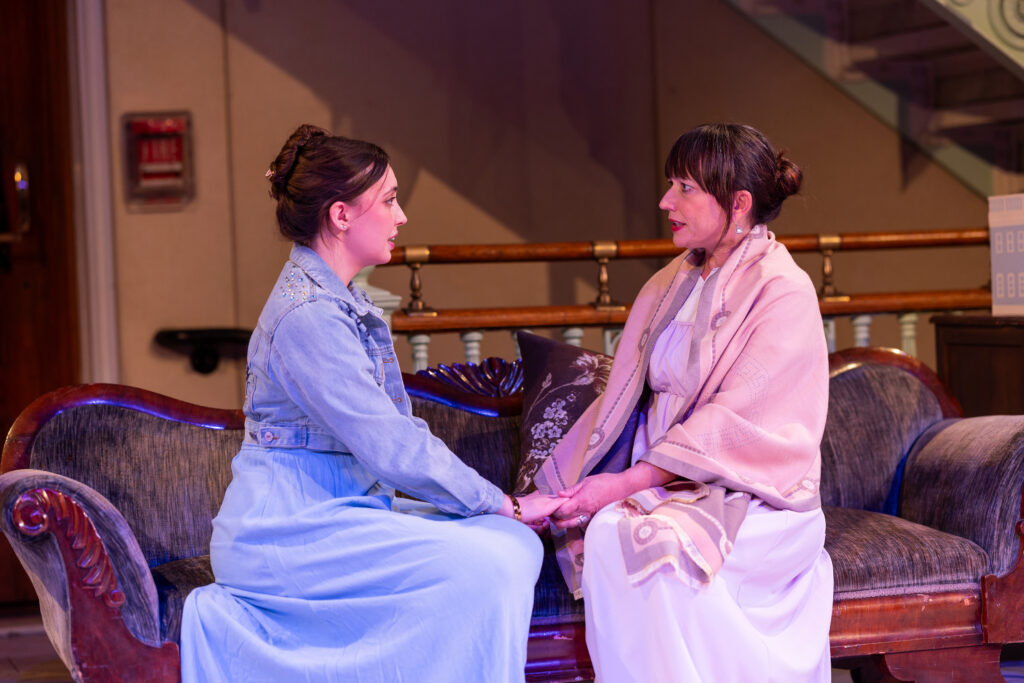
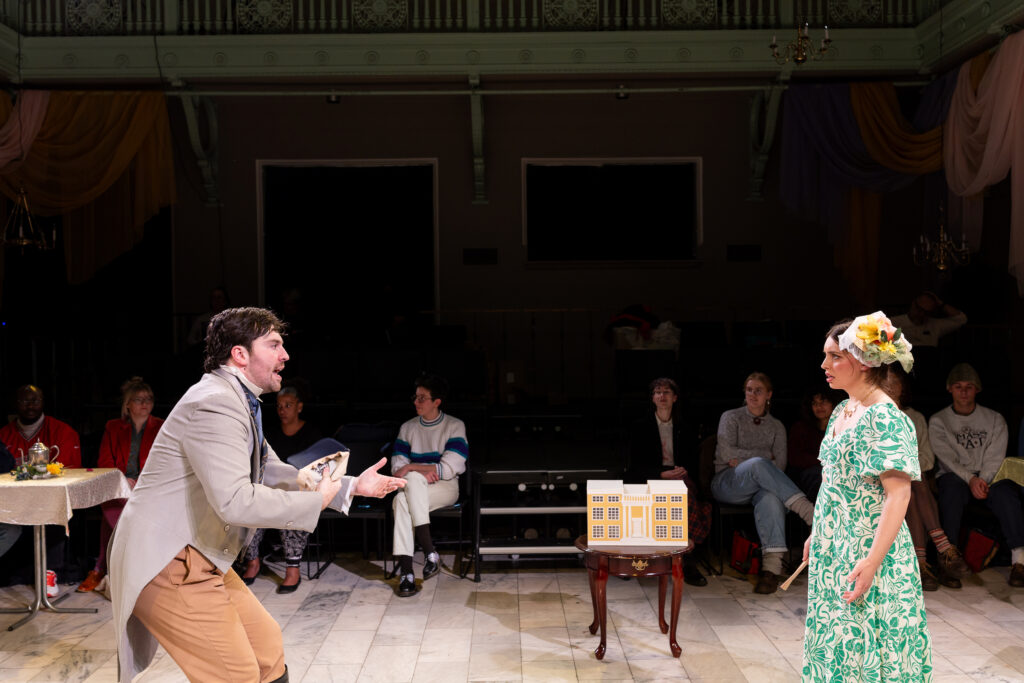
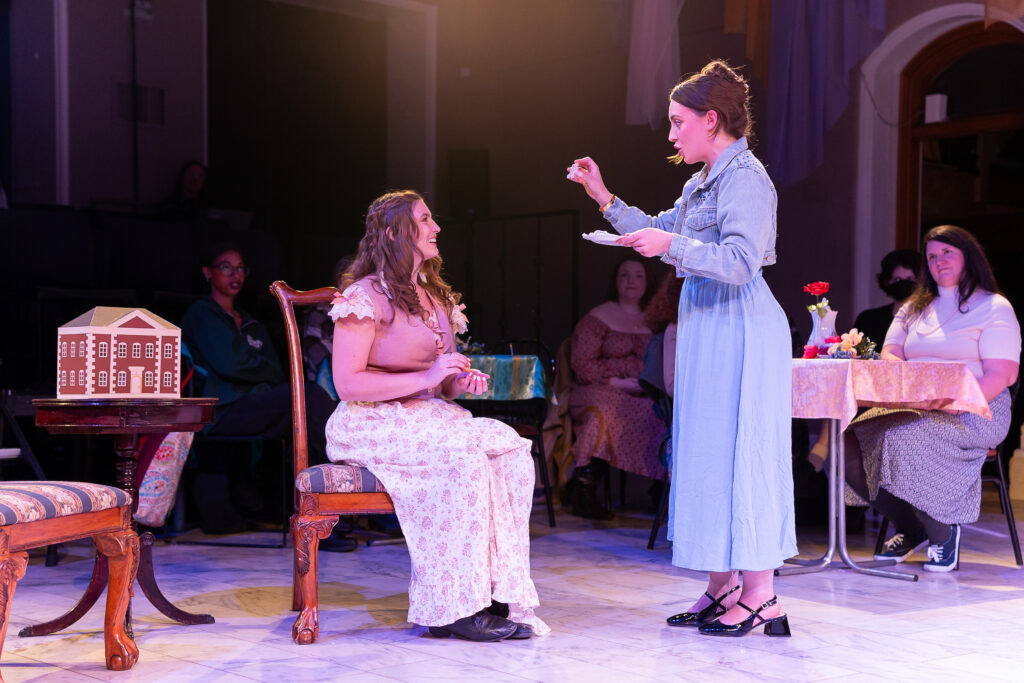
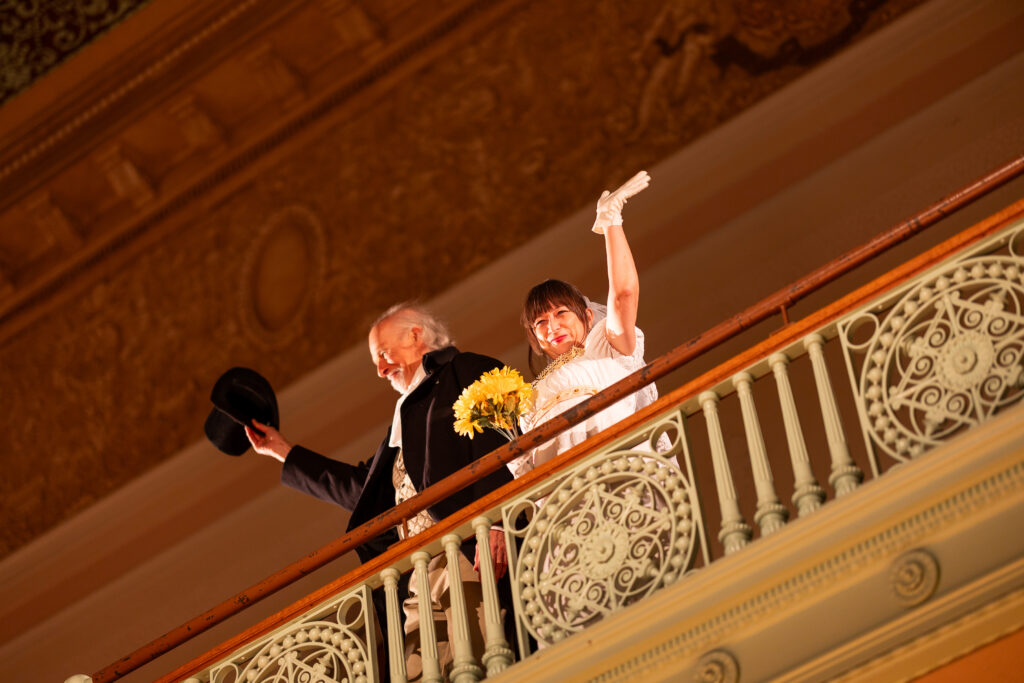
Cristhian Mancinas-Garcia and Parker Jennings in ‘Every Brilliant Thing’ at Apollinaire. Photos by Danielle Fauteux Jacques

By Shelley A. Sackett

A one-person show about suicide and depression that threatens random audience participation, runs for approximately 75 intermission-less minutes, and pledges to be funny and uplifting has a pretty high bar to clear. Yet, Apollinaire Theatre Company does just that with room to spare in its brilliant production of Every Brilliant Thing.

The play’s narrator, the irrepressible Parker Jennings (alternating the role with Cristhian Mancinas-Garcia, who also performs it in Spanish), is already standing in the middle of the stage when even the earliest audience member arrives. As if welcoming them into her own living room, she greets them warmly with an unaffected smile and a blue basket full of cards.

“I have a job for you all this evening,” she exclaims as she hands out the numbered cards with instructions to shout out what is written whenever she says that number.

Set in the round in an intimate black-box space that is furnished with comfortable salon-like seating, Jennings’ rapport with the audience is immediate and palpable. Upbeat jazz and full house lights heighten the sense of communal conversation. Before she has uttered her first line, she has us in the palm of her hand, making us feel like we’re here by design rather than happenstance.

“The list began after her first attempt,” she begins. “A list of everything brilliant about the world. Everything worth living for.”

The first call and response quickly follows. “Number One,” she says, and the person holding that card shouts out, “Ice cream.” Number two is water fights. Three is staying up past your bedtime and being allowed to watch TV. Any flicker of stage fright or self-consciousness has completely evaporated. We are in this together.

In an instant, Jennings the Narrator has morphed into the seven-year-old girl who, after learning that her mother attempted suicide, vows to make her mother feel better by making a list of everything that makes life worth living and sharing it with her. This coping exercise will see her through the next several decades and, by the end of the play, will number one million.

Her first encounter with death (“a loved one becoming an object”) and the first audience-supporting role (as the vet) occurs when she has to put down her beloved dog. Jennings’ improvisational chops and talent for putting the audience at ease are on full display. Other interactive roles will include her father, teacher, school counselor, and first love/wife.

Her second encounter with the idea of death occurs when her father picks her up from school after her mother’s first suicide attempt. He explains to the little girl that her mother is in the hospital because she is sad, because she couldn’t think of anything worth living for.

The precocious child intuits the concept of glimmers, the opposites of triggers. These are small experiences of pleasure that happen during simple, everyday activities. Noticing and appreciating them can cue your nervous system that you’re safe and can relax.

She devotes her life to crafting a list of every brilliant thing she can think of, first in an attempt to save her mother and later for herself, as she navigates her own journey of hills and valleys and, poignantly, fear that her mother’s mental illness tributary runs through her veins as well. As time moves on, the list becomes a sort of diary that reflects the texture of her everyday experiences.

“Things may not always get brilliant, but they get better,” she says. “We need to imagine a future better than the past because that’s what hope is and without hope, life isn’t worth living.”

Thanks to Joseph Lark-Riley’s carefully curated sound design, the significance of blues and jazz also runs deeply. These songs and artists link the Narrator to her vinyl-loving dad and tether her. Lyrics from “Drown In My Own Tears,” “I Love You Just the Way You Are” and “At Last” are more than toe-tapping background; they are placeholders and place setters that connect us to our narrator and her story. It’s no surprise that one of the items on her list is: “A song transporting you back to a moment in time.”

The tone and substance of Duncan Macmillan’s script (written with Johnny Donahoe, a British stand-up comedian who first played the role at the Ludlow Fringe Festival in 2013) covers a lot of ground. The Narrator’s ability to confront issues as heartwrenching as the guilt felt by children of suicides, social contagions, and the virulence of hard-wired, chronic depression with playfulness, insight, and unflinching honesty prevents the play from becoming mawkish, which easily could have happened if penned by a less skillful and empathetic playwright.

Danielle Fauteux Jacques wisely directs with a light touch, and Jennings shoulders the production with chipper verve and a storyteller’s charm. Yet, she also brings an emotional intelligence to her performance, the shadow of a veil that, when lifted, reveals the scars of underlying trauma. Most recently seen as Sarah in Apollinaire’s equally extraordinary “Touching the Void” last May, Jennings is an actress I would (and did) go out of my way to catch in any role she should take on. Her energy, authenticity and confidence are matched only by her raw talent.

As the play winds down, the Narrator’s list takes on a life of its own as an ersatz crowdsourced lifeline, publicly shared and collaboratively complied. Although the list couldn’t save her mother, it may just have prevented her from following in her footsteps. She leaves us collectively more open-hearted and open-minded with the balm of these parting words of benediction: “If you live a long life and get to the end of it without ever once having felt crushingly depressed, then you probably haven’t been paying attention.”

‘Every Brilliant Thing’. Written by Duncan Macmillan with Johnny Donahoe. Directed by Danielle Fauteux Jacques. Scenic and Sound Design by Joseph Lark-Riley. Lighting Design by Danielle Fauteux Jacques. Produced by Apollinaire Theatre Company at Chelsea Theatre Works, 189 Winnisimmet St, Chelsea, MA through January 19th.

For more information and to buy tickets, visit apollinairetheatre.com

Peabody Essex Museum showcases centuries-old Flemish art and artifacts

Michaelina Wautier, “Everyone to His Taste,” circa 1650. Oil on canvas. © The Phoebus Foundation, Antwerp.

By Shelley A. Sackett

SALEM – Between the early 1400s and late 1600s, the area in Northern Belgium now known as Flanders was embroiled in war, plagues, and religious upheaval. Ruled by Spain, borders shifted regularly and the reigning Catholic archdukes tried to stem Protestant encroachment. Most Flemish art served religious or political purposes, created for royalty and clergy to hang in palaces and churches.

The Peabody Essex Museum in Salem is showcasing the artistic renaissance of the period in “Saints, Sinners, Lovers and Fools: 300 Years of Flemish Masterworks,” a major exhibition of paintings, sculpture, and decorative arts on view through May 4.

Jewish life during this time was marked by its own history of persecution, expulsion, and ultimately, a muted religious freedom. Jews who had refused conversion to Christianity in Spain were expelled or killed by the Catholic monarchs during the Inquisition of 1492. Some fled to Portugal, where they were able to live as Marranos (also known as crypto-Jews, or Jews who converted to Christianity but secretly practiced Judaism). Many became merchants, trading in Iberian commodities.

Jews were drawn to the port city of Antwerp – then part of Portugal – a hub of international commerce. There, they played a key role in the city’s economy as non-citizens who could practice their trade, if not their religion.


By the 1600s, Flanders was flourishing, awash in the unprecedented wealth that global trade brought through ports such as Antwerp. Other major cosmopolitan cities, including Ghent and Bruges, became influential centers for a new bracket of business and intellectual elites. A modern civil society emerged, where a free market allowed all entrepreneurs to elevate themselves above their station and control their own fate.


Life was good for this rising middle class, and for the first time, Flemish artists and craftsmen had a new market for their works, one fueled by the tastes and appetites of these nouveau consumers rather than by the political needs of reigning royal and religious power.

These Flemish Renaissance painters radically changed European art and generated a booming commercial market, the first in European history. It is in homage to these artists that Peabody Essex Museum hosts this exhibition. Co-organized by the Denver Art Museum and the Phoebus Foundation in Antwerp – now in Belgium – it features rarely exhibited masterpieces by Peter Paul Rubens, Anthony van Dyck, Hans Memling, Jan Gossaert, Jan Brueghel, Clara Peeters, Jacob Jordaens, Frans Francken, and Michaelina Wautier, among many others.

The extensive exhibit is carved into seven sections that break 300 years of tumultuous Flemish tumultuous history into discrete areas of intense focus. Wisely, the exhibit starts with “This Is Flanders,” geographically grounding the viewer. Maps and an introductory video are both helpful.

“God Is in the Details,” the largest section, displays devotional art earmarked for both private and public prayerful use. The Catholic Church was the biggest commissioner – and displayer – of these religious paintings. Pensive religious hymns echo through the gallery, complementing the display.

With “New Perspectives,” the subject matter and style shifts from the rigidly iconic and religious to richer, freer artistic compositions of landscapes, still lifes, and portraits that capture the personality of both subject and artist.

“Everyone to His Taste,” by Michaelina Wautier (circa 1650), is a luminescent painting of a boy trying to take an egg from another. It illustrates the proverb, “To each his fancy, but sharing is best.” Wautier is one of four female artists represented in the exhibit.

Innovations of all sorts are highlighted and heralded. Artistic and scientific inventions, such as oil painting and bird dissection, were invented in Flanders and influenced how artists depicted the body. As new genres emerged in the 1600s, Flanders became a center for experimentation by curious scientists, engineers, physicians, botanists, cartographers, and humanists.

“Fool in the Mirror” is a section full of whimsical, clever scenes that, while humorous and irreverent, caution Flanders’ wealthy citizens that although living a Dionysian life of excess may feel good, they should beware of crossing the ever-present line that would prevent them from getting into heaven. These cautionary messages hint at the importance – and challenge – of maintaining pious and humble lives in the face of such sudden immense wealth.

Jan Massijs, Rebus: The World Feeds Many Fools, about 1530. Oil on panel. © The Phoebus Foundation, Antwerp

“Rebus: The World Feeds Many Fools” by Jan Massijs (circa 1530) is a showstopper in this section. It is also a rebus word puzzle the artist has challenged the viewer to solve. All the rage in the 1500s, a rebus is a device that combines the use of illustrated pictures with individual letters to depict words or phrases. Massijs’s rebus has hints and even the answer displayed beside it.

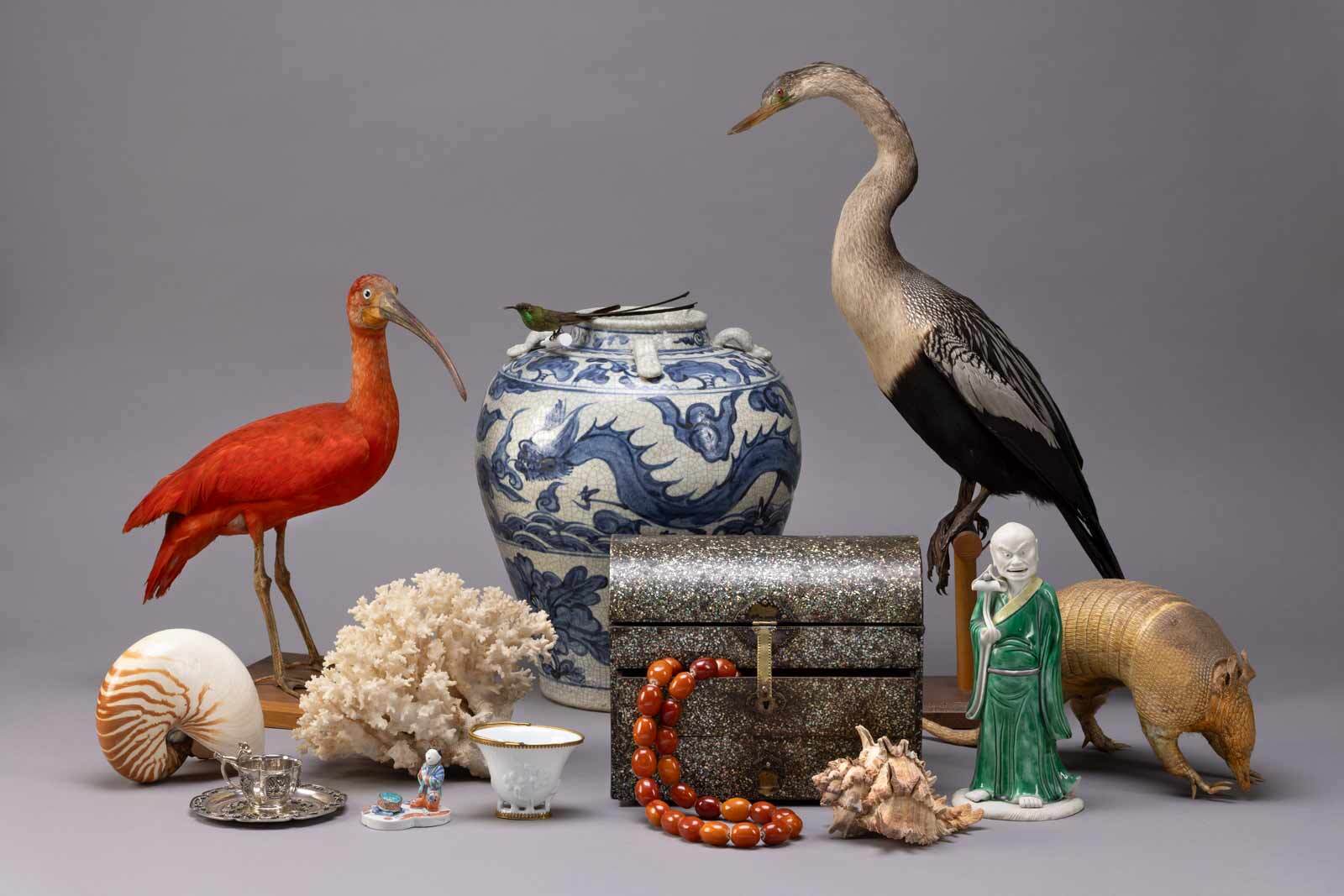
The last section, “Cabinets of Wonder,” pays tribute to the collections of “curiosities” Flanders’s individuals amassed to both reflect their wealth and connections and also possess a microcosm of the world in miniature. PEM’s “Wünderkammer Gallery” evokes these 17th century cabinets, which are full of such seemingly random items as cauliflower coral, a skull-shaped pendant, and a stuffed ostrich. More than 100 objects hail from Africa, Australia, Brazil, China, Indonesia, and Japan.

A selection of natural and man-made wonders in the Saints, Sinners, Lovers, Fools cabinet of wonders at PEM

There are two omissions from the exhibit. One is deliberate and due in part to lack of space. Although Brussels was the principal center for tapestry weaving at the turn of the 15th and 16th centuries, a bias toward painting existed both then and in the collection on display at PEM.

The other omission is any mention of the crypto-Jews who fled the persecutions and expulsions in the Iberian Peninsula and the key roles they played in cultivating Antwerp’s economic preeminence by helping develop the important diamond, pearl, and commodities industries.

A Theatrical Alchemy, A.R.T.’s ‘Diary of a Tap Dancer’ Is More Than the Sum of Its Parts

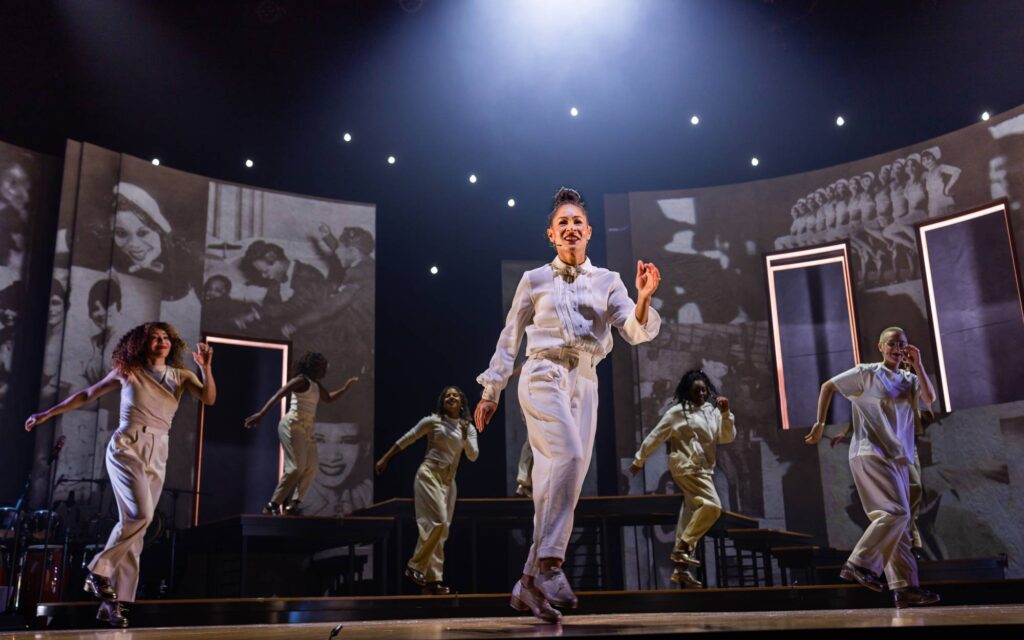
Ayodele Casel (center) and the cast of A.R.T.s ‘Diary of a Tap Dancer.’
Photos: Nile Scott Studios and Maggie Hall
 

By Shelley A. Sackett

Ayodele Casel’s ‘Diary of a Tap Dancer’ defies pigeonholing. First, it is a crackerjack tap dance concert, choreographed and performed by a jubilant devotée of the genre whose sensitivity to its rhythmic musicality keeps the action moving and the audience’s toes tapping along.

Second, it is a narrative documentary that “shines a light on women hoofers,” especially the unknown and forgotten black tap dancers of the 1920s through the ‘50s who blazed a trail for others, like Casel, to follow. Projection Designer Katherine Freer has curated a six-screen still and moving visual accompaniment that introduces us to all the dancers who might have been written out of history — women like Juanita Pitts, Jeni Le Gon, Cora LaRedd, Louise Madison and Marion Coles —  but for her efforts to draw attention to them.

“I have an intense need, desire and responsibility to speak their names,” Casel, the self-proclaimed sepia Cinderella of tap, shares. “They were entrepreneurs, choreographers and dancers. Our time on earth matters. Don’t wait for an invitation to tell your story.”

Additionally, Casel’s ‘Diary of a Tap Dancer’ is just that- an oral diary that tells, in upbeat, humorous and, at times, painfully repetitive detail, the story of her life.

Born in the Bronx to a Puerto Rican mother and African American father (whom she didn’t meet until she was 17 years old), she was sent as a child to live with her Puerto Rican grandparents, where she honed her scrappy spirit by getting into fist fights with boys. When she returned to the Bronx, she and her mother watched old movies and read movie magazines, falling for the glamor and magic of Ginger Rogers and Fred Astaire. She discovered the world of tap during a high school class in movie history. Later, as an NYU theater major, she took her first tap class, showing up with shoes from “Payless” that were as close to Rogers’ as she could find.

“Tap is magic,” Casel says. “It changed my life.”

Her single-minded persistence landed her a spot as the first woman in Savion Glover’s (of mid-90s off-Broadway hit, “Bring in ‘da Noise, Bring in ‘da Funk,” fame) dance company, a real turning point in her career. Tap legend Gregory Hines has referred to her as “one of the top young tap dancers in the world.”

When it comes to paving the way for other marginalized dancers, Casel doesn’t just talk the talk; she also walks the walk (taps the tap?) by sharing the stage and spotlight with seven female and nonbinary young dancers who both complement each other as an ensemble and shine as soloists. But the spritely, charismatic, and extraordinarily talented Casel can’t help but steal every scene with the simplest flap-ball-change. Who knew tap could be so orchestral and communicative?

Under Torya Beard’s (Casel’s longtime collaborator and wife) direction, the atmosphere is set even before the show starts with an almost holy ambient organ major harmonic dyad punctuated by muted city traffic, sirens, and birds. A simple blue set sports what looks like graffiti but is actually a photograph of 18th-century legislation forbidding slaves from owning drums.

A slow spotlight reveals white-clad dancers using every inch of Tatiana Kahvegian’s sparse but effective stage. Dancers are scattered in little solo spaces reminiscent of the staging of “The Lion King.” When the soundtrack kicks in and they all start tapping, it’s like a magical sound bath of rhythm and movement.

Backed by a terrific trio of on-stage musicians (Carlos Cippelletti on piano, Raul Reyes Bueno on bass and Keisel Jiménez Leyva on drums), the musical dance numbers are a pure delight. Casel tells her intimate and powerful story through straight narration, rap, beat and counter-beat. Her acting chops show in the comfort with which she addresses the audience. It’s no surprise to learn that “Ayodele” is Yoruban for “joy.” Casel is not just a top-notch dancer and choreographer; she is genuinely warm, funny, smart, guileless, and humble. She is also an articulate, eloquent, and bold guide who unlocks the enchantment and triumph of the human spirit that is the essence of tap.

The problem (at least at last Sunday’s world premiere production, which ran 30 minutes beyond the show’s already overly generous 2 hours with one intermission) is that Casel has a lot to say about a lot of topics about which she is understandably passionate. “This show is narrative justice,” she explains.

But by trying to tackle such big-ticket items as racism, sexism, African American history, misogyny, and historical exclusion, instead of leaving her audience feeling enlightened and informed, she leaves them wishing for more dance and less talk. A LOT less talk.

While Casel is an excellent and engaging narrator, it is the magic language of her syncopated footwork and vocal scat work that offer a more compelling and emotionally accessible (and less preachy) tribute to the art form of tap and the black foremothers she seeks to honor. A little editing could go a long way.

‘Diary of a Tap Dancer’ – Written and Choreographed by Ayodele Casel. Directed by Torya Beard. Musical Direction by Nick Wilders; Scenic Design by Tatiana Kahvegian; Costume Design by Camilla Dely; Lighting Design by Brandon Stirling Baker; Sound Design by Sharath Patel; Projection Design by Katherine Freer; Compositions, Orchestrations, and Arrangements by Carlos Cippelletti, Ethan D. Packchar. Presented by American Repertory Theater at the Loeb Drama Center, 64 Brattle St., Cambridge, through January 4, 2025.

For tickets and information, go to: https://americanrepertorytheater.org/shows-events/diary-of-a-tap-dancer/

100 Years Later, Martha Graham Remains the Gold Standard of Contemporary Dance

Cast of Martha Graham Dance Company

Martha Graham Dance Company’ — Presented by Celebrity Series of Boston at Emerson Cutler Majestic. Run has ended.

By Shelley A. Sackett

The last time I saw a Martha Graham piece performed was at the Metropolitan Museum of Art in October 2023, when I had the random good fortune to attend its exhibition, Art for the Millions: American Culture and Politics in the 1930s. As part of that exhibit, dancers from the Martha Graham Dance Company staged some of Graham’s most powerful ’30s solos in galleries throughout the museum.

I was lucky enough to catch “Lamentations” in the New Greek and Roman Galleries, the spectacular “museum-within-the-museum” built to display the Met’s extraordinary collection of Hellenistic, Etruscan, South Italian, and Roman sculpture.

Graham’s 1930 work, set to Hungarian Zoltàn Kodàly’s plaintive music, features a single dancer whose angular moves inside a stretchy fabric cocoon have long marked Graham’s trailblazing style. Over a mere four minutes, the dancer fights what feels like an eternal battle to get out of her encasement. Only her face, hands and feet are visible, yet the geometric shapes she creates epitomize her fruitless struggle. She pleads and prays, but there is no escape. Graham called the piece “the personification of grief.”

Seeing the timeless, sculptural piece in a sun-filled atrium with an audience of ancient statues was nothing short of sublime.

Its recent performance at the 1,200-seat beaux-art Emerson Cutler Majestic, though a less intimate setting, was no less astonishing.

Few dance companies have transfigured the art of contemporary dance quite like Martha Graham’s. Since the company’s founding in 1926, Graham’s signature style has remained a bedrock of American modern dance and continues to be taught worldwide.

In anticipation of the company’s 100th birthday celebration in 2026 (GRAHAM100), the Boston Celebrity Series brought the legendary troupe to Boston for three special appearances to kick off its own 2024/2025 Season Dance Series.

The Friday night capacity show illustrated why Graham remains the gold standard of contemporary dance choreography.

The program opened with “Dark Meadow Suite (1946), highlights from her longer “Dark Meadow.” The full ensemble (featuring Lloyd Knight and Anne Souder) performs an ancient mating ritual as part of Graham’s American homage to a mythological rite of spring.

The piece opens with a Greek chorus of five women who circle trancelike, stamping a primordial rhythm with their bare feet. Thick, rich music by Carlos Chávez sets the auditory stage for stunning, sensual, animal-like movements as dancers join, separate, and pulsate in perfect synchronicity. Playful lighting (Nick Hung) adds color and texture and black and orange flowing costumes (Martha Graham) are equal parts elegance and flirty frolic. Knight and Souder are the embodiment of grace as they perform their coupling ceremony, which Graham described as “a re-enactment of the mysteries which attend the eternal adventure of seeking.”

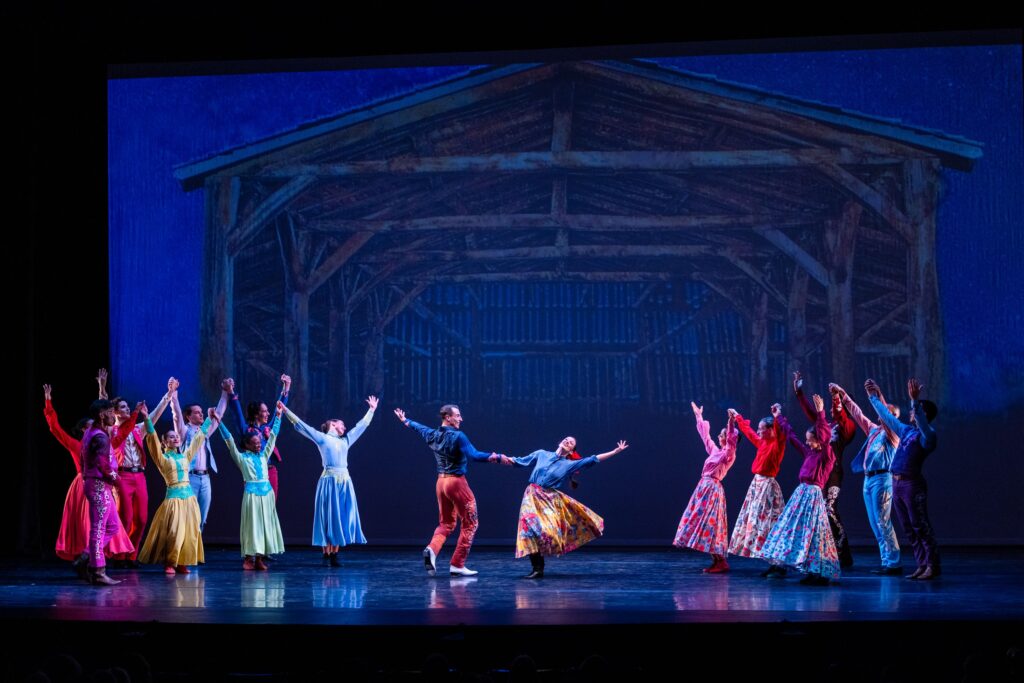
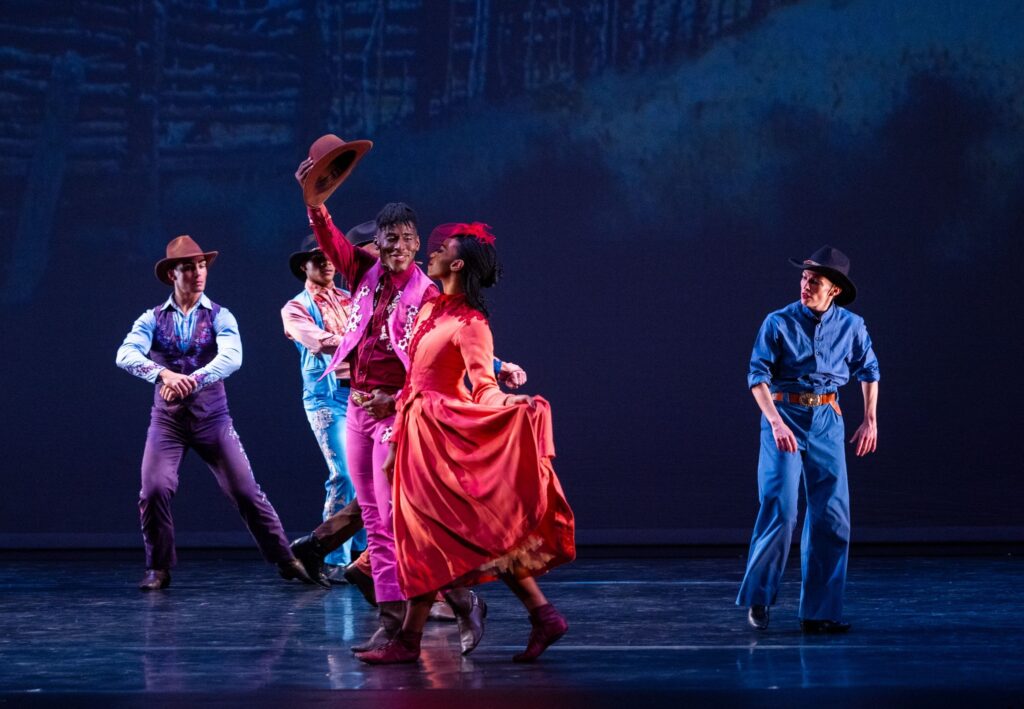
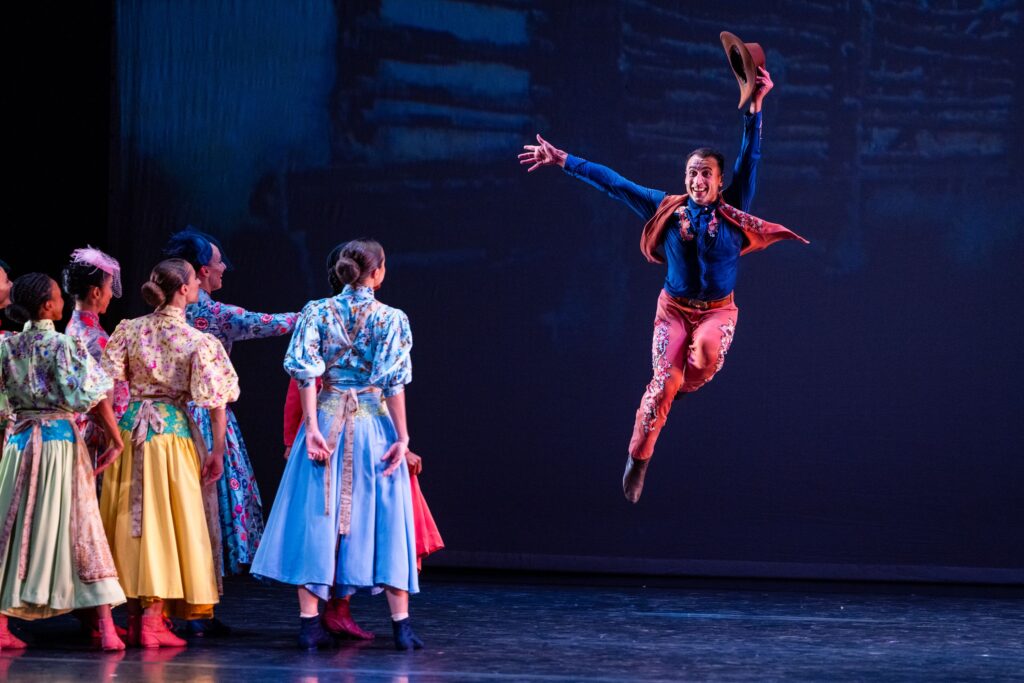
Close Graham friend and collaborator Agnes de Mille, the storyteller niece of filmmaker Cecil B. DeMille, choreographed the iconic “Rodeo or The Courting at Burnt Ranch.” For its GRAHAM100 3-year celebration, Gabriel Witcher rearranged Aaron Copeland’s trademark music for a six-piece bluegrass ensemble. Celebrating the diverse genesis of America, the piece is a series of humorous vignettes featuring dancers clad in full-blown cowpoke, cowgirl, and genteel pioneer women’s regalia.

Like a silent movie, the action takes place on a Saturday afternoon and evening on a ranch in the southwest. DeMille referred to her work as “a pastorale, a lyric joke,” and as The Cowgirl, Laurel Dalley Smith manages to be sassy and funny while displaying serious dancing talent. The piece flits from a Wyatt Earp TV set to a mariachi band to a barn dance, loving spoofs that straddle Broadway blockbuster musicals, classical ballet, and cowboy rodeo activities. In between are tastes of square dances, polkas, and couples pairing and unpairing. Screen projections that change from ranch to sunset to starry night to barn dance are effective without being hokey.

Post intermission, the afore-described “Lamentations” is even more stunning on the heels of the slapstick-like “Rodeo.” So Young An, the recipient of the International Arts Award and the Grand Prize at the Korea National Ballet Grand Prix, is a talent to be reckoned with.

The evening ends with the 2024 piece, “The People.” Choreographed by Jamar Roberts, who describes his work as “part protest, part lament,” the piece resonates with references to American history. Dancers are both uplifting paeans to the hope and promise of American folk music and downtrodden, burdened examples of what can happen when America doesn’t live up to its promises. A new score by Pulitzer Prize-winning composer and American roots musician Rhiannon Giddens (arranged by Witcher) spotlights rich, throaty harmonies peppered with pockets of poignant silence.

The last time the Martha Graham Dance Company adorned Boston’s stage was in 2005. Judging from the exuberant standing ovation its 2024 audience bestowed last Friday evening, one can only hope they got the message that they have been away far too long.

ASP’s ‘Emma’ Is Deliciously Incisive, Ingenious and Impudent

Lorraine Victoria Kanyike, Fady Demian, Josephine Elwood, and Liza Giangrande in Actors’ Shakespeare Project’s production of ‘Emma’. Photo by Nile Scott Studios.

‘Emma’ — Written by Kate Hamill. Based on the novel by Jane Austen. Directed by Regine Vital. Scenic Design by Saskia Martinez; Costume Design by Nia Safarr Banks; Lighting Design by Deb Sullivan; Sound Design by Anna Drummond. Presented by Actors’ Shakespeare Project at Multicultural Arts Center, 41 Second St., East Cambridge through December 15th.

By Shelley A. Sackett

Jane Austen’s 1815 novel “Emma,” like all her other novels, explores the concerns and difficulties of genteel women living in Georgian–Regency England. Her Emma Woodhouse is a bright, wealthy, and confident young woman who basically has it all — education, intelligence, beauty, and money. She also has a surplus of self-confidence, pride and time. She is as spoiled, meddlesome, and self-deluded as she is witty, charming, and pithy.

She lives in an age that prepares wealthy women like Emma for a life of the mind but permits them no occupational outlet. It is matrimony or nothing. It’s no wonder the poor girl nearly explodes with pent-up energy and resentment.

Bored with her own life, Emma turns to the challenge of meddling in the lives of others, manipulating them for sport. She doesn’t court friends; she undertakes assignments. Although she is as unskilled at reading others as she is at self-examination, she fashions herself a gifted matchmaker. Her delusional overconfidence as a marriage broker blinds her to her own romantic potential and leads to misunderstandings, mayhem and heartache.

To her credit, Kate Hammill has taken Austen’s borderline unsympathetic heroine and turned her into a likable rebel who rails against the cruel patriarchal system that imprisons her potential. “What is the purpose of educating women only to have them marry?” she asks. “I must have something to do, or I shall go mad.”

Hamill is no stranger to the genre (she adapted three other Austen works as well as “Little Women” and “Vanity Fair”), and her “Emma“ brims with a delicious melding of past and present, creating a heroine as at home at a lady’s afternoon tea as cutting up the disco dance floor in a white go-go jumper.

Elwood and Mara Sidmore

Over nearly 2 1/2 hours (one intermission), the plot unfolds. Emma (played with boundless joy and energy by Josephine Moshiri Elwood) and the cast are introduced to us at a party celebrating the wedding of her former governess, Anne (Mara Sidmore), and the widower Mr. Weston (Dev Luthra). Emma tells her father and her best friend since childhood, George Knightley (an outstanding Alex Bowden), that she practically arranged the marriage by introducing them. After such a clear “success,” Emma is determined to make another match. This time, she has set her sights on Mr. Elton, the village vicar. Both Emma’s father and Knightly caution her against interfering, but they ultimately fail to dissuade her.

“You can’t control everything, Emma,” Knightly warns her repeatedly, only to meet the same response: “But isn’t it fun to watch me try?”

In an act as dispassionate and calculating as Henry Higgins’ taking on Eliza Doolittle, Emma decides that for her next “project,” she will undertake the transformation of Harriet, a 17-year-old student of unknown parentage and inferior social status. Harriet is an eager beaver, as compliant and adoring as a lapdog.

Emma sets about improving (i.e., making her more like herself) her “friend,” starting with convincing her that the groundskeeper, Robert Martin (Fady Demian), the man she loves, is beneath her. When he proposes, Emma gets Harriet to refuse him. She is determined to get Mr. Elton to fall in love with Harriet, thereby elevating both Harriet’s social standing and her own reputation as an unmatched matchmaker.

Needless to say, all does not go according to Emma’s plan. The rest of the play is peppered with colorful characters and rotating liaisons that, owing to double and triple casting, are often hard to keep straight. Aloof, mysterious Jane Fairfax (Lorraine Victoria Kanyike) is Emma’s equal and rival, the only one able to ruffle Emma’s feathers. She is as cool as Emma is hot-blooded, as calm as Emma is kinetic.

Adding insult to Emma’s injured pride, she is also accomplished (as a governess) and intriguing (she left her most recent job under mysterious conditions). She is a thorn in Emma’s side, catapulting her best-laid plans into the abyss.

Although marriage doesn’t figure into Emma’s plans for herself, Knightly and Emma are a match made in heaven that is tediously obvious. They squabble and dance around each other until Emma’s former governess, a very pregnant Anne, practically knocks their heads together and tells them to “work it out!”

Emma must first be pushed off her narcissistic pedestal before this can happen. Ironically, it is meek, malleable Harriet who does the honors when she rejects Emma’s “help” and realizes she has been duped. “You think you control everything, but you don’t control me anymore,” she practically spits.

Like a deer caught in headlights, Emma has a major breakthrough of sudden self-examination. Breaking the fourth wall (which Hamill and Vital execute frequently and effectively), she addresses the audience with cartoonish naïveté. “I may not know everything,” she deadpans in the same stunned voice with which Dorothy announces, “Toto, I have a feeling we’re not in Kansas anymore.”

Liza Giangrande and Elwood

Subtlety is hardly this production’s strong suit.

What IS its strong suit is a stellar cast with unrivaled energy. Elwood IS Emma, with all her strengths and weaknesses. It is a pleasure witnessing an actor so comfortable in her own skin and in that of her character’s, and a joy to behold her joy in the role.

As Harriet, Liza Giangrande has to walk a fine line between hysterically funny and pathetically histrionic. Giangrande rises above the sometimes two-dimensionality of her character, embracing Harriet’s more accessible, loveable, trusting side.

Bowden’s Knightly centers the plot and grounds Emma. He also projects and articulates so effectively that even when his back is to the audience (a frequent and unfortunate feature of the staging, as is poor sight lines from most seats), his lines are easily understandable. Likewise for Mara Sidmore’s Anne Weston.

Although the play is fun, full of funny one-liners and Monty Python-esque routines, at the end of the day, it is Emma and the complicated times she lives through that resonate. As we wade through the sight gags, slapstick, and farce, her plaintive refrain rises above to ring clear as a bell: “What is the purpose of educating women if a lady is not allowed real employment?”

Yet Hamill ends on a hopeful note, planting the seeds of 20th-century feminism in 19th-century soil.

“If I teach my girls the best I can and they teach their girls the best THEY can and their girls and their girls, and so on – who knows what we could make? What power we could harness? What we could do? Can you imagine—someday—a whole world full of Emmas, working together?” Emma asks the half-stunned, half thrilled Knightly.

Dev Luthra and Mara Sidmore

“Now THAT, dear Emma,” Knightly should have said in response, ”is a cause indeed worthy of a rebel like you.”

For more information, visit https://www.actorsshakespeareproject.org/

SpeakEasy’s “Pru Payne” Is A Must See for Fans of Fabulous Theater

Karen MacDonald and Gordon Clapp in SpeakEasy Stage Company’s production of Pru Payne.
Photo: Nile Scott Studios

By Shelley A. Sackett

Karen MacDonald, recently introduced as “the empress of Boston,” adds another gem to her tiara with her portrayal of Prudence Payne, a Dorothy Parker-esque reviewer whose sharp wit, acid tongue and encyclopedic familiarity with minutiae of all things cultural have earned her many awards. We are introduced to her as she and her son, Thomas (De’Lon Grant) sit in the Brook Hollow clinic anteroom, awaiting a consultation with a doctor. The television is blaring pablum. Pru regally grabs the remote, waves it like a magic wand. She tries to turn the television set off, but can’t. She retakes her seat, slumping in confused defeat. Tommy reminds her that there are other people in the room who may want to continue watching. “Re. Member,” Pru says, enunciating each letter as if it were a syllable unto itself.

In a flash of a flashback, the music cues and we are transported to 1988 (kudos to Set Designers Christopher and Justin Swader, whose elegantly simple set easily morphs in our mind’s eye from medical waiting room to time travel “Beam Me Up Scotty” mode to grand ceremonial dais.) Pru is at the pinnacle of her career, about to become the first woman and first critic to receive the alliteratively laden AAAA’s (American Academy of Arts and Aesthetics) Abernathy Award.

We catch her as she mounts the podium amidst resounding applause. Her acceptance speech is impudent, provocative and riotously funny. She is brilliant and revels in peppering her monologue with fast-paced literary citations that showcase her sophisticated and seasoned palette while challenging her audience to guess their source. If there were a Mensa Jeopardy, Pru would be its host.

MacDonald, Marianna Bassham

But a sudden shift, almost imperceptible at first, indicates all is not quite right with Pru. She devolves into F-bombs, rectal references and borderline slander. Thomas approaches her, but she waves him away. When she loses her place and starts to panic on stage, MacDonald’s prodigious skills are on full display. In the blink of an eye, her Pru actually pales, her face sags, her shoulders droop and her speech falters. Thomas rescues her and escorts her to her seat. We are back in the waiting room, where the TV continues to blame.

Brook Hollow, it turns out, is a Massachusetts memory clinic where Thomas has brought Pru for evaluation following her speech and the uproar it causes. To smooth the turbulent wake Pru left with the AAAA, he has offered up her memoir as a peace offering, due the following fall. It is only two weeks later, yet we sense that Pru has deteriorated. She is still irreverent and acerbic, yet her confusion and slips are more frequent.

Thomas is desperate to thwart his mother’s memory loss. It is an irony lost to no one that a woman whose memory is galloping away is chasing her past before it is out of reach in order to write her memoir.

For the next 90 intermission-less minutes, we ride shotgun over two decades as Pru travels down the path of full-blown, irreversible dementia. If this sounds gut-wrenching and jarring, it is. Yet, in the skilled hands of master wordsmith and award-winning playwright Steven Drukman (and under Paul Daigneault’s flawless and sensitive direction), it is also rip-roaringly funny and brimming with empathy. The Newton native has married head and heart in a tightly crafted script that abounds in clever one-liners and zinger plays on words. (It also has tons of fun local references). Painful as the topic and Pru’s story are, Drukman’s humor and hopefulness dull the knife’s sharp blade just enough to prevent the play from circling the drain of utter despair.

Greg Maraio, De’Lon Grant

He has also penned a group of supporting characters who each have independent agendas and stories, yet who interlace as an ensemble that embraces and supports the play’s eponymous Pru.

Pru and Thomas, an aspiring novelist, meet with Dr. Dolan (the magnificent Marianna Bassham in an unfortunately understated, somewhat unimaginative role), who, unsurprisingly, wants to admit Pru for observation. They start to protest when Pru spots Gus Cadahy (the quietly show-stopping Emmy, SAG and IRNE Awards winner Gordon Clapp), a custodial engineer who is accompanied by his son, Art (Greg Maraio). They, too, are at Brook Hollow so Gus can be evaluated for memory decline and associated behaviors.

Pru and Gus are yin and yang, opposite forces that form a whole in a balance that is always changing. He is lower middle class, uneducated, and speaks with a thick Boston accent. She is stratospherically wealthy, wears her pedigree on her sleeve, and effects a Brahmin patois. He is unapologetic, hilarious and down to earth, determined to squeeze every last drop of fun and pleasure out of life. He makes no excuses and accepts what comes his way.

She is calculated, driven and controlling. “Good enough” are two words meant to be spat, like a curse. Despite her sophistication and breeding, she is far crasser than the social mores minded Gus.

Their love affair at Brook Hollow opens the door to more than a delineation of their differences. Pru is Gus’ missing piece and vice versa. He softens and grounds her, whether playing gin, dancing, making love or reeling her back from memory’s steep precipice. Pru, for the first time in her life, is able to let go, let loose and let herself love and be loved.

MacDonald, Clapp

Meanwhile, their sons have their own backstory, which would be a spoiler to divulge other than to let slip that, while their parents are creating new memories, their sons are revisiting old ones.

Boston native Maraio is terrific as Art, both in his interactions with his father and with Thomas, especially as concerns their parents’ relationship. He brings a nuanced vulnerability to his external impermeability. Grant, so wonderful as Keith in “A Case for the Existence of God,” brings that same sweet openness to Thomas, a quiet defenselessness and optimism.

Although Drukman meanders peripherally into timely topics of the 1990s and 2000s (AIDS, politics, and the demise of cultural standards, for example), he has the good sense to use this detour for context rather than theme. He has written an important and riveting play about a timely and difficult subject that is, in its own right, much more than just “good enough.”

We ache for Pru and her family, but covet our view through the keyhole at that in-between stage where one starts to become unglued. yet is still together enough to be aware of what is happening (and what is to come). We also come face to face with some heady and introspective queries.

Clapp, MacDonald

How, for example, do you sum up a person, especially one whose life ends in the black hole of dementia and Alzheimer’s Disease? Who is the real Pru? How should she be remembered? Is it fair to her to remember her in her absolute decline or is it dishonest to remember her otherwise? Do we curate our own memories? Do others curate theirs of us? At the end of the day, does it really matter?

As her own memories dissolve and past human connections along with them, Pru has moments lucid enough to still contemplate Pru-worthy big picture questions. What if, she wonders, her entire life was just a memory trick?

What if, indeed.

“Pru Payne”— Written by Steven Drukman. Directed by Paul Daugneault. Presented by SpeakEasy Stage at Boston Center for the Arts, Calderwood Pavillion, 539 Tremont St., Boston, through Nov. 16.For tickets and more information, go to https://speakeasystage.com/

The Huntington’s “Nassim” Bridges Our Differences through Language, Gimmickry and Charm

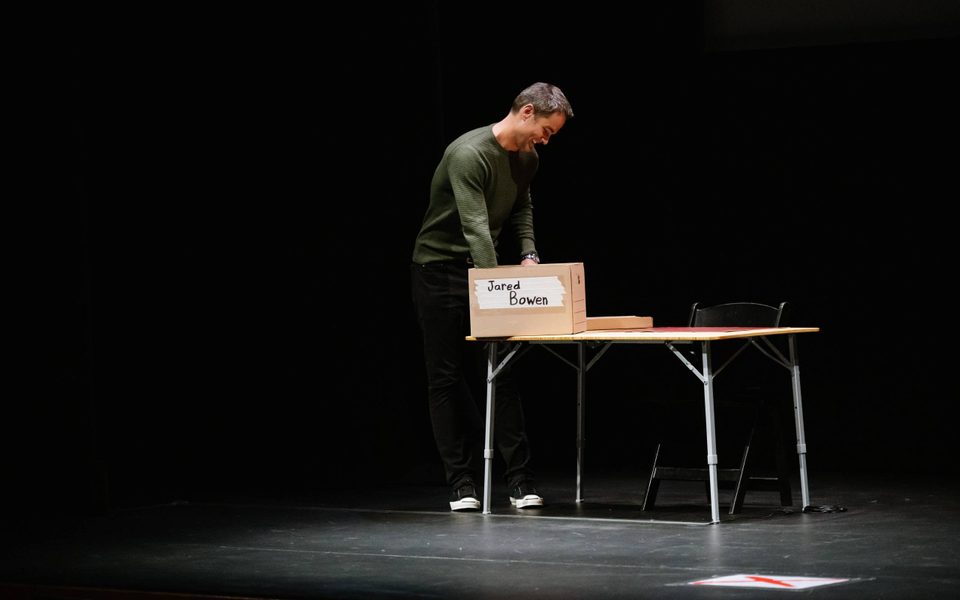
Jared Bowen in Nassim at the Calderwood Pavillion, BCA. Photos by © Mike Ritter

“Nassim” — Written by Nassim Soleimanpour. Directed by Omar Elerian. A new guest performer for every show. Presented by The Huntington through October 27.

By Shelley A. Sackett

“White Rabbit, Red Rabbit,” Iranian Nassim Soleimanpour’s absurdist adventure, which sits on the boundary of comedy and drama and burst into London’s West End in 20212, changed my opinion about audience participation in theater. Not a big fan of the genre, I left the 2016 performance at New York City’s Westside Theatre a convert.

Conceived while 29-year-old Soleimanpour was barred from leaving Iran for refusing military service, the play challenged its audience on issues of trust, obedience and complicity while demolishing the fourth wall and having a different actor read the script for the first time at each performance.

The words were Soleimanpour’s; the implicit messages were the idea of someone trying to speak through someone else and the question of what censorship means.

So when The Huntington announced it was producing the eponymous “Nassim,” I was on board. Originally commissioned and produced by London’s Bush Theatre in 2017, the drama, comedy and social experiment is even more timely today.

Fueled by curiosity, compassion and a longing for global community, Soleimanpour employs his trademark style of having a different actor cold read his script in front of a live audience. Karen MacDonald, the “empress of Boston theater,” had the honors the night I attended, and she rose to the task with her usual humor, flair and skill.

For 75 intermission-less minutes, MacDonald read from a script (minus the italicized stage directions) projected on a jumbo screen, as its pages were moved by disembodied hands. The play’s theme, a meditation on how foreign languages divide us, slowly comes into focus. While Soleimanpour’s plays have been performed in dozens of languages worldwide, they’ve never been performed in Farsi in his native country because of governmental repression. This situation particularly distresses him because his mother, who still lives in Iran, has never heard or seen one of her son’s plays performed in her (and his) mother tongue.

Although “Nassim” at times feels insubstantial and the gimmicky aspect often crosses over into banal cutesiness, its positive message of global community through communication and understanding prevails. Mimicking a language class, Soleimanpour’s script invites the audience (and especially MacDonald) to experience the beauty and magic of his native language, Farsi. We discover through the timeless and borderless device of fairytales.

Naheem Garcia

“Once upon a time” are our first Farsi words, along with “mom.” “You have to learn your mother tongue,” MacDonald reads.

In Act Two, Soleimanpour’s script turns more autobiographical, and we find out that he wrote the play in Farsi with words he wanted to learn in English. The play, which celebrated its 479th performance and has been staged all over the world, was intended as a means for its author to meet new people and be taught new words all over the world.

“A writer’s heart will always beat in his mother’s tongue,” Soleimanpour says through MacDonald. “But isn’t it amazing how languages work? They bring us together; they tear us apart.”

It would be too much of a spoiler to reveal all the surprises in store, but this charming and timely piece of experimental, experiential theater is a must for anyone curious about more than the shiny, big productions that often dominate conversation, reviews, and box office receipts. Take a chance with this little gem; you won’t be disappointed.

For more information, go to https://www.huntingtontheatre.org/

The escape from Mussolini’s antisemitic Italian fascism told in ‘Pack One Bag’ podcast

David and Sergio David Modigliani reviewing documents.

By Shelley A. Sackett

Heirlooms hold the keys that can unlock family histories. For many, these stories remain untold, preserved in artifacts that are passed from generation to generation and display case to display case. They sit silently on a shelf, admired and gathering dust.
Award-winning documentarian David Modigliani’s family was different.

When his grandfather, the Italian-born economist and Nobel Prize winner Franco Modigliani, died in 2003, David’s father Sergio inherited 19 boxes of documents. He kept them in a storage unit, where they remained taped up and unopened until COVID, when David decided to check out what was inside them.

He and documentary producer Willa Kaufman had begun dating just before the country went into lockdown during the pandemic. The boxes were a perfect diversion.

What they found inside was a treasure trove of family archives including letters, personal diaries, and fascist spy documents detailing his family’s harrowing times fighting to survive during the rising tide of antisemitism in 1930s Italy. That was the start of “Pack One Bag,” a 10-part podcast that traces his family’s escape to America.

In the boxes, there were scores of love letters between Franco, then a 19-year-old economics student, and Serena Calabi, the daughter of Jewish publishing baron, Giulio Calabi (known as “The King of the Books”) and the love of his life. Although David had grown up hearing the fairytale stories about his grandparents’ epic romance and their escape from fascist Italy for the United States in 1939, these letters did more than just preserve their love; they bore witness to the perils they confronted as Benito Mussolini and his Italian Racial Laws fueled antisemitism.

Most eye-opening was the 25-page letter that Giorgio, Franco’s brother who stayed behind in Rome, wrote and sent to David’s grandfather just after the war. It detailed, in “harrowing, page-turning prose,” his experience of navigating his family and shepherding them through a gauntlet of horror during the Mussolini regime.

“Reading this letter was chilling and opened up a much deeper understanding of the universe my grandfather could have experienced had he not been so fortunate to fall in love with my grandmother and escape fascist Italy with her family before the outbreak of war,” David told the Journal.

The professional storyteller in him knew he had to get to the bottom of his own family’s story. Toting his grandparents’ love letters, he and Kaufman went to Italy to speak to surviving family members, retrace his family’s steps in Rome and Bologna, and discover the answer to a question that haunted him: Why didn’t they all just flee Italy when they could?

The couple spent months piecing together a story that includes narratives of relatives left behind, recorded in their octogenarian voices. They plumbed state archives and even interviewed former Italian prime minister Mario Draghi, one of Franco’s students. They returned home knowing they had the raw material for a thrilling and timely story. But how to best tell it?

Film has been David’s medium ever since falling in love with the collaborative process of documentary storytelling while a graduate student at the University of Texas at Austin. He has won numerous awards for his feature films, which have run on Hulu, Netflix, PBS, and HBO.

But this time was different. There were no great visual assets and most of the main characters are no longer living. His coproducer reminded him that podcasts are at heart a visual medium. “A podcast is more akin to reading a novel than film. The audience must construct and build through their own imagination the world you are trying to create for them,” David said.

Actor/producer/writer Stanley Tucci signed on as executive producer and the featured voice of Giulio Calabi. David voices his Nonno Franco and Nonna Serena.

As a kid, he had done impersonations of his grandparents for his sisters and cousins, and when his collaborators heard them, they agreed that it would be an authentic way for him to bring his grandparents to life. David always meant to record them, and regretted that he didn’t prioritize that before they died. “I felt very close to them when I was recreating them for the podcast,” he said.

Episode 1 of the series David and his team created débuted at the 2023 Tribeca Festival as “Shalom, Amore.” It won the Jury Award for Nonfiction Audio, citing its “unexpectedly moving narrative that blends the personal, political, and comical” as it takes listeners “on a journey across generations and continents.”

Later, he changed the name to “Pack One Bag” to reflect the details of his family’s story. When his great-grandparents began illegally ferrying money across the border into Switzerland in the 1930s, they packed one bag so it would look like they were going on vacation. When the Nazis banged on doors in Rome’s Jewish ghetto in 1943, they instructed them to pack one bag.

“This story is about people who happened to be Jewish in the 1930s in Italy,” David said, “but it is a universal story. It applies to people in any environmental or political crisis who have to leave their homes. What do you take with you?”

David, 44, grew up as a “Reform Jewish kid in Brookline” and was especially connected to Judaism culturally and historically. He vividly understood how being Jewish had impacted the physical locations of his family. “My grandparents were in Belmont largely because of their Jewish identity and because they left Italy just in the nick of time,” he said.

He hopes that listeners can find some answers for the present moment from the way his family confronted their situation. “The question at the heart of ‘Pack One Bag’ is ‘when confronted with fascism, do you stay or flee? What if you can’t?’ ” David said.
Noting the upswing of nationalism, totalitarianism, and antisemitism at home and globally, he is reminded how fascism needs an “other” to survive and thrive, a subset of the population that the majority is motivated to antagonize, scapegoat, and persecute.

He cites his great-grandfather Giulio as advice to those being “othered.” “You resist as best you can for as long as you can, and then you flee,” David said.

“For those that have the privilege to exist inside a fascist society without being persecuted, the onus is on us to preserve democracy and to attempt to return society to a more inclusive and tolerant place.”

To listen to the podcast and for more information, visit packonebagshow.com.

Salem teen takes his talents to ‘Leopoldstadt’

Elias Wettengel

By Shelley A. Sackett

When her son was little, Liz Polay-Wettengel tried to get him interested in soccer, which his older brother had loved at that age. Instead, all three-year-old Elias wanted to do was memorize lines from the movie “Frozen” and perform them in the living room.

“We knew he needed to try the stage,” she told the Journal.

By the time he was four, Elias Wettengel was on his way to an acting career that would culminate with his casting in the role of young Jacob/Heini in the new production of Tom Stoppard’s award-winning “Leopoldstadt,” which runs at the Huntington Theatre through
Oct. 13.

The sprawling drama follows multiple generations of the fictional Jewish Merz-Jacobowitz family in Vienna in the 20th century. As it moves from 1899 to 1955, the play showcases everyday family dynamics against the ever-changing tides of revolution, war, antisemitism and assimilation.

Stoppard was inspired by the experiences of his own family; all four of his grandparents and three of his mother’s sisters lost their lives in the Holocaust. His stirring masterpiece takes a bold look at what it means to be Jewish for one’s self, in the eyes of others, and in the broader context of history.

“Leopoldstadt” won four Tony Awards in 2023, including Best Play, and two Laurence Olivier Awards, including Best New Play, when it débuted in London’s West End in 2020. The Huntington Theatre production is presented in association with the Shakespeare Theatre Company and features a cast of 15 adults and four children.

Elias, now a 13-year-old student at Collins Middle School in Salem, feels honored to play the roles of Jacob and Heini in such a meaningful play. “As a Jewish kid, the play has extra meaning for me. I sometimes get chills during the scenes,” he told the Journal.

“Leopoldstadt” is an emotionally intense and politically timely production, especially for American Jews. Elias and his mom handle the challenges of his role through open and honest conversations about what being Jewish means today and about how one’s ancestors can shape future generations.

It helps, according to Liz, that her brother-in-law Jason Stark teaches genocide studies. “We answer any questions that arise about death and the Holocaust. We don’t shy away from hard questions and encourage Elias to ask them,” she said.

For Elias, the resilience of family is an important message of the play. “I hope audiences see how generations of Jewish families relate, and the continuous impact they have on each other’s lives throughout time,” he said.

Family is also a major focus of his own religious practice. One of his favorite pieces of Judaism is that his family celebrates holidays like Sukkot by opening their home to everyone who wants to participate, “Being Jewish is always visible in our lives. I love sharing my Jewish culture with my family, friends and community,” he said. He is studying for his bar mitzvah, which his family will host in late 2025.

Elias’s theatrical journey began at the Salem YMCA, and he has since had featured roles in regional productions and in several film and television projects. He acknowledges that balancing the demands of school and performing is sometimes hard, but feels lucky to be a student in a district where his teachers assist him. “They come up with a plan to make sure I’m supported both as an actor and a student,” he said.

He is inspired by the actors he has the opportunity to work with, whether in community theater, films or the current play at the Huntington Theatre, which he hopes will serve as a stepping stone to appearances in additional professional productions. “I’d love to go on a tour or perform on Broadway!” he enthused.

As for advice to four-year-old youngsters who think they want to become actors? “Don’t be sad when you don’t get a role you want. Be happy to be part of theater in general. It isn’t about the role; it’s about the experience,” he said. Θ

For more information and to buy tickets, visit huntington­theatre.org.