Shavit’s Patriotic, Personal Narrative of Israel

Ari Shavit’s “My Promised Land: The Triumph and Tragedy of Israel” is a literary magnetic force. It attracts with enchanting rhapsodies about the miracles of the land of Israel and the early Zionist years; it repels with tales of occupation, corruption and cruelty. It navigates through the entirety of the Israeli experience, from 1897 to 2013, with 16 epochal pit stops. It extols Israel’s greatness and censures her weakness. It is positive and negative, and every gradation inbetween.

Shavit is a distinguished Israeli journalist who has compiled a patriotic, personal and powerful narrative. His clear and engaging style makes the sometimes incomprehensible complexities of Israeli politics understandable, even to one whose familiarity with the plays and the players is cursory. His interviews with key historical figures are intimate and raw, his scholarship exhaustive and praiseworthy. With a style that combines Studs Terkel, James Michener and ThomasFriedman, it is no wonder this book is a bestseller.

Shavit begins at his and Israel’s beginning, with his Zionist British great-grandfather’s 1897 trip to Palestine. Herbert Bentwich’s purpose was to evaluate the land as a potential national homeland for the Jews. What he saw led to his conclusion that the land was physically suitable. What he chose not to see would underpin the triumph and tragedy of Israel. While the 500,000 Palestinians living as nomads lacked cogent national identity, they were undeniably there in 1897.

Throughout his book, Shavit repeatedly links Israel’s current existential challenges to the single question, “How could they not have seen them?” By personalizing the tales, the reader feels what Shavit feels, and sees what he sees. We stand beside the early settlers as they clear the swamps, we smell the first orange blossoms in Rehovot, and we tingle alongside early kibbutzniks with the thrill of “creating something from nothing.” We also cringe at Lydda in 1948, where the War of Independence leads the Zionists to “throw off the yoke of morality,” looting, torturing and expelling Palestinians into the desert. “Lydda is our black box,” Shavit avers. “In it lies the dark secret of Zionism.”

There are chapters on the 1967 launch of Israel’s nuclear program, Tel Aviv’s frenzied culture, Israel’s religious zealots, and of course, the occupations and settlements. In “Up the Galilee,” a Palestinian-Israeli attorney provides apenetrating alternative viewpoint. “Existential Challenge” examines Iran.

“My Promised Land,” however, is much more than the sum of its parts. It is an exceptionally crafted valentine to Israel from her rebellious but unconditionally loving son. Shavit acknowledges her faults and wonders, but mostly he worries about her future.

“This start-up nation must restart itself,” he opines. “This immature political entity must grow up. Out of disintegration and despair we must rise to the challenge of the most ambitious project of all: nation rebuilding. The resurrection of the Israeli people.”

Is Shavit optimistic that this can happen? There are as many who would say yes as no. And every gradation in between.

Ari Shavit Random House Publishing, 2013
 

Don’t Pass Over‘The Whipping Man’

The finest theater experience makes us think, feel and debate. We gain some new insights into ourselves and others, and maybe learn a new fact or two. Such a trifecta is rarely attained, and when it is, we should notice with our feet. Matthew Lopez’s “The Whipping Man,” currently in its Boston premiere run at the New Rep Theatre in Watertown, is just such a play. In a nutshell, the 2006 Obie Award-winning period drama is set in Richmond, Virginia during the crucial month of April 1865, as three historical events intersected: the end of the Civil War and American institutionalized slavery; the assassination of Abraham Lincoln; and Passover, which began the day after Robert E. Lee’s surrender.

The setting is the half destroyed mansion of the Jewish DeLeon family. The characters include Caleb DeLeon, the injured Confederate soldier who has returned to the family home, and Simon and John, two newly freed DeLeon slaves, who had been converted to Judaism and raised as Jews by Caleb’s father.

Over the course of two days, the three address and try to make sense of their pasts as they reconstruct their futures against the backdrop of a suddenly reordered world. They revisit bitter traumas, reveal devastating secrets and warily navigate the waters of “freedom.” The play closes as the three conduct a makeshift seder, insisted upon and led by Simon.

“This year we are slaves, next year we may be free,” Simon recites before singing a few verses of “Go Down, Moses.” The stirring weight of the African American spiritual that celebrates the same hopes and dreams shared by the Israelites as they commemorate deliverance from Egyptian bondage is otherworldly in its force, emotion and layers of meaning.

As Simon, Johnny Lee Davenport brings a decency, self-confidence and self-knowledge to the play’s pivotal character. He embodies the shuffling, obedient slave of just yesterday, while evidencing the emerging freeman, at the helm of his future. Keith Mascoll’s John is spry and cocky, with impeccable timing and delivery. His is Simon’s perfect foil.

For a Jew, the complex messages of “The Whipping Man” are sobering. How do we face our collective hypocrisy that, after suffering the evils of slavery, we became slave owners? How do we bear our collective shame and guilt that we converted slaves to Judaism, but did not treat them as fellow human beings? What are the roles and responsibilities of legacy, trust, family and faith? We can almost channel the discomfort of many southern Jewish families as they sat down to the seder meal in 1865, a dank cloud of irony hovering unwelcome over the table.

To its great credit, the New Rep recognized the challenge posed by this complicated play, and invited the public to a free symposium of Jewish and African American scholars who discussed its meanings prior to the opening of the show. Perhaps the most insightful comment was by Professor Hillel Levine, an expert in historical conciliation, who interpreted “The Whipping Man” as a commentary on lost opportunities during Reconstruction.

“Maybe if Abraham Lincoln had had seders all over the country, things would have been different. Maybe it’s not too late,” Levine pondered.

“The Whipping Man” is the perfect antidote to this winter’s arctic freeze. Go with friends, maybe even read the play, and then settle in for scintillating discussion. The hot topics are sure to warm heart, mind and soul.

Pictured above from left: Jesse Hinson (Caleb), Johnny Lee Davenport (Simon) and Keith Mascoll (John) participate in a Passover seder in “The Whipping Man.”
Andrew Brilliant / Brilliant Pictures

Get in the Pink at the MFA

Pink brings out the worst in me. I chafe and cringe, feeling trapped in a sorority I never pledged. Blame it on my vestigial 60’s feminism, or the resentment I still harbor over the pink butterflies wallpapered to my bedroom ceiling without my knowledge or consent when I was seven. Whatever. Just bring me pink as undiluted red.

My spousal equivalent, on the other hand, is as keen on pink as I am not, especially when it comes to flowers. Only recently he finally gave up the challenge of changing my mind with a bouquet of the right shade of pink. He, like me, was convinced that it simply didn’t exist.

Until, that is, the MFA’s gender- bending “Think Pink,” an exhibit devoted to exploring design and gender with a wide range of all things pink from the 17th century to today.

The compact but sprightly show traces the evolution of pink with clothing, jewelry, accessories, graphic illustrations and paintings drawn from the museum’s collections. The fashions are stunning, with examples from Christian Dior, Elsa Schiaparelli, Ralph Lauren and Oscar de la Renta. The hats, in particular, are whimsical and striking.

We learn that both males and females claimed pink as their own, until the 19th century when men started wearing dark business suits and pink took on a feminine identity. Over the centuries, cultural, artistic and technological changes have swung the pink pendulum from rose to magenta to shocking pink and back again. Artificial dyes inspired neon, nervy, shocking pink, a color sometimes surrealist in application. Since 1992, pink has come to symbolize the global effort to fight breast cancer, thanks to the efforts of Estee Lauder and former SELF Magazine editor Alexandra Penney.

Pink HatWoman’s hat Flo-Raye, New York 1945–55 Plaited straw and artificial flowers * Gift from the Collection of Violet Manno Shumsky through her estate


Amidst the yards of charmeuse, feathers and sequins, the most eye-catching is a sleek, pink, wool twill man’s suit, designed in 2013 by Ralph Lauren for Vogue International editor-at-large, Hamish Bowles. The ensemble is intended to copy Robert Redford’s costume from the 1974 film version of “The Great Gatsby.” It would look great on David Bowie, too.

Another standout is Kenneth Paul Bock’s “Model in Sweeping Pink Coat,” a watercolor illustration for an Oscar de la Renta W Magazine design.

 Pink PaintingFemale model in sweeping pink coat by Kenneth Paul Block (American, 1925– 2009)1980sWatercolor and black marker on paper * Gift of Kenneth Paul Block, made possible with the generous assistance of Jean S. and Frederic A. Sharf

 “Think Pink” is informative, thought-provoking and for some, transformative. As society embraces more fluid ideas of gender and color, perhaps it is time for this stubborn holdout to do the same.

Photographs­ MFA, Boston

Bernie Madoff: Jewish Rogue or Rogue Jew?

We humans pay a price for our free will, and that price is accountability for our actions. According to Jewish thought, we are born with two opposing inclinations, one good (“yetzer ha-tov”) and one evil (“yetzer ha-ra”). Yetzer ha-tov gives us the opportunity to become closer to God. Yetzer ha-ra is not a demonic external force, but rather an undisciplined abuse of natural appetites and passions. These God-given instincts are not intrinsically evil, but harm ensues when we cede them control.

It is through our knowing and willing acts that we indulge our evil or good impulses. Our bible is full of characters who exemplify this dualism. Cain and Esau are no less human than Abel and Jacob; they simply have made different choices. The underlying issue becomes not judging one good and the other evil, but rather understanding what motivated them to act as they did.

In “Imagining Madoff,” Deborah Margolin’s 2010 provocative and compelling play, we meet two such men. Both are Jewish. Both weave biblical parables, Talmudic quotes and Jewish jokes into their conversation. One is Bernie Madoff; the other is Solomon Galkin, a synagogue treasurer, former concentration camp inmate, and poet/Talmudic philosopher. Galkin is based not so loosely on Elie Wiesel. Madoff is unabashedly based on the Ponzi maestro. The play’s spotlight mostly alternates between Madoff’s maximum-security cell, where his consciousness streams aloud to an invisible biographer, and Gaulkin’s plush study, where he and Madoff bond during an all-nighter fueled by scotch. They yak like boyhood chums, alighting on such topics as baseball, sex, lust, humor, friendship, money, God, guilt, Judaism and the Holocaust.

“We acted like old friends,” Madoff tells his biographer. “But that was just us being Jews. We didn’t really know each other.”

Through her insightful and skillfully crafted monologues and dialogues, however, Margolin lets her audiences get to know these two men and discover what makes them tick. Margolin resists prototyping Madoff as an inhuman monster, or Galkin as a paragon of moral authority. She assumes we all know the who, what, when, where and how of each man’s story. Instead, she presents them as multi-dimensional human beings, and trusts her audience to draw their own conclusions about the “why.”

Jeremiah Kissel possesses the role of Madoff with a brilliant sense of electric urgency. His Madoff is complicated and contradictory. One minute he is charming, handsome and smart; the next, he is sleazy, foulmouthed and foul-tempered. He relives crying after he told his first lie as a child, sensing, like a crackhead after his first hit, that he would forever be powerless and addicted to duplicity.

“It was so easy it was painful,” he recounts. “I just told the truth in a completely false way.”

As Galkin, Joel Colodner brings a quiet, weighted, calm confidence to the role. Here is a man who survived evil and doesn’t blame the God who created the men who committed it. If anyone could justify a free pass on amorality, it is Galkin. Instead, he takes solace and refuge in his religion, embracing Torah, ethics, ritual and the goodness of the Jewish people. He, too, is complicated and contradictory.

Ultimately, we see that Madoff and Galkin are two sides of the same Jewish coin. One talks the talk; the other walks the walk. Both have made choices in their lives, but those choices do not alter the fact that they are both Jews. The audience’s job is to notice, not to judge.

When asked why she wrote this play, Margolin answered by email, “The theater is the place where writers and actors ask: Who is this person? Why does he behave as he does?”

“When all is said and done,” she continued, “both Madoff and Galkin are just men. I wanted to ask a dramatic question that explores the seductive beauty and the real and present dangers of absolute faith, either in God, or in men.”

“Recommend” is too tame a word to use in reference to “Imagining Madoff.” I extol it as a sublime work of art, from its brilliant set to its inspired acting to its gifted writing. If you miss its run, you will be sorry.

Pictured above: Joel Colodner (left) starred as Solomon Galkin and Jeremiah Kissel as Bernard Madoff in “Imagining Madoff.”


Celebrating the Beauty of a Hindu-Jewish Fusion Wedding


U
Mass medical students Jhilam Biswas and Danny Barker met in 2006, before classes had even started. His undergraduate academic interest was anthropology; hers was sociology. They shared passions for world travel and global health issues, and both valued religion, culture and family. Jhilam is Hindu and Danny is Jewish.

Early in their relationship, they committed to learning about each other’s traditions, observing the High Holidays, Passover and Durga Puja with their respective families and friends. During their courtship they attended interfaith weddings that featured two distinct ceremonies — one for each religion. But when it came time to plan their own nuptials, Jhilam and Danny wanted to integrate their two unique cultures into one fused ceremony.

Jhilam

Jhilam Biswas

“Initially, Jhilam and I were both nervous,” Danny reflected. “Would the wedding feel ‘too Hindu’ or ‘too Jewish?’ Would we dishonor our traditions by mixing them together? Could we incorporate both cultures so that each family felt respected?”

Prior to their October 13, 2013 wedding, the couple engaged in many conversations with their religious officiants — Rabbi Lev Baesh of Austin, Texas, and Jhilam’s uncle, Dr. Ranen Chatterjee.

“It was out of our conversations that the parallels and overlapping symbolism were uncovered and woven together,” Rabbi Baesh said.

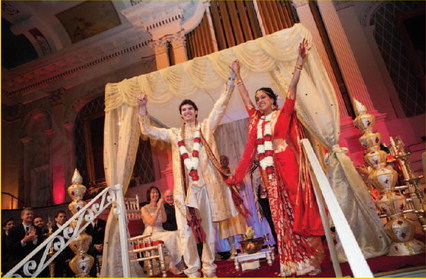
The Jewish chuppah, for example, is a smaller version of the mandap, the Hindu wedding canopy. In both traditions, the number “7” carries symbolic meaning. In a Hindu wedding, the bride and groom circle a fire seven times; in traditional Jewish ceremonies, the bride circles the groom seven times. The Seven Blessings (Sheva B’rachot) and Seven Steps (Saptapadi) are key parts of each service. Finally, at the conclusion of the traditional wedding ceremony, the Jewish groom breaks a glass and the Hindu bride steps on a clay pot. Both rituals symbolize the strength, care, love and respect needed to nurture and protect the marital relationship.

Couple

Danny Barker and Jhilam Biswas under their mandap chuppah.

For Sharmila Biswas, Jhilam’s mother, researching and planning her daughter’s wedding actually taught her something new about her own tradition.

“I did not have a baraat (Hindu marriage procession) at my wedding. It was not part of a Bengali wedding when Anup and I married in 1975. Today, every Indian wedding has a baraat. It is fun and gives people a chance to relax and feel part of the festivities. Through helping to plan this wedding, I was introduced to certain rituals of a modern Hindu wedding,” said Sharmila, who now lives in Norwell.

The baraat was actually a highlight of Jhilam and Danny’s wedding. Danny donned traditional Hindu clothing and rode a bejeweled horse down Worcester’s Main Street, all to the beat of the dhol (an Indian drum) and the rhythm of Indian music. The entire wedding party followed: dancing, clapping, laughing and kvelling.

Danny

Danny Barker rode a bejeweled horse down Worcester’s Main Street as part of a baraat (Hindu marriage procession).

When planning the wedding, the families met regularly to discuss ideas. There were difficult conversations, and compromises on both sides.

“The parents followed their children’s lead in what would be incorporated in the ceremony,” said Jeri Barker of Swampscott, Danny’s mother. “The planning process, and negotiating all the details, brought us all closer together.”

Anup Biswas, Jhilam’s father, agreed. “I always thought our families were very similar. It pleased me greatly to see so many of our wedding traditions intermingle with each other.”

Once the structure of the ceremony was sketched out, the couple designed a booklet for guests explaining the traditions and their meanings. Friends and family members contributed their unique talents and skills.

Dr. Peter Barker, Danny’s father and a passionate gardener, worked with the florist. “My neighbors, friends and I enjoy growing the big, beautiful, dinner plate dahlias,” he said. “I wanted to personalize the wedding flowers by including our dahlias. Some guests got a kick out of recognizing their flowers in the displays.”

Jhilam and Danny chose to be married in Worcester, the city where they met. They fell in love with the elegant and sophisticated Mechanics Hall, a beautiful Renaissance Revival concert hall built in 1857. For Jhilam, whose family has a long history of musicianship, the venue had special significance.

“In the months leading up to the wedding, I described the ceremony to my family and friends as ‘half-Hindu and half-Jewish,’” Danny said. “Looking back on it, that description doesn’t seem quite right. I now recognize it was possible for the ceremony to be fully Hindu and fully Jewish, all at the same time.”

Danny elaborated on this point.

“On the wedding day, I was raised onto a horse during a traditional Indian procession called a baraat, and my Hindu mother-in-law was raised on a chair during the hora. We had a wedding canopy with features of a chuppah and a mandap. My sister wore a beautiful saree from Bangalore, and my father-in-law wore a suit. It was a seamless blend — but most importantly, it was our own,” Danny said.

Jhilam agreed. “Wedding planning was a microcosm for relationship issues that got worked out earlier in our lives rather than later. In the end, we all came together and celebrated our hearts out, side by side,” she said.

Photos by David Tucker


This Is Not Not Your Bubbe’s Bible

“Unscrolled: 54 Writers and Artists Wrestle With the Torah” presents 54 of the edgiest and most inventive d’vrei torah imaginable. There are poems, stories, essays, memoirs, plays, recipes, an architectural rendering and a graphic novel. They are penned by contemporary Jewish luminaries such as A.J. Jacobs (“The Year of Living Biblically”), Joshua Foer (“Moonwalking with Einstein”), Damon Lindelof (“Lost”), Jill Soloway (”Afternoon Delight” and “Six Feet Under”) and Josh Radnor (“How I Met Your Mother”).

“Unscrolled” had its genesis during animated Torah discussions at the annual meeting of Reboot, a national network of young Jewish creatives and intellectuals devoted to grappling with questions of Jewish identity, community and meaning. The lively Torah dialogues morphed into a book where 54 individuals wrestled with a single section of the Torah, yanking it into the 21st century.

These unorthodox riffs are as uneven as they are varied. While some are serious and traditional, others are hilarious, and some may really offend certain readers. The best stories are in Genesis and Exodus. The results are simultaneously reverent and irreverent; sentimental and raunchy; somber and humorous. While there is not a dull one in the mix, there are a few that confuse profanity with profundity; blasphemy with innovation.

What resonates, however, is how each author succeeded in personalizing the characters and tales of the stories we have heard over and over, year after year. This alone makes “Unscrolled” a work of consequence.

For example, we sit beside Pharaoh at his computer as he Googles “boils,” “lice” and “frogs” on WebMD. We watch Zipporah pout, sulk and vamp as Moses’ neglected wife in a graphic novel version of Moses receiving the Ten Commandments. We hear a pensive Miriam muse to herself how she, “star of the sea, star of the river,” delivered her brother Moses not once, but twice. We meet a saucy, mouthy Rebekah at the well, and Esau, “the first Jew to wish he wasn’t.” We rethink “an eye for an eye” through a wise and touching poem. The Tabernacle, all 7,200 cubits of it, finds a home in Manhattan as a vertical skyscraper. Another chapter lists it on MLS.

You get the idea.

Physically and organizationally, the book is a pleasure to read. Each section contains a synopsis of the parsha, with the particular verse that inspired the commentator’s interpretation. These synopses, faithful to the biblical text, read with a narrative ease and fluidity. Their pages are bordered in luscious hues. In the back of the book is a userfriendly listing of each contributor, with just enough biographical detail to enhance reading his or her commentary.

We have all heard that humor is part of what binds us as Jews. The 2013 Pew Research Center survey of Jewish Americans reports that 42% believe “having a good sense of humor” is an essential attribute of being Jewish, ranking it higher than being part of a Jewish community, observing Jewish law or eating traditional Jewish foods. While “Unscrolled” may not be everyone’s cup of tea, for the Pew Study’s 42%, this book is a refreshing hoot.

Unscrolled: 54 writers and Artists Wrestle with the Torah; Edited by Roger Bennett Workman Publishing Company, Inc., 2013

PEM’s Impressionists On The Water: A New Look At Old Favorites

Walking into a room of Impressionist paintings always feels like coming home; there is a calm to the predictably pleasant. It takes a bold and innovative approach to snap one out of this complacency, and Peabody Essex Museum’s new exhibit, “Impressionists On The Water,” is that and more.

With over 90 paintings, prints, model boats and photographs, the exhibition focuses its lens on the influence waterways had on French Impressionists Monet, Renoir, Matisse, Signac, Pissarro, Caillebotte and Daubigny.

The unconventional staging of the show is masterful. Each display is punctuated with models of the boats illustrated in the nearby paintings. Of the two full-sized boats, the replica of the craft in Caillebotte’s “Boating on the Yerres” is a work of art in its own right. The curators have overlooked no detail: even the gallery walls are treated with sculptural elements that evoke a watercraft.

France’s many rivers and ocean harbors inspired its national pastime of pleasure boating. Among the most passionate sailors and yachtsmen were our beloved painters, and each has a maritime story to share.

PEM-BoatFull-sized model of the boat in Caillebotte’s “Boating on the Yerres.” (Shelley A. Sackett)


Caillebotte designed and created more than 20 boats; a racing rule bears his name. Signac owned 30 boats. Daubigny and his protege, Monet, lived on studio boats so they could be closer to their subject matter.

Throughout the exhibit we sense a celebration of light, water and sky. These painters brought the hallmarks of the Impressionist movement to their water experiences: spontaneity, sunlight, exhilarating color and a devotion to painting outdoors. They painted what they saw and felt; there is passion in their palettes.


Among the harbors, regattas, beaches and waves, one painting really stands out. Eugene Delatre’s “Woman Rowing” is a watercolor of a solitary woman in shadow, rowing towards sunrise. She is the lone female of the show and the lone loner; every other boating painting depicts at least two men.

PEM-monet

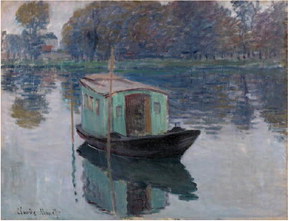
Claude Monet, “Monet’s Studio-boat, (Le bateau-atelier).” Collection Krller-Mller Museum, Otterlo, The Netherlands. (Courtesy of Peabody Essex Museum)

The most unexpected and wonderful surprise of the exhibit, however, is the lifesized reproduction of the floating boat Monet painted in the adjacent “Monet’s Studio-boat.” We are encouraged to enter and take a seat. The boat is outfitted with every appliance and comfort, and video displays mimic a water-line perspective. Like Alice and her rabbit hole, we have stepped into another world.

By the time we reach Monet’s “Waves Breaking,” the last painting in the show, we are looking through eyes that have gained a fundamental understanding of the artistic possibilities inherent in water and boats. We linger a bit before leaving, seeing what Monet saw, breathing the salt air and celebrating a single moment of just standing by the sea.

Pictured at top: Gustave Caillebotte, “Boating on the Yerres (Prissoires sur L’Yerres).” Milwaukee Art Museum, Gift of the Milwaukee Journal Company, in honor of Miss Faye McBeath. Photograph by John R. Glembin. (Courtesy of Peabody Essex Museum)

Human Enslavement Was Not Unique to the Nazis

What must it have been like for the Viennese Jews on November 10, 1938, the morning after Kristallnacht? One day earlier, their synagogues stood, their shops were open and their bank accounts existed. Yet in the blink of an eye their status changed from marginalized to subjugated, and they were helpless to change it.

In “12 Years a Slave,” which is based on a true story, we meet Solomon Northup, an African-American violinist in upstate New York who lived an integrated, privileged life with his wife and two children. It was 1841 and the racial cruelty of the antebellum south might as well have been happening on the moon.

Until, that is, the day Northup accepted a job from a pair of white men to play violin in a circus. Lured to Washington, D.C., he was wined, dined (and wined some more) until he passed out in a drunken stupor. He awoke shackled and enslaved.

The remaining two hours of the film shine an unflinching lens on the vile evil and frenzied violence that defined plantation slavery in the 1800’s. It is a challenge to endure and a relief to conclude. Northup spent a dozen years being passed from master to master, and we witness every humiliation, whiplash and sociopathic plantation owner uncomfortably close-up. The pathos is all the more visceral because we know Northup was born into freedom, and that he is worldlier than his custodians. We feel his desperation. Although the film ends on a happy note, we remain unsettled and sad. Where does this subhumanization of one group by another come from?

The time, place and circumstances of “12 Years a Slave” and Kristallnacht are different, but the same wrong was inflicted. In America and in Nazi Germany, white plantation owners and Aryan SS guards gave themselves permission to enslave people and practice ruthless sadism. What is most disturbing about “12 Years a Slave,” however, is not the desensitizing violence; it is the lack of closure, and the dark thoughts and feelings that evokes. Where is the justice? Where is the retribution? Elie Weisel may have been able to offer God his forgiveness for allowing the Holocaust to exist, but for some of us spectators, that just doesn’t settle the score.

Chiwetel Ejiofor stars as Solomon Northup in “12 Years a Slave.”

Evocative Post-Impressionist Exhibit Enthralls

Salem Cove, 1916


M
aurice Prendergast (1858-1924) and his jubilant style seduced me at the Barnes Museum in 1999. A snobby Francophile, I was ill-prepared to lose my heart to an American Post-Impressionist artist in that quirky bastion of French Impressionist masters. But lose it I did. For the last 14 years, I have wondered why Prendergast was not more widely exhibited. Bowdoin College Museum of Art’s stunning “Maurice Prendergast: By the Sea,” on exhibit until October 13, 2013, makes up for lost time.

Prendergast was born in St. John’s, Newfoundland, to a shopkeeper who moved the family to Boston in 1868. He studied painting in Paris and spent summers in France honing his skills and establishing his lifelong artistic niche of representing seascapes and the crowds that flocked to them.

He returned to Boston in 1894 where he worked as a commercial artist. He spent many hours at Boston’s piers, chronicling the men, women and children who idled by the water.

By 1900 he had his first solo show in New York. He was continuously lauded and exhibited until his death in 1924. A lifelong bachelor, his frail health left him deaf at an early age. His brother Charles, a gifted craftsman whose frames house many of the works on display, was his constant companion and supporter.

The enchanting show (and its equally wonderful catalog) gathers, for the first time, a retrospective of Prendergast’s seaside imageries of New England, Italy and France. The 88 oils, watercolors, pastels, sketches and monotypes celebrate the artist’s decades-long love affair with all things “seaside.” These are not just pictures of pretty scenery. Each is alive with crowds of happy people enjoying the sea. The thickly applied vibrant color of his oils, and masterful fluid transparencies of his watercolors, establish Prendergast as an imaginative authority of his craft.

salemcoveRevere Beach 1896.


Strolling from room to room, one is aware of the influences of Sargent, Cezanne, Renoir and Bonnard. And yet, with that awareness comes an appreciation for this artist’s unique and innovative contribution to the evolution of the genre. His oil paintings vibrate with sumptuous color. His playful watercolors emit a peacefulness and deep admiration for both landscape and those enjoying it. The obvious joy his animated well-dressed subjects take in their surroundings is contagious. Adding to this exhilarating mix is the unexpected surprise of recognizing our own backyard in many of the paintings’ titles (Marblehead, Nahant, Revere Beach, Salem). The oil, “Marblehead Harbor,” on loan from the Barnes Foundation, is a particular thrill.

I dare you to go to this delightful show and not fall in love. In fact, I double dare you.

My Virgin Visit to Nordstom’s Makeup Department

I have been to Las Vegas, Reno and Aruba, and left without putting a single quarter into a slot. I have all the television stations and have never seen a single episode of “American Idol,” “Dancing With the Stars” or “Survivor.” Nordstrom opened in Peabody on April 17, 2009, and I had never stepped foot inside its doors. As a 60-something Jewish female, it was time.

I wanted to sport visible proof of my deflowering. What better way than letting the beautician Chanelle use my face as a canvas for her palette of expensive face paint?

In truth, I had a headshot photo shoot scheduled the next day, and oral surgery the previous week had left me looking, well, my age.

Chanelle was gentle with me, cooing encouragement as she removed my glasses and examined every pore with evaluative eyes. She described the procedures I would be undergoing, defining why each product was necessary to achieving her goal. The list was long.

Feeling like an obedient preschooler, I submitted to her authority. My makeup regime is limited to concealer, blush, mascara and lipstick, and then only when attending a gala wedding at the Four Seasons. I had no idea what the four beigecolored pots de maquillage were. Chanelle’s explanation left me feeling I had been living on borrowed time, and that each product would be critical to my survival going forward.

Even in my naked myopia, I could sense the array of clinical instruments to my left, laid out neatly by shape and function. There was no turning back.

Coat after coat was applied, brushed, reapplied and rebrushed. I counted six different brushes, more than the Impressionists ever used to create masterpieces. The makeup had names like primer, foundation, concealer, highlighter and bronzer. I felt like the outside of my house. The functions sounded inherently contradictory: an illuminating concealer, a lightweight foundation and one that lifted as it covered. Even my eyelids needed camouflaging. When I looked atmyself in the mirror, I saw a Prendergast oil painting rather than the captured glow of pubescent skin. I burst out laughing.

Chanelle, bless her heart, soldiered on. Next came the eyes. I was immediately reminded why contact lenses and I had never gotten along. The approaching mascara wand in my peripheral vision elicited a textbook Pavlovian response of watering and blinking. Before the eyeliner had been imbedded between each lash (“Never draw a line across your lids!”), I was fantasizing about makeup removers and a long shower.

The one that really got me, however, was the creation of eyebrows. I truthfully had never felt disadvantaged by my lightly endowed eyebrows. In fact, my girlfriends who are slaves to plucking and waxing are green with envy. I thought they were a lifestyle asset. Not so, apparently. My face would look much more youthful with the framing eyebrows would provide. When I looked in the mirror, I saw a cross between my grandmother and Martin Scorsese.

By contrast, the blush was fun. Unsurprisingly, the one named Orgasm is their top seller. Luckily, it did not match my skin tone, as it was predictably out of stock. My lined dry lips required a $30 remedy. The case, at least, was exquisite, worthy of Faberge. I did not escape purchase-free, but I only added one item to my shopping list of blush, lipstick and gargantuan quantities of concealer (which I would apply with a paint roller, if such a product existed). That add-on purchase? A case full of autumn eye shadows. The included free eyeliner had clinched the deal.

I tried my best to gush and cluck as I gave myself a parting glance in the blindingly lit mirror, but I’m sure I fooled no one. Especially not Chanelle. In the privacy and muted, conventional lighting of my kitchen, however, I did ooh and aah, and yes, admire. Those eyebrows did lift my face, and I’ll be darned if my skin didn’t look 25 years younger. (Okay, maybe closer to 10.) I wondered if the store’s bright lights are deliberately of torture quality to terrify and encourage equity loan-caliber purchases. Ponce de Leon’s ghost holds court in Nordstrom’s makeup department, where he is healthy, wealthy and wrinkle-free.

I am a 60-something Jewish female who has never had Botox or any of its iterations. Don’t count on an article chronicling a change in that status any time soon.


Pictured above: The author, after Chanelle did her magic.