By Shelley A. Sackett
Ever since high school English classes, where most of us first encountered (and many fell head-over-heels in love with) Virginia Woolf and her seminal novel, Mrs. Dalloway, any speculation about the characters that populate the book has been largely prospective rather than retrospective. What might have happened to these people, so intertwined, next, we wondered. Few, if any, even thought about what Clarissa Dalloway might have been like as a teenager, or the origins of the relationships woven into the tapestry of her life.
Luckily, playwright Lindsay Joelle (TRAYF, The Garbologists) not only pondered, but dug in and applied her creative juices to pen Dalloway: First Love, a creditable version of 18-year-old Clarissa and her cohorts during one indelible summer. Her play is the perfect backstory — it enriches Woolf’s novel for those familiar with its characters without alienating or abandoning those who have never read it.
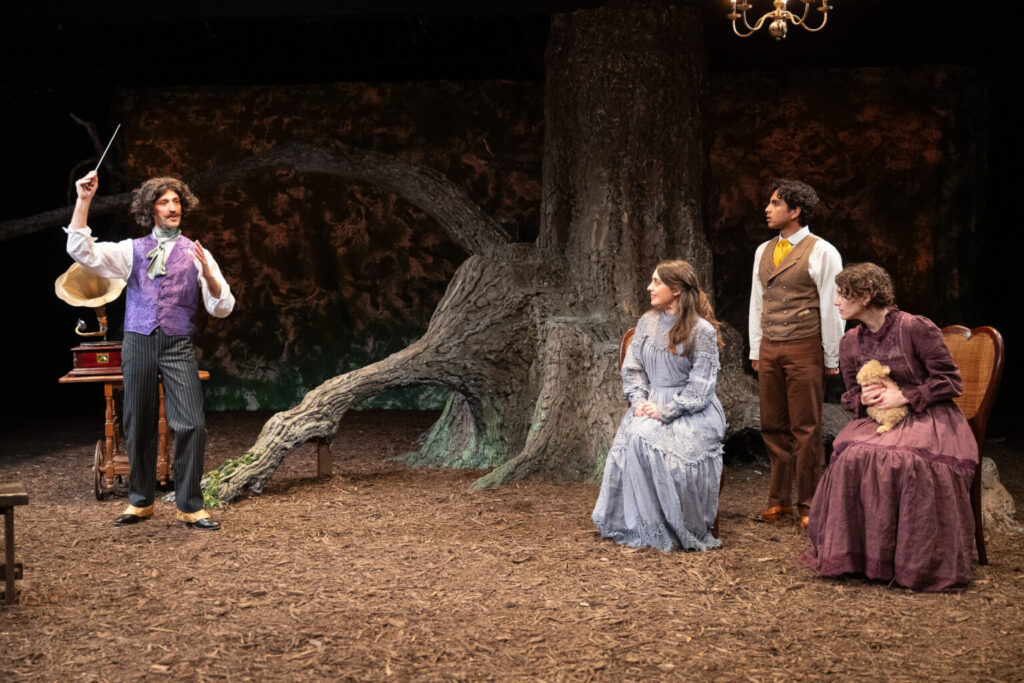
It also makes for an enjoyable theatrical experience, especially when paired with a (mostly) exceptional cast, outstanding direction, and stunning set. Gloucester Stage Company presents this world premiere through August 29, and it is well worth the trip up the coast to see it.
A nutshell version of the novel is helpful to appreciate the play. Mrs. Dalloway covers one day in the life of Clarissa Dalloway, a 51-year-old upper-class housewife, as she walks through her London neighborhood to prepare for the party she will host that evening. She thinks about many people from her past, reliving interactions and replaying conversations. All will be at her party, including a former suitor, Peter Walsh, her husband, Richard Dalloway, and Sally Seton, a firebrand in her youth who shared an incendiary and life-altering kiss with Clarissa and who now has five sons and a husband.
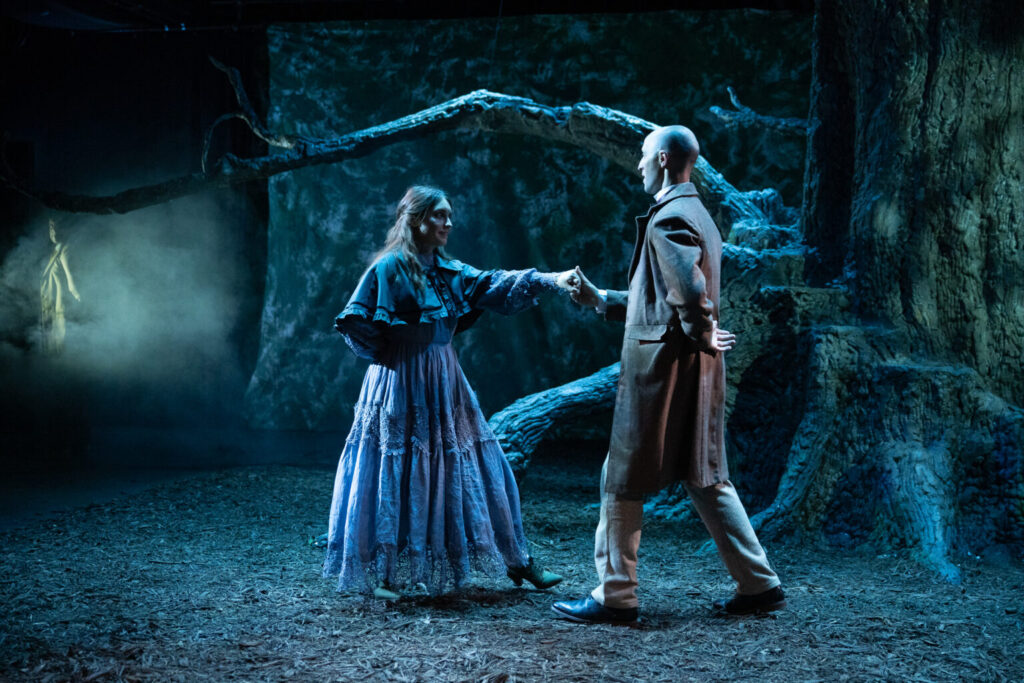
The play opens as a tomboy-clad young woman lolls, book in hand, under a massive tree that is the stage’s centerpiece and around which all the action will take place (set design by Kristin Loeffler). Engrossed, she recites aloud, “Mrs. Dalloway said she would buy the flowers herself,” the first line from the 1925 novel. With that simple reference, Joelle acknowledges that, while her work is of her own invention, she is aware of and pays homage to its underlying source.
In a flash, we are in 1890, 35 years earlier, at the Bourton family estate. Clarissa Parry (a luminous Josephine Moshiri Elwood) is about to turn 18. Motherless since childhood (Woolf’s mother died when she was 13-years-old), she lives with her stern, no-nonsense father (Jesse Garlick, who plays several roles) and desperately misses her sister, whose fatal fall from the set’s massive tree she still grieves (with the help of the opioid, laudanum).
This is the summer she will pursue and be pursued by a number of suitors. They will fall into three categories: those her father prefers, those she prefers, and one lifelong friend who longs to elevate his status from friend to husband. The problem is that Bourton is facing financial ruin (a fact for which her father takes no responsibility) and he has laid a guilt trip on Clarissa that it is her duty to “marry up” and save them both from ruination.
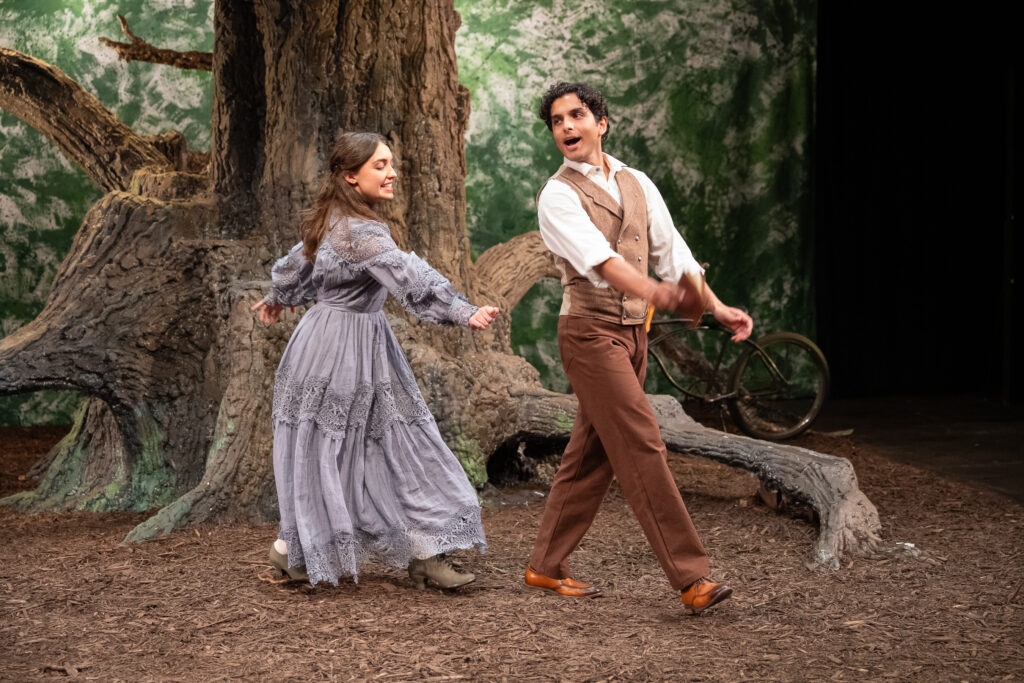
Peter Walsh (Shobhit Pisa) is the life-long friend. Penniless and of Indian descent (his parents still live in India), he left Oxford under cloudy circumstances and has returned to Bourton to propose marriage to the love of his life. Clarissa is caught off guard, wanting to keep her best friend’s companionship, but unwilling to sacrifice romance to do so. Enter Sally Seton (a deliciously salacious and scene-stealing Haley Dyana Schwartz) and her bag of magic tricks.
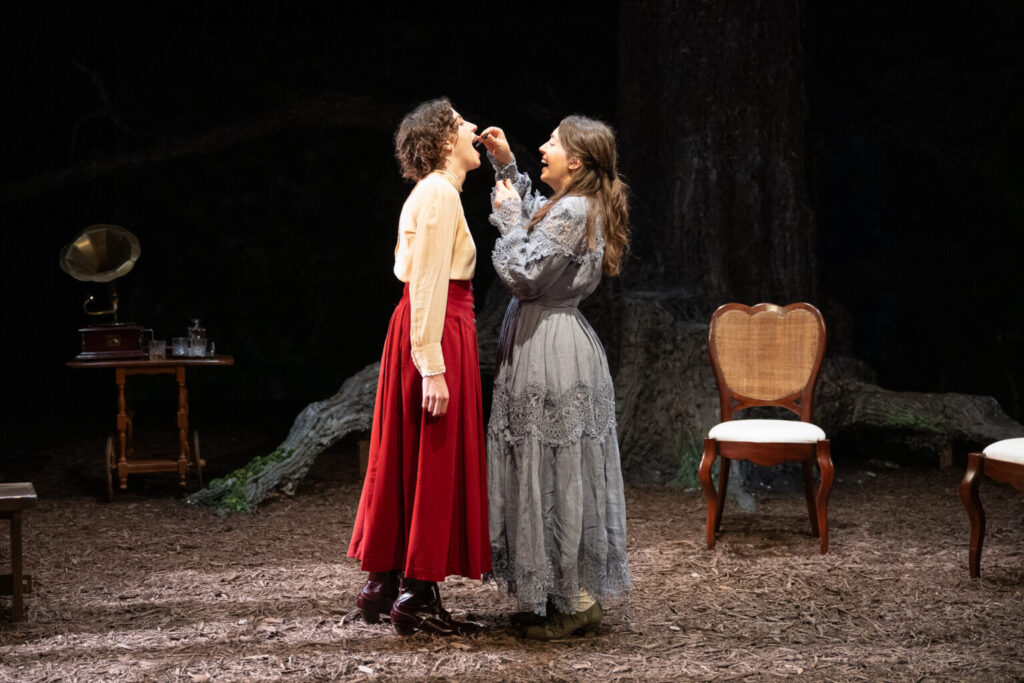
At Bourton under dubious pretenses, Sally captures Clarissa’s attention, captivating her with tales of wanton, Je m’en fou behavior and arousing a heretofore unknown passion. When the two share a delicate kiss (at Clarissa’s instigation), Clarissa is left shell-shocked and head-over-heels in lust.
This simmering pot boils over with the arrival of Hugh, a smarmy, wealthy suitor summoned by Clarissa’s father to woo her and save the family homestead. Turns out he and Sally have a backstory. The two squabble like schoolyard rivals, revealing how cunning and duplicitous they both are at heart.
Clarissa, however, has been awakened by Sally to her own homo/bi-sexuality (Woolf herself and Vita Sackville-West shared one of the most famous literary relationships of the 20th century, beginning as an intense romantic affair in the mid-1920s and evolving into a lifelong friendship that lasted until Woolf’s death in 1941). She falls hook, line and sinker for Sally’s picture of a Utopian world where women are free to live without men, on their own terms and in charge of their own bodies and destinies. “There is no need to be anyone but ourselves,” Sally says. She talks of a “Women’s Collective,” and Clarissa is ready to pack her suitcase and abandon stuffy, patriarchal England.
More down to Earth, Peter counsels her that “the privilege to be whoever you are is reserved for the wealthy” which, at least for the moment, includes neither of them. Snotty, snide Hugh (Garlick shines in this role), for his part, maintains the party line of his class and sex — marriage is a business arrangement best left to men to arrange.
There are a slew of other suitors, Clarissa’s sister’s music teacher and even a séance, all of which feel like they serve Joelle’s inexplicable need to run out the clock and pad the character list.
With the arrival of Richard Dalloway (Garlick, perhaps at his most comfortable), the tone shifts from semi-frenzied to semi-gentrified. Richard is Peter’s foil, as cerebral and self-contained as Peter is emotional and impulsive. Yet, he instinctively knows what Clarissa wants and, more importantly, what she needs. Unlike Peter, he doesn’t require a roadmap; he just does it. He may be dispassionate and aloof, but he pushes the right buttons and she is finally able to relax.
While Act II starts out with a bang (the séance), it quickly bogs down as Joelle shifts gears and (again, inexplicably) has her characters catapult into 20th century speculation about women’s rights, racism, and the challenges facing those fighting the good fight. (“See you in 1990,” one character actually says). Fortunately, Joelle rights the ship before capsizing, and we are again in the midst of the summer of first loves, first unrequited loves, and first steps towards lifelong relationships.
Woolf champions those connections forged in 1890 in her novel, where Clarissa relives many events of that summer, including the life-altering kiss with Sally. “She and Sally fell a little behind. Then came the most exquisite moment of her whole life passing a stone urn with flowers in it. Sally stopped; picked a flower; kissed her on the lips. The whole world might have turned upside down! The others disappeared; there she was alone with Sally,” she wrote.
Joelle closes by beautifully bridging the 35-year gap between her play and the novel with a single line. Spoken by Clarissa to Richard Dalloway, it is both indicative of the reins she will hold during their marriage and a direct link between Clarissa’s character at 18 and 51. “I shall always buy the flowers myself,” she informs him, and that, dear audience, is that.
‘Dalloway: First Love’ by Lindsay Joelle. A world premiere production directed by Rebecca Bradshaw; scenic design by Kristin Loeffler; costume design by Chelsea Kerl; lighting design by M Berry; sound design by Aubrey Dube; intimacy direction by Cassie Chapados; stage managed by Carolyn Ferris. Presented by Gloucester Stage Company in Gloucester, MA through August 29, 2026.For more information, visit https://gloucesterstage.com/dalloway/

