Salem reinvests in Artists’ Row with its first Artist in Residence

By Shelley A. Sackett, Salem Gazette correspondent

downloaddownload-1


Last Thursday, Artists’ Row was a beehive of activity. Alexis Batakis, a UMass Amherst art major from Peabody, donned short overalls and wielded a drill as she hovered over a pile of wood in a corner that was destined to become a 24-foot community table, the latest example of Salem’s commitment to public art.


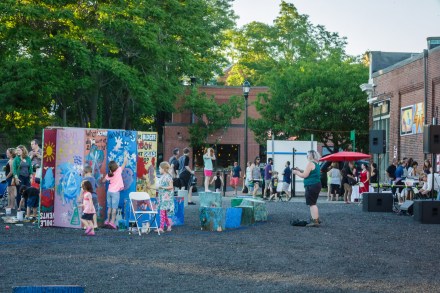
Kids and parents, teens and grandmas sat down together and created mosaics from buckets of natural and upcycled materials that ranged from mussel shells to pieces of fabric during the first of six weekly Public Art Salons.


The mosaics will eventually become the top a 24-foot long table that will remain in Artists’ Row and become a gathering place for conversation, creativity and community.


This Community Table is the latest brainchild of Salem’s first Artist in Residence, Claudia Paraschiv. She is a Salem architect and owner of Studioful – Architecture, Community Art and Neighborhood Design, and founder of Salem Public Space Project.


She was as busy as a bee, organizing volunteers, like her husband Michael Jaros, who teaches English at Salem State University, and was having a blast brandishing a hammer instead of a piece of chalk. “I love doing this. It is liberating and fun,” he said, obviously meaning it.

 

images


The Community Table will be built over five weeks by “anyone who would like to contribute time, artistry, ideas, help, materials or conversations,” Paraschiv said. She likes to imagine people sitting at the table and finding their artistic contribution and sharing that memory with new friends.


Her mission, as Artist in Residence, is to transform Artists’ Row into a local destination rather than a transitional, walk-through space. She intends to accomplish that through a series of creative placemaking events, called Public Art Salons, that will take place every Thursday, July 13 through August 17, from 3-7pm.


Located at 24 Derby Street in historic downtown Salem across from Old Town Hall and Derby Square at 24 New Derby Street, Artists’ Row occupies land that originally functioned as the City’s market place. Today, the space has five buildings that range in size from 370 to 1,000 square feet. Four function as working and gallery space for artist tenants, and a fifth is a restaurant, the Lobster Shanty.


Salem Public Art Planner Deborah Greel, who manages Artists Row and refers to its stalls as “art incubators”, wants to take the Row to the next level.


“It’s a place of challenged space. It’s wide. People don’t know where it is or how to get there,” she said, adding it is seen more as a cut through than a destination.


“We want Artists’ Row to be a creative space, a place that people are curious to stop at and see what’s going on there.”


To that end, the Public Art Commission and Greel launched the Artist in Residence Pilot Program (AIRPP) as an ongoing public art initiative to benefit the community by cultivating Artists’ Row’s potential. “Knowing the skill level Claudia has in creative placemaking, we asked her for a proposal,” Greel said.


Paraschiv was the first Artist in Residence in Dorchester’s Four Corners and recently facilitated the 289 Derby Community Design placemaking events.


Coined in 2010, the term placemaking describes a hands-on approach for improving a neighborhood, city, or region by inspiring people to collectively reimagine and reinvent public spaces as the heart of their community. Typically, placemaking involves a series of collaborative, inclusive meetings among stakeholders, municipal and professional representatives, and facilitators.


After she was hired, Paraschiv’s first step was to meet with the Artists’ Row tenants over a six week period for listening sessions where she asked them their priorities and needs, and how the AIRPP could help. “The consensus was to transform the Row into a destination rather than a traditional, walk-through space,” she said.


To accomplish that, she developed the concept of a Community Table with each artist tenant contributing materials that will be applied to the table directly and through use in the mosaics.


The Community Table will be designed and built during a series of five creative placemaking events, named Public Art Salons. These are also opportunities for people to cultivate local talent and build productive and meaningful relationships.


The 24-foot long table will be constructed in six parts that people can separate to sit at and lunch separately, or combine together into one long communal table. “The table will also integrate small gardens and spread knowledge about native plants,” Paraschiv said, noting that one thought is to have a birdbath right in the middle of the table.


To facilitate the cross pollination of ideas, she has engaged three professionals to help her host the Salons: ecological landscape designer Annie Scott (thrivedesign.studio); artist Lexiee Batakis (@ayyyitslexayyy); face painter Alison Troy (@AlisonTroy) and reading nook architect David Rabkin (@WentworthArchitecture).


She envisions the Salons as engaging the entire space of Artists’ Row in ways that will evolve over time with community feedback, ideas and participation. Reading areas, gardens and other possible are under discussion.


In the meantime, Paraschiv is very much in the moment, and her enthusiasm for the Community Table she is shepherding into being is contagious. A passerby she engages in conversation happily joins the table to create her own mosaic contribution.


“When Claudia was doing all those different projects each week at 289 Derby, it was just wonderful to go down there and eat and play,” Greel said with a wide smile. “Building community is actually the most important piece of the placemaking process.”

 

289 Derby final design a triumph for community engagement

By Shelley A. Sackett, correspondent

289derby-placemaking-placemats_votes-and-notes_page_1-1

The 289 Derby final collective schematic plan shows a balance of green space and paved surfaces with an amphitheater-like area, lawn with shade, a multi-use stage and a variety of areas for meetings, play and chance encounters.


289 Derby Street is a half-acre parking lot that directly borders the South River. The site hosts a pop-up carnival during Halloween each year and little else.


All that is about to change.


Salem acquired the parcel in 2016 and, with a recent $750,000 state grant for construction, the City hired CBA Landscape Architects to design the new public space that will connect downtown Salem to its waterfront.


CBA Landscape Architects engaged Claudia Paraschiv as a consultant for this placemaking phase. She is a public artist, urbanist, and registered architect in the Commonwealth of Massachusetts and owner of Studioful -Architecture, Community Art, and Neighborhood Design.


She founded the Salem Public Space Project to facilitate these placemaking meetings and engaged John Andrews, of Creative Salem, to co-facilitate. He built the 289 Derby St. website that included the public input surveys that were crucial to the information gathering process.


After a series of four 289 Derby Community Design Events, the permanent park design was unveiled at the fifth and final June 21 event, and it is a curvy beauty.


00_main

Participants of one of the four 289 Derby Community Design placemaking events.


The whole process took a mere five weeks and involved the participation of community members in an exciting and innovative approach to collaborative public space planning called placemaking.


First coined in 2010, the term describes a hands-on approach for improving a neighborhood, city, or region by inspiring people to collectively reimagine and reinvent public spaces as the heart of their community. Typically, placemaking involves a series of collaborative, inclusive meetings among stakeholders, municipal and professional representatives, and facilitators.


The goal for the 289 Derby Street public space project, according to Deputy Director of the Department of Planning and Community Development Kathleen M. Winn, is to have a place that is both beautiful year-round and flexible enough to accommodate different types of programming.


Unique to this project, however, was the process used to achieve that goal. Rather than engaging in the traditional top-down practice of having CBA Landscape Architects design the space first and then ask the public to retrofit it to specific use, the community meetings were used to hear from residents and other stakeholders what they wanted to use the space for before they designed it.


Anyone interested would be invited to join the conversation and have a say and a vote in how the 289 Derby space would be used and what it would look like.


“The idea is to bring the project to the people who will use the space and then have it designed to fit their desires,” Paraschiv explained.


Members of the Salem community were invited to help design the city’s public space at the vacant 289 Derby Street lot during four community events that took place on site from May 24 to June 14.


Each 289 Derby meeting gave participants a hands-on opportunity to experience the different activities the space might sponsor, such as music, yoga, gardening, games, outdoor movies and even paddle-boarding on the South River.


“The space was transformed to show people literally, ‘look how cool this could be!’” Paraschiv said.


The first event, “Dance & Design”, featured performances by local dance groups and a chalkboard wall where attendees were invited to write their favorite activities.


“Meet & Share” offered the opportunity to share personal visions of the public space’s character, programming, meaning and culture; games and activities were the focus of “Plan & Play.”


Both Paraschiv and Andrews couldn’t be more pleased with the process and its outcome.


“This was a grassroots effort to design and construct an otherwise empty lot. The idea is to try to bring it to the people who will use the space and then have it designed to fit those needs,” said Paraschiv,


“One thing we learned during placemaking is what a powerful tool the community and the municipality has with this process under the right direction,” Andrew said.


At the fourth meeting on June 14, approximately 200 residents local food and the opportunity to review and comment on the final two design options, one straight and one curvy.


By a margin of 70 to 18, the curvy plan was the overwhelming favorite.


cba_2-options

Participants chose the “curvy” plan at right over the straight plan at left by a          70 to 18 margin.


The final collective schematic plan shows a balance green space and paved surfaces with an amphitheater-like area, lawn with shade, a multi-use stage and a variety of areas for meetings, play and chance encounters.


Some of the possible green space uses include botanical gardens and a labyrinth that could double as a space for group exercise and a small skating rink in the winter.


“It’s hard to believe that just five weeks ago we had our first listening session with ‘Dance & Design,’” said Paraschiv.


CBA Landscape Architects is continuing the design work and developing cost estimates. Permitting is underway and the City expects to have documents ready for late August, according to Winn.


Because the lot is the site of October’s Derby Street Carnival, construction could not begin before November.


In her summary report, Paraschiv credits local support for helping the Community Engagement achieve its three objectives of: designing a schematic plan direction with strong public support; creating simulated events of feasible, actual use; and inspiring local stewardship of some key elements of the park and programming for 289 Derby.


“This permanent park design is a collaborative collection process by the people who came to the meetings and the architects,” Paraschiv said with obvious pride.


Andrews believes that those vested in the 289 Derby collaborative process might likewise influence the larger long-term project of creating a connection between downtown Salem and the waterfront.


“One thing is certain,” added Andrews, “It really drives home the emphasis on making a harbor walk a feasible and existing part of Salem’s future.”


For more information, visit salempublicspaceproject.com and CreativeSalem.com/289Derby.


JCCNS Inclusion Camp champions diversity

Shelley A. Sackett, Journal correspondent


Campers on bball court 04


When Marty Schneer arrived in Marblehead in 2013 to take over as executive director of the JCCNS, one of the first people he met was Marcy Yellin, whose 32-year-old son, Jacob, has special needs and was employed at the JCCNS.


She told Schneer that the community lacked an inclusion camp. He asked her what she would like to see. Within months, Schneer formed a committee with Yellin and a few others, including Special Education teacher Melissa Caplan. By the following summer, the JCCNS Inclusion Camp was up and running with 20 campers and Caplan at the helm as director.


This year the Inclusion Camp has 40 campers, a staff of 25, and a long waiting list. Specially trained staff work with children to integrate them into Kindercamp, Simchah classic camps and the Simchah CIT program.


There are no criteria for admission. “We take inclusion pretty seriously, so how could we make criteria that excludes some?” Caplan asked. The only reason a camper might not receive support is if that individual already tried camp and the staff knows it is unable to keep that child of their peers safe.


Screenshot_2016-07-01-11-19-31-1


Special needs campers participate in the same activities as their chronological peers, including aquatics and sports. “The goal of the camp is not only to provide services to a population who until now was not included, but also to break down the boundaries that often exist when people are not exposed to differences at an early age,” Caplan said.


Campers range in age from 2.9 months to teenagers. Staff includes teens and young adults who themselves have disabilities, filling an additional community need. “These individuals come to work and receive a paycheck just like their non-disabled peers,” Caplan said.


Inclusion campers and staff cope with a variety of disabilities that include developmental delays, intellectual impairments, autism, cerebral palsy, blindness, social/emotional disabilities, muscular dystrophy, down syndrome, seizure disorder and many more.


Most require on-on-one aids, which is expensive, and which is covered partially through private donations and organized fundraising. “We pride ourselves that the cost to attend camp is the same for all, whether you need a one-on-one aid or not,” Schneer said. “The underlying philosophical approach is that this is good for entire community of campers.”


“Marty believes in the need to support a neuro-diverse population, even though it costs the JCCNS a great deal,” Caplan added.


The term “neuro-diverse” means normal, natural variation in human cognition. It embodies the idea that those who are non-neuro typical can live their lives as they are with accommodations and modifications instead of being forced to conform to “normal.”


Caplan’s educational background includes a bachelor’s degree in multiple disabilities and a Masters degree in Early Intervention. She has worked in Roxbury, Newton and Marblehead and currently teaches special education at the Clarke School in Swampscott. “I believe wholeheartedly in the spirit of inclusion. It is a passion of mine,” she said.


During the rest of the year, the JCCNS runs adaptive/inclusion programs. Caplan works “very part time” in the year-round Inclusion Program, which last year added inclusive basketball and lacrosse clinics, Sunday family drumming circle and an IEP (individual educational program) support clinic for families. The program already has adaptive swim and gym programs.


Next year, Caplan would love to expand the sports clinics and start a lacrosse league and a Special Olympics swim team. “We have tons of great ideas and committed staff and eager participants. The only setback is funding,” she said.


In the meantime, Yellin sees the fruits of her vision every Friday as she walks down the hill to the JCCNS where she plays music. “I see wheelchairs amongst kids playing and all kinds of people in one space. It’s a beautiful sight,” she said.

Walnut Street Shul Preserves the Future

Rabbi Kagedan proudly stands at the Walnut Street Synagogue bimah.

Unbeknown to the ten Chelsea families who founded the Orthodox Congregation Agudath Shalom in 1897, they had erected their synagogue in a city that in their lifetimes would become home to the largest percentage of Jews of any other city in the United States except New York.


In 1890, 82 Jews lived in Chelsea; by 1910, that number swelled to 11,000, one of every three residents. By 1930, almost half of Chelsea was Jewish, earning it the moniker, “Yerushalayim d’America.” If it seemed like there was a synagogue on almost every corner, that’s because there was: in its 1.8 square miles, Chelsea housed 18 synagogues.


When tragedy struck and the Great Chelsea Fire of 1908 reduced most of the city, including Agudath Shalom, to ashes, the shul’s immigrant founders were undaunted. They rolled up their sleeves and in 1909 rebuilt the synagogue on Walnut Street, which inspired the new building’s nickname, the Walnut Street Shul.


Designed by architect Harry Justin Joll, the magnificent building boasts ceiling frescoes painted by immigrant artists and an awe-inspiring ark by Sam Katz, the renowned master woodworker from the Ukraine who made Chelsea his home in the 1920’s.


Fast forward to 2017, and most everything about Chelsea has changed.


Gone are the kosher butchers, bakeries and religious and cultural institutions. Yiddish and Hebrew have been replaced by the mother tongues of recent immigrants from Central America, Asia, Southeast Asia and the Caribbean. According to the most recent Cohen Center for Modern Jewish Studies survey, Chelsea’s Jewish population has shrunk to statistical insignificance.


Of the 18 synagogues, two remain: Temple Emmanuel and the Walnut Street Synagogue.


RabbiArk2


The Walnut Street Synagogues’s congregants are determined to revitalize their synagogue and, while they’re at it, to blaze a new trail for Orthodox Judaism. Last September, they hired Rabbi Lila Kagedan, the first female clergy member in the United States to preside in an Orthodox synagogue using the title “Rabbi.”


Within the world of Orthodox Jewry, this is a big deal.


Rabbi Kagedan attended Yeshivat Maharat, the Orthodox women’s religious training program founded by Rabbi Avi Weiss in the Bronx, New York. Because rabbi is a masculine word, Rabbi Weiss allows his graduates to adopt whatever title they want.


Some choose rabba (a feminized version of rabbi) or maharat (a Hebrew acronym Rabbi Weiss invented that translates as female leader in Torah, spirituality and religious law). When Rabbi Kagedan and her two female classmates graduated in 2015, she alone chose the title rabbi.


“It was the title that most accurately described the work that I trained to do. Like calling a doctor ‘Doctor,’” she said. “People did try to discourage me because it hasn’t been a typical choice in Orthodoxy, but I always wanted to serve the community and use my training and knowledge to support the Jewish community with pastoral and halachik needs.”


The Rabbinical Council of America (RCA), which represents over a thousand Orthodox rabbis across the United States, saw the matter differently. It adopted a policy in the fall after Rabbi Kagedan’s graduation prohibiting the ordination or hiring of women rabbis.


“Should it be allowed? Who’s going to make it illegal?” asked Jonathan Sarna, the prominent author, historian and Brandeis University professor who has written extensively about American Judaism. “In America, the congregants make their own decisions. We don’t have a Chief Rabbi. We don’t have a Ministry of Religion. Every congregation is, in a sense, a law unto itself,” he said by phone from Jerusalem.


None of these religious politics mattered to Board Secretary Richard Zabot, whose grandparents arrived in Chelsea in 1905 from Russia and helped found the Walnut Street Synagogue. In Rabbi Kagedan, he saw a perfect fit. “She showed a willingness to work with the unknown in order to achieve our goal: the rejuvenation of our synagogue,” he said.


Fellow Board member Eddie Medros, who grew up in Chelsea in the 1950s and attended the Elm Street Synagogue, agrees. “She is infectious with her drive and enthusiasm. She brings warmth, passion, inclusiveness and a love of Judaism,” he said, noting she has already reached out to the local community in a meaningful way.


The attraction was mutual. “The shul presents a challenge, which I am always up for. I also feel committed to keeping a shul that has existed for so many years going. Continuity is powerful,” she said.


Devra Zabot, Richard’s daughter and events chair of the shul’s museum, described the extensive vetting process Rabbi Kagedan received before the synagogue board offered the ultimate vote of confidence. “Given that the board members are all over the age of 70 and mostly male, this was a heavily discussed decision,” she said.


In the ten months she has been at the spiritual helm, Rabbi Kagedan has been busy learning the ropes and making connections with the greater Jewish and local Chelsea communities. Almost immediately upon arrival, she led the High Holiday services and organized a Chanukah celebration with a klezmer band that attracted over 150 people, including Zahava Stern, a new young member.


“I met a lot of people who grew up in Chelsea and were bar or bat mitzvah-ed in this shul, but have since moved out to Sharon or Brookline. They were so excited to come back and see an active community in a place they hold so dear to their heart,” she said.


Stern also noted that Chelsea’s location attracts families from the North Shore, East Boston, Cambridge and Somerville. “It’s a secret gem right in the middle of the action,” she said.


The Walnut Street Synagogue offers monthly Shabbat and holiday services, classes on a variety of Jewish topics and holidays, and pastoral counseling and services. Rabbi Kagedan is the founding member of the Chelsea Interfaith Council and has met with the City Manager and other non-profit organizations about partnerships and integrating the shul with the Chelsea community.


The shul is supported by its board and members and by the Chelsea community at large, including citizens, city councilors and non-profit organizations. There are 120 members, and it operates as a fully Orthodox shul, with a mechitza on Shabbat and during high holidays services. The Jewish Chelsea Home generously opens its doors to the Rabbi and her family and guests to stay over on Shabbat.


Somehow, Rabbi Kagedan also finds time to serve on several professional and religious boards. “My peers have been largely supportive and open. Once people meet me and get to know me and see or experience the work I am doing, there is less anxiety and hype about being a woman Orthodox rabbi and people see me as just simply an Orthodox rabbi,” she said.


For now, Chelsea and the Walnut Street Synagogue are her prime focus. “Chelsea was at one time a real center of Jewish life in the region. My priority is to get Chelsea back on the radar of Jews in Massachusetts and to let people know the Walnut Street Synagogue is operational,” she said.


This is music to Richard Zabot’s ears. He remembers as a child when all 1,109 seats would be occupied during the High Holidays. “The shul hasn’t lost any of its charm or awe. We’re inviting 900 new people to join us this Yom Tov and be part of the preservation of the future,” he said.

North Shore Jews Pray with their Feet in Salem’s Pride Parade


By Shelley A. Sackett, Journal correspondent


Laura-Jillian

(L-R): Laura Shulman Bronstein and Rabbi Jillian Cameron with their “totes gay” tote bags.


The sixth annual North Shore Pride Parade and Festival will wind its way through Salem on Saturday, June 24, and for the first time, there will be an official Jewish North Shore group participating.


Even though the parade takes place on Shabbat, the Jewish day of rest on which observant Jews refrain from various forms of labor, 30 people have committed to marching under a banner that identifies the group as “Jew(ish) Tribe for Pride” and includes the logos of its sponsors, InterfaithFamily and Cohen Hillel Academy. 40 more have expressed interest.


It all started at last year’s parade, in which Laura Shulman Brochstein, Rabbi Jillian Cameron and Liz Polay-Wettengel marched with their families. They were chatting on Salem Common, where the parade ends, lamenting the lack visibility from the Jewish community, despite what they knew to be a welcoming Jewish community for LGBT individuals and families.


They figured the likely reason was that the event took place on Shabbat.


Liz with Sign

​Liz Polay-Wettengel holds an equality sign at last year’s North Shore Pride Parade.​


“Because of our collective professional experience working for Jewish organizations over the years, we knew that for many, this was the barrier for participation,” said Polay-Wettengel, who lives in Salem and is National Director of Marketing and Communications at InterfaithFamily.


Brochstein is a social worker from Marblehead and the North Shore Outreach Manager for Jewish Family and Children’s Service; Rabbi Jillian Cameron, of Salem, is the director of InterfaithFamily/Boston.


“We thought, ‘What if we marched as individuals and not as an organization?’” Polay-Wettengel continued. Over lunch one day, the three decided that, as Jews in the North Shore community, they wanted their LGBTQ friends to know that the Jewish community supported them.


The three women organized an independent Jewish group, called Jew(ish) Tribe for Pride, creating an opportunity for North Shore Jews to march together, regardless of institutional or rabbinical support or opinions.


As a Jew, a rabbi and a member of the LGBT community, Rabbi Cameron can’t think of a better way to spend Shabbat on June 24 than marching with her North Shore community. “For me, this is a sacred act, an act of prayer, a way to seek out greater connection with my fellow human beings and with God,” she said.


Although Beverly’s Temple B’nai Abraham members will participate in the Pride Parade for the third consecutive year, they march with the Beverly Multi-faith Coalition. After their Shabbat morning services in the TBA chapel have ended, “We will pray with our feet (as Rabbi Abraham Joshua Heschel described his experience marching for civil rights),” said TBA’s Rabbi Alison Adler.


“ I don’t see walking in a parade in support of equality and inclusion as a violation of Shabbat – just the opposite,” she said. “Shabbat is supposed to give us a taste of the kind of world we want our children and grandchildren to inherit, a world of equality, free of hatred. I am thrilled that there will be more of a Jewish presence this year under the Tribe for Pride banner.”


Rabbi Adler was instrumental in getting the North Shore Pride Board to change the night of the interfaith service preceding the march from Friday to Thursday. As a result, most North Shore rabbis and cantors will attend this year, leading a song together as part of the service.


Rabbi Michael Ragozin, of Conservative Congregation Shirat Hayam in Swampscott, applauds Rabbi Adler’s success and will attend and publicize the Thursday night event. However, he cannot do the same for Saturday’s parade.


“Shabbat and support for the LGBTQ community are two values that I hold dearly. Unfortunately, the North Shore Pride parade conflicts with Shabbat, and I will not publicize events that conflict with Shabbat,” he explained.


Rabbi David Meyer of Marblehead’s Reform Temple Emanu-el supports any of his congregants who wish to attend and participate in the parade, although he thinks it would be in poor judgment to have the Temple play an official role in a secular event that takes place on Shabbat.


“Although certainly not a traditional approach to Shabbat observance, sharing in the work of increasing civil rights, justice and peace in our community, nation and world is very much in keeping with Reform Jewish principles,” he said.


Rabbi Cameron welcomes everyone to march under the new Jew(ish) Tribe for Pride banner. “In life, there aren’t many parades, aren’t that many times we get the opportunity to show up and physically express the things which are important, which makes us who we are,” she said.


For more information, email northshorejews@gmail.com. or visit salem.org/event/north-shore-pride-parade/. To RSVP, go to bit.ly/NorthShorePride.

PEM hires neuroscientist to enrich visitor experience

Tedi Asher

Dr. Tedi Asher

Groundbreaking initiative first in the museum world

By Shelley A. Sackett, correspondent


By his own admission, Dan Monroe is “afflicted with intense curiosity.” The Peabody Essex Museum executive director and CEO relaxes by intensely investigating fields unrelated to art and appreciation, such as quantum physics.


A few years ago, neuroscience caught his attention. After reading roughly 150 books and publications, it became clear to him that neuroscience has a direct role to play at PEM.


“What we essentially do is to create experiences of art and culture. We call them exhibitions and programs, but we are really creating experiences,” he said.


Since research shows that all experiences are created in our brains, he reasoned, if PEM wanted to remain at the forefront of designing meaningful, relevant and impactful art experiences, it would be a good idea to better understand how brains work.


Essentially, he thought that by getting inside visitors’ heads and figuring out how they felt, how they saw, what caught their attention and what they remembered, PEM could enrich their visits.


Plus, it would make the museum a more fun experience.


His team began experimenting with this new approach, adding innovative multi-sensorial elements to select exhibits. Professional dancers greeted visitors in the “Rodin: Transforming Sculpture” galleries, their movements and poses reflecting those of the sculptural works. “Asia in Amsterdam” showcased fragrant spices, a soundtrack conveying 17-th century Dutch life, storytelling and striking graphics.


The feedback was overwhelmingly positive.


“The dancers created a new kind of attention and a new avenue for people to appreciate and see sculpture,” he said, noting that the traditional way museums transmit information — through written labels — is not working. “If people read them at all, they spend an average of 2.5 seconds, even at the oversized introductory panels,” he said. He wanted a more transformative experience for the PEM guest and, based on visitor surveys, so did the public.


After the success of the Rodin and Asia shows, Monroe and his team decided to expand their reach. They applied for and received a $130,000 grant from the Barr Foundation, a Boston-based philanthropic organization, to launch the neuroscience initiative and delve deeper into using neuroscience research to enhance the way PEM designs exhibits.


The initiative enabled PEM to hire Dr. Tedi Asher, a neuroscientist who earned her Ph.D. from Harvard Medical School’s Biological and Biomedical Sciences program 2016, and joined PEM as its full-time Neuroscience Researcher in April. “To our knowledge, this is the first art museum in the world to hire a neuroscientist and put them on staff,” Monroe said.


Asher is thrilled with her first job outside the academic arena. “Where else but at art museums can one witness such breadth and depth of emotional experience?” she asked.


She was looking for a position that would allow her to creatively communicate neuroscience to non-scientists in a non-traditional teaching environment that would reach beyond academia and benefit the public at large.


“I came across PEM’s job ad and it seemed to fit that bill,” she said.


Asher’s primary academic focus has been studying emotion, starting as an undergraduate at Swarthmore College, where she studied learning and memory in the common fruit fly. Her doctoral work in neuroscience investigated aggressive behavior in mice.


At PEM, she will step out of the laboratory and explore how PEM can enhance and enrich the visitor experience by designing exhibits that will evoke human emotions, thereby leaving lasting impressions.


“Teri has a keen interest in using neuroscience to make the world a better place. She’s learning a great deal about art and culture and how museums work at the same time she’s teaching us about neuroscience and how brains work,” Monroe said.


Asher’s tasks are threefold. She will investigate how human brains are wired to appreciate art and how that information can be used to design exhibits that resonate on a personal level. She will then work with PEM staff, teaching them basic concepts that are relevant to their work as exhibition and program designers, such as how visual and attention systems work and how they relate to emotion. Finally, she will also pen a small publication to explain the concept behind the neuroscience initiative and its applicability to museums.


The skills she honed during schooling — particularly her ability to “mine the literature in an efficient and effective way” — will be key to her position. Specifically, she will be looking at the structure of the visual system and how that influences visual perception, asking questions such as, “What neurostructures allow us to regulate attention? What characterizes how we allocate attention with an experience like a museum visit?”


It will be then be up to PEM exhibit designers and staff to translate and incorporate that information into the museum’s installations.


The timing of Asher’s hire couldn’t be more perfect. PEM continues to undergo a comprehensive renovation and expansion project, featuring a 40,000 square-foot new wing of galleries, which will open in 2019. At the same time, Monroe explained, PEM is also in the process of refreshing its permanent collections, creating new installations of virtually all of them.


“The entire experience at PEM will be new, based on ideas we’re deriving from neuroscience and other fields,” he said. Asher will assist in this overhaul too.


Since 2003, PEM has used The Morey Group to measure overall visitor satisfaction through a standardized survey tool used within the museum industry. Among the 80 museums tracked by Morey, PEM is head and shoulders above the rest, ranking number one every year since 2003.


“We’ve long been pursuing innovative approaches,” Monroe explained modestly, adding, “but the neuroscience initiative is a distinctive one.”


Monroe credits the neuroscience initiative with motivating PEM to shift gears away from written text and towards better and more storytelling. “Stories are the glue that holds us together as social animals. Good stories elicit emotion and emotion is really critical,” he said.

Creating intergenerational bonds the old fashioned way: by writing letters

by Shelley A. Sackett


Stanley Elementary School fourth grader Drew Hause couldn’t wait to go to school last Wednesday, June 7. Since October, he and 21 other students in Mrs. Sami Lawler’s class have corresponded with pen pals from the Swampscott Senior Center and today was the day they would finally meet them face-to-face.


The seniors were just as excited. For many who live far away from their own grandchildren, gaining a peek through the keyhole of a nine-year-old’s life over the course of the school year was a welcome treat during the long slog of the New England winter. Meeting them in person would be icing on the cake.


The intergenerational program was started years ago by Marilyn Cassidy as a way to connect seniors and young school children. For the first few years it was at Hadley Elementary School, then Clarke Elementary School, and this year its home base was Stanley.


Hause and Sackett

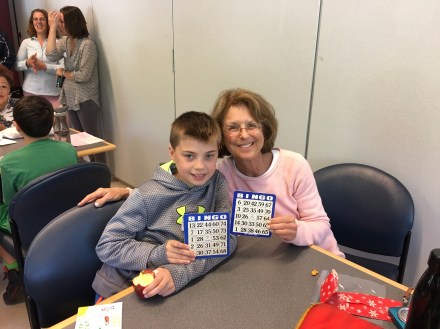
Pen pals Drew Hause and Shelley Sackett get ready to try their luck at bingo.


“The kids loved writing. They poured their heart and soul into their letters and I learned things while I was proofreading with them that I would otherwise not have known,” Lawler said, adding, “It was pretty special.”


Mello-Lawler-Fray-Kerr-Glynn

Mrs. Ami Lawler (second from left) and fourth grade class mom chaperones at the Swampscott Senior Center pen pal lunch.


Norma Freedman, of Swampscott, chaired this year’s Senior Center pen pal program. She has had a pen pal for many years, and even wrote to one girl throughout the summer while she was away at camp.


“It’s a lot of fun and it’s good for the kids. They know there’s someone in the world besides their immediate family that cares for them,” she said.


The biggest challenge for her? “They draw a lot on the envelopes. I’m not an artist and I don’t draw, but I tried to, to keep it interesting for them too.”


The students arrived at the Senior Center by van (courtesy of the Senior Center) clutching handmade decorated envelopes, presents and lunch. Their senior pen pals were already there, and squeals of delight filled the lunchroom as hugs, presents and — of course — letters were exchanged.


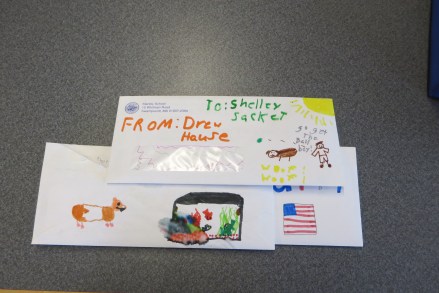
Thomas Mello presented his pen pal, retired social worker Bill Foley, with a last letter in an envelope covered with colorful drawings of his pets, a guinea pig and an aquarium full of fish. Unsurprisingly, his favorite part of the pen pal project was “drawing on the cards.”


Mello-Foley-Jaeger-Kerr

From left: Thomas Mello, Bill Foley and Caleb Jaeger-Kerr get to know each other over lunch.


After lunch, seniors and fourth graders played four rounds of bingo, bonding even more over lessons in frustration and good sportsmanship. Freedman reminisced how her pen pal won one game last year and hugged and kissed her. “He was so happy. It was like I gave him the world,” she said with a smile.


Holly Mello, Thomas’s mother and one of the class chaperones, touted the scholastic benefits of teaching kids to communicate the old fashioned way — through letters. “It’s a great way for the kids to have an applied experience to practice their writing during the school year. They have grandparents, but they see and talk to them often on the phone,” she said.


Even though he didn’t win at bingo, Drew Hause had a big smile on his face as he hugged his pen pal goodbye and enthusiastically invited her to continue the correspondence after school lets out for the summer.


He offered parting words of advice to incoming Stanley fourth grade students. “When you guys are in Mrs. Lawler’s class, and she asks if you want a pen pal, you should say yes. You’ll be so happy because then you’ll meet them and it will be so much fun!”

Rosenberg Takes the Jewish Journal Helm


When Steve Rosenberg was seven years old, he had a friend who delivered newspapers for The Boston Globe. He tagged along, reading the paper before throwing it on the front doorstep. That early experience opened his eyes to the fact that there was a “whole, big world outside of my neighborhood that came in a newspaper every day,” Rosenberg said.


His fascination with journalism grew, reaching a peak during his teenage years with the Watergate political scandal and the crucial roles played by Carl Bernstein and Bob Woodward, two young Washington Post reporters whose determination and relentless hard work broke the story that toppled Nixon’s presidency.


“Watergate showed just how important the free press was to our country, and that with a little digging, a young reporter could help protect our democracy. I knew then that I wanted to be a journalist,” he said.


Rosenberg made that dream a reality, graduating from University of Massachusetts Amherst with a major in journalism in 1981. Thirty years later, after returning to school, he earned an MFA in writing and literature from Bennington College.


And as of its May 4, 2017 issue, he is the new publisher and editor of the Jewish Journal. “I’m excited. This is a dynamic and thoughtful community. And, in this time and age, committed journalism is needed more than ever,” Rosenberg said. “We give voice to a population and a demographic that otherwise might be ignored, and also serve as a watchdog of the government.”


Rosenberg will bring decades of experience to his role, including 15 years as a staff writer and columnist for The Boston Globe and three years as editor of The Jewish Advocate. His articles and columns have been broadly published in the US, and abroad in The International Herald Tribune, Ha’aretz Newspaper and The Jerusalem Post.


The Jewish Journal is a 40-year-old nonprofit based in Salem that reaches 17,000 homes semimonthly. Rosenberg is its fifth editor since 2014, and Bob Rose, president of the Journal Board of Overseers, thinks he is an excellent match. “Steve has a long and distinguished career as a journalist, has very deep personal roots in the North Shore and is intensely committed to Judaism,” he said.


Rosenberg intends to bring strong, quality journalism that reflects the greater Jewish community of the North Shore to the Jewish Journal. He plans to make the paper “newsier” with opinion and editorial pages “filled with experts who base their pieces entirely on facts.”


Lynn Nadeau, of Marblehead, has been a Jewish Journal board member for 12 years and is delighted with Rosenberg’s hire. “He is a real journalist, not an advocate. He chooses his words carefully, with nuance and thought. He will uphold the values we hold: accuracy, fairness, balance, inclusiveness, civility, transparency and integrity,” she said.


According to Rose, Rosenberg’s duties as publisher/editor include producing print and web versions of the Jewish Journal; supervising and leading the staff; interfacing with the Board; engaging with the Jewish community in the broadest sense; and inspiring philanthropy and development.


“Rosenberg is a good fit because he understands that the Jewish Journal serves a niche. Hopefully, he will fill the paper with local stories that were always the meat of the paper,” said Barbara Schneider, who was the Jewish Journal’s publisher from 2004 — 2015.


“As publisher/editor, he has a particularly challenging role,” she continued. “The publisher’s duty is to keep a nonprofit paper on a solid financial footing while being an outreach ambassador to the community. His role as editor is to fill the paper with interesting and frequently controversial stories. Sometimes these roles conflict.”


Rosenberg thinks of himself as a writer and storyteller above all, and he enjoys the interview process, especially its qualities of intimacy and inherent trust. He is continuously captivated by what he learns when he spends an hour sitting and listening to someone tell their story, and by the similarities he sometimes finds with his own life. “It’s rewarding to publish these pieces because they help serve as common threads, and remind us that we have much more in common with our neighbors than we thought,” he said.


Many of Rosenberg’s articles for the Boston Globe chronicled life in the Greater Boston suburbs, giving voice to commonplace people. Fishermen, gang members, suburban moms, rabbis and veterans are among the hundreds his columns brought to life. His most recent book, “Middle Class Heroes: Voices from the Boston Suburbs” is an anthology of almost 90 of these columns.


In his new role as publisher/editor, he intends to bring similar personal stories to the Journal, focusing on people who work tirelessly in the Jewish community, and on everyday relatives who help sustain their familes and Judaism. “These pieces provide a glimpse of our shared values and priorities,” he said. “We are documenting a time and place in American history.”


Mark Arnold, Journal publisher/editor from 3003-2006 and a longtime journalist, applauds Rosenberg’s commitment to reflect the diversity of the local Jewish community and to write about “real people doing real things.” “Steve will be honest about the challenges our institutions face and show where we are and aren’t making progress,” he said.


He added that Rosenberg has the qualities needed for the position: a clear vision of the role the Jewish Journal should play in the community; a set of values and goals to steer by; patience, diplomacy, creativity, and open mind, and — thick skin. “I think Steve has been waiting his whole life for a challenge like this,” Arnold said.


Rosenberg and his wife, Dr. Devorah Feinbloom, a chiropractor and director of Marblehead Natural Healing, have one son Aaron, currently enrolled in Clark University’s Masters in Business Administration program.


Rosenberg is passionate about Israel and Judaism, and he travels to Israel a couple of times a year, where he especially loves spending time in the desert. Closer to home, he also enjoys walking and relaxing in the woods and on the beaches near his home. He has played guitar since childhood and recently bought an electric drum set. He also studies the Torah and finds Rashi’s commentaries particularly intriguing.


Asked which of his many accomplishments — journalist, photographer, documentary filmmaker, author, editor, TV station manager, producer — he is proudest of, Rosenberg doesn’t hesitate. “My family is the most meaningful and really, the only lasting accomplishment in my life,” he said. He also mentioned a strong group of friends from kindergarten he is in regular contact with, and whom he loves.


“Relationships keep me going; all else is temporary,” he said.

Reality Fair Provides Reality Check

Wulf,Gj,Boppart,Ac

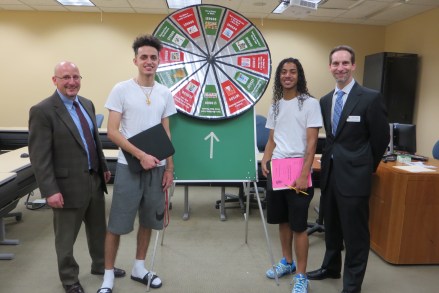
Andrew Wulf, SHS Assistant Principal for Teaching and Learning, SHS seniors Xhoralgo Gjinaj and Vistor Acosta, and Bryan Boppert, SSU AssociateDirector of the Student Navigation Center, pose with the Reality Check wheel of fortune. PHOTO: Shelley A. Sackett


Salem High School senior Daniele Alejandro hoped the financial Salem High School Reality Fair, a simulation of the financial challenges adults face, would show him how to be financially stable. After attending last Wednesday’s event, he came away with a better idea of how many obstacles he will face to achieve that goal.


“I was surprised at the cost of housing and how expensive it was. We had three people sharing an apartment and it was still difficult to pay for utilities,” he said.


Jaileny Pimentel, whose favorite subjects are calculus and statistics and who is interested in a career in business, looked forward to learning “tricks on how to save money.” Some students, like Victor Acosta, already pay all their personal bills, such as food and cell phone. Acosta recognizes he needs to learn to save on a regular basis and hoped the fair would teach him how to better manage money so he could afford to own a car.

Alej,Pimen

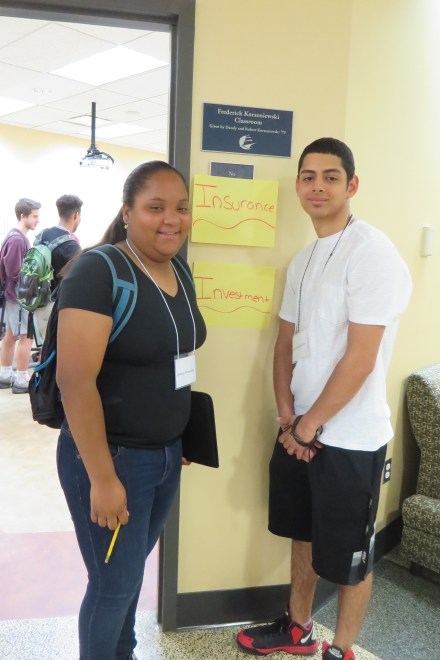
SHS seniors Jaileny Pimental (left) and Daniele Alejandro about to enter the Insurance and Investments booth.


Other students, like Xhoralgo Gjinaj, simply welcomed the opportunity to be out of the classroom on a beautiful May day. He anticipated the fair being “fun, interesting and something new.”


Since 2015, Salem Public Schools has run the SHS Reality Fair, providing graduating seniors with the opportunity to experience an up close and personal snapshot of what lies ahead of them as financially independent adults. The fair also supplies them with some of the tools they will need to tackle the many obstacles they will encounter along the way.


“We are very excited to be partnering with Salem State University (SSU), Salem Five Bank and Cabot Wealth Management. Everyone is committed to making sure our seniors leave high school understanding how to manage money,” said Andrew Wulf, Assistant Principal for Teaching and Learning at Salem High School.


The Reality Fair planning team included Mikki Willson from Cabot Wealth Management; Ginny Leblanc, who teaches at Salem High School and handled most of the event coordination; and Adria Leach and Bryan Boppert from SSU. Bertolon School of Business at Salem State University hosted the event.


Each student received an individualized packet upon arrival with their name, occupation, and a summary of their hypothetical financial life at age 25, including net income after all taxes are deducted from their salary. Armed with that figure, they visited 16 booths to fill in the blanks on how to survive on that amount of money while also managing student loan debt and saving some money every month. Adult volunteers from the business, non-profit and public sectors staffed the booths, located in classrooms throughout the building.


At the end of the three-and-one-half hour fair, each student came away with a realistic monthly budget and the skills necessary to build one for themselves in the future.


Among the booths were: Career Counseling, Charity, Clothing, Credit/Lending, Credit Counseling, Education, Food, Luxury, Furniture, Housing, Insurance, Investment, Retirement, Savings and Transportation. In the Reality Check booth, a giant wheel similar to the “Wheel of Fortune” greeted visitors. Instead of winning vowels, however, a spin of this wheel yielded those little twists and turns life can unpredictably throw at you. Landing on green meant unexpected gains; red signified a loss.


For example, the green slots included a $100 birthday present from your parents or a part time job that yielded $250 a month. Red could mean an $875 expense to attend a wedding or $500 to replace a broken smartphone.


“It was really eye opening to see how the real world works,” said Alejandro, who hopes to earn an R.N. degree after graduation.


Bryan Boppert, Associate Director of the Student Navigation Center at SSU, greeted each student when they entered the lobby with a handshake and a smile. This was his first year of official involvement in the Reality Fair, but he was aware of it last year.


“Students took away the real world benefit of learning that budgeting is a skill learned through practice that requires discipline to maintain. Some students wanted fancy cars and vacations, but in the end they wound up broke,” he said, adding that the real benefit of the Reality Fair is that students can fail in a simulated way instead of trying it in the real world where they could lose their car or hurt their credit score.


His office, which counsels SSU students on borrowing responsibly, paying bills on time and managing the complex world of college, would love to replicate the Salem High School Reality Fair for their own students. “I would go so far as to say that the state should mandate financial literacy for all students because it has such a positive effect,” Boppert said.


Wulf has received positive feedback from the volunteers and students, who mentioned that the fair gave them a nice dose of reality regarding the complexities of managing their money. He believes that having volunteers from different companies and organizations was key to making the experience more authentic for the students.


“We have yet to hear from a student that the fair was not worthwhile,” he said with pride.

For Two Local Synagogues, Inclusion Is a Priority


Inclusion

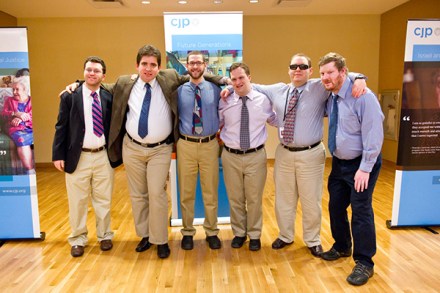
Transition to Work graduates.


Congregation Shirat Hayam (CSH) in Swampscott and Temple Sinai in Marblehead were among the dozens of synagogues that applied for Ruderman Synagogue Inclusion Project (RISP) grants in 2016. They both were selected and on May 23, they will be among the nine 2017 Cohort of RISP Congregational Partners welcomed and recognized at the annual CJP “Celebrating Inclusion” event.


“We are very excited to be working with two synagogues on the North Shore this year and are very interested in regional collaboration,” said Molly Silver, who manages the partnership between the CJP and RISP. “Being inclusive is a sacred and holy imperative of Jews and this project helps synagogues realize their own unique vision of inclusion.”


For over a decade, the Ruderman Family Foundation philanthropic mission has emphasized disability advocacy and inclusion. Its newest initiative, RISP, awards $5,000 grants to synagogues in the Greater Boston and North Shore communities to help fund programs that ensure that all people, including those with profound disabilities, are able to participate in congregational activities.


RISP started as a pilot program in 2013 with just three Boston synagogues.


Sharon Shapiro is the daughter of founder Morton E. Ruderman and a Ruderman Family Foundation trustee. As Community Liaison, she is in charge of all projects in the greater Boston and North Shore areas, including RISP.


“There is a group of people who are not coming to synagogue because they feel there’s nothing there for them,” she said. “RISP raises awareness for inclusion in general, but specifically for people with disabilities because that is the focus of our foundation.”


Silver was particularly struck by Temple Sinai’s and CSH’s strategic and thoughtful Inclusion Action Plans and ambitious goals. “What stood out about their applications was a deep and profound desire among both communities to be a “kehillah k’dosha”, a holy community that strives to welcome everyone who walks through their doors.


Rabbi Michael Ragozin hopes CSH will become fully inclusive of children with disabilities and their families. “It’s heartbreaking to hear the stories of rejection that families, seeking to raise their children in a Jewish community, families whose children will thrive in a Torah environment, have experienced,” he said.


Beyond the letter of the grant, he also hopes CSH will become even more inclusive of interfaith families, the LGBTQ community, households with varied incomes, and individuals experiencing mental health issues.


“Inclusion is a clarion call to honor the uniqueness of each one of us,” he said.

Temple Sinai’s Rabbi David Cohen-Henriquez agrees. “To be able to reach and kiss the mezuzah, to be able to drink water or go to the restroom, to have access to the bimah and the Torah, to be able to read and hear the services are things we might take for granted,” he said, noting many others in the community might not be as fortunate.


Both synagogues have formed Inclusion Committees with ambitious and concrete goals and plans for the coming year. Amanda Clayman and Michele Tamaren co-chair CSH’s 14-member “Shir Lanu: One Song – Every Voice” committee. Deborah Shelkan Remis chairs Temple Sinai’s nine-member committee.


Remis pointed to the network already operating for congregants who need rides or meals, have hearing assisted devices or need large print siddurim. “This is just the beginning,” she said.


AT CSH, Hebrew School director Janice Knight leads Torah study focused on inclusion as a Jewish value and has invited trainers to work with staff and teens through “Gateways: Access to Jewish Education”. CSH greeters have received training on the use of inclusive language. An accessibility handout itemizes available inclusion support.


“We believe inclusion is holy, just and divine. Everyone is welcome and must feel welcome at Shirat Hayam,” Clayman said.


Ruderman trustee Shapiro remembers about five or six years ago when someone from CSH with an adult son with disabilities was trying desperately to make changes at the synagogue. “I think it took this project and other families coming forward to make the wok really impactful in the synagogue top down and bottom up,” she said.


That “someone” is Marcy Yellin, whose 32-year-old son Jacob is a regular at CSH events and services. “I’m thrilled for Shirat Hayam to be included in the Ruderman Foundation grant. I have great respect for all the things the Foundation does. It’s wonderful to see that people are taking disabilities seriously and mobilizing together to support our most vulnerable, especially in the Jewish world,” she said.


She paused for a moment and then added with a smile, “we have waited a very long time for this.”