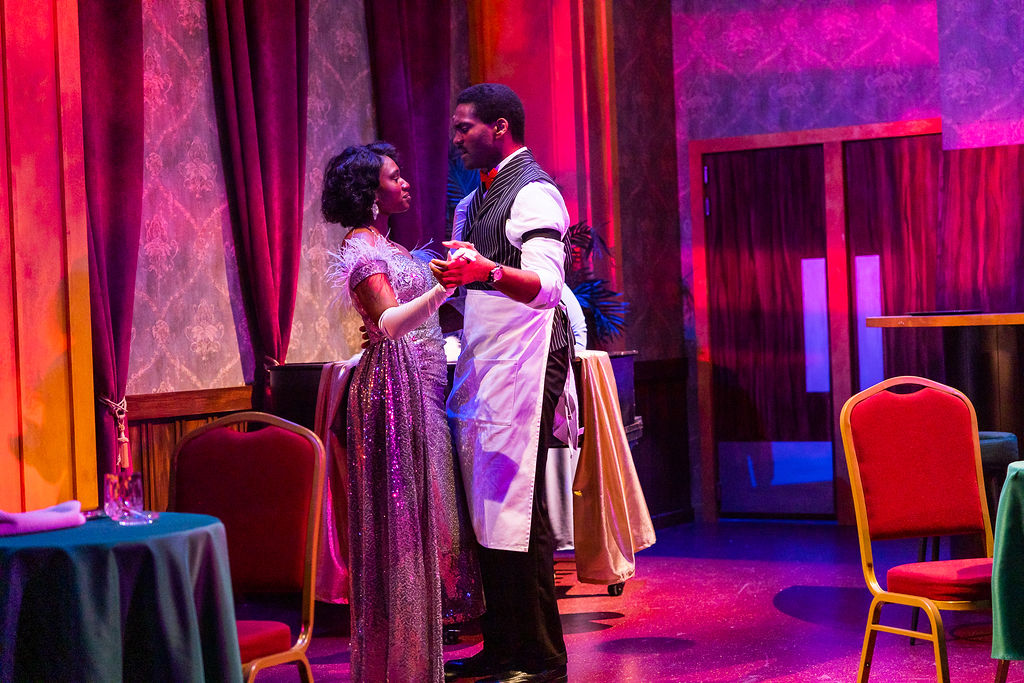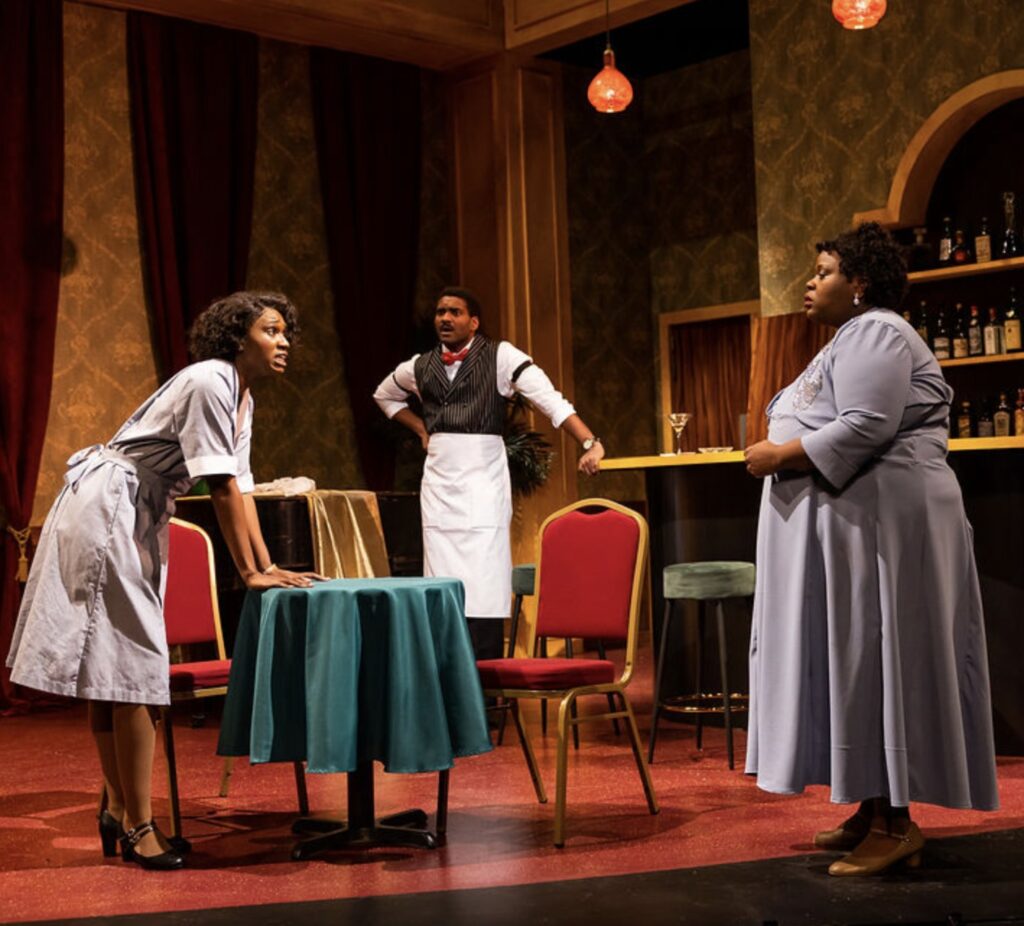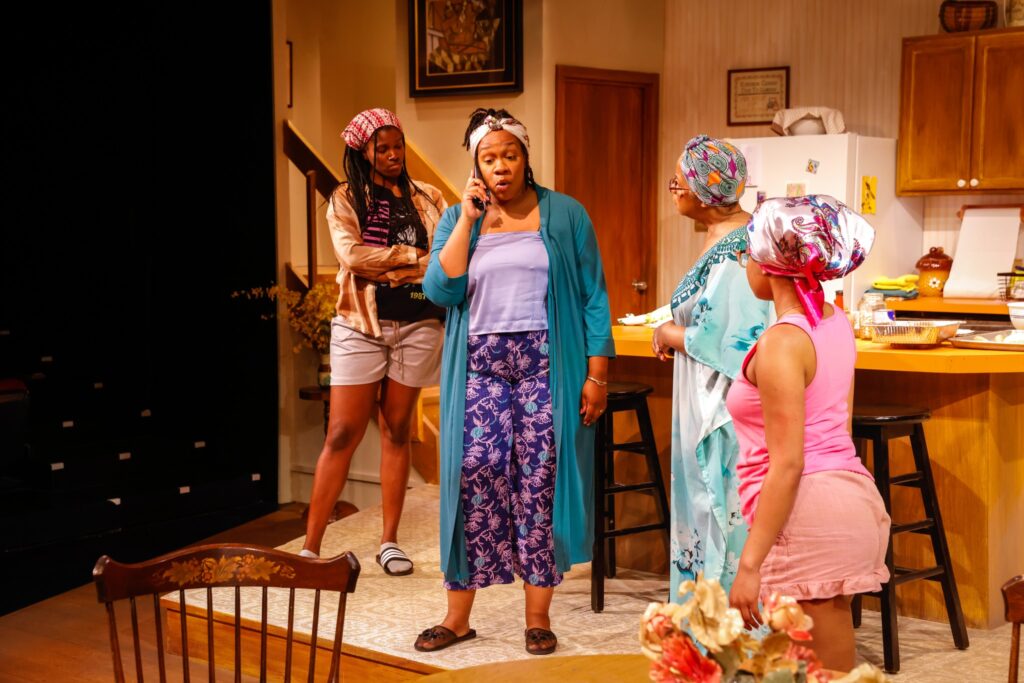
With ‘The Orchard,’ Arlekin Players Theatre’s Igor Golyak Continues To Push The Artistic Envelope 

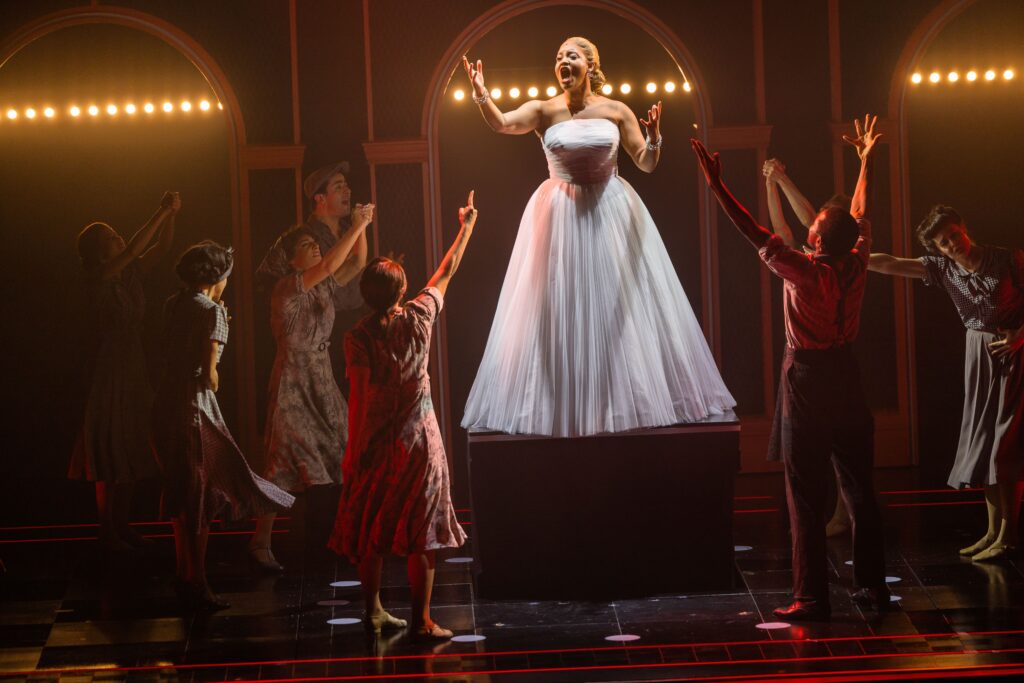
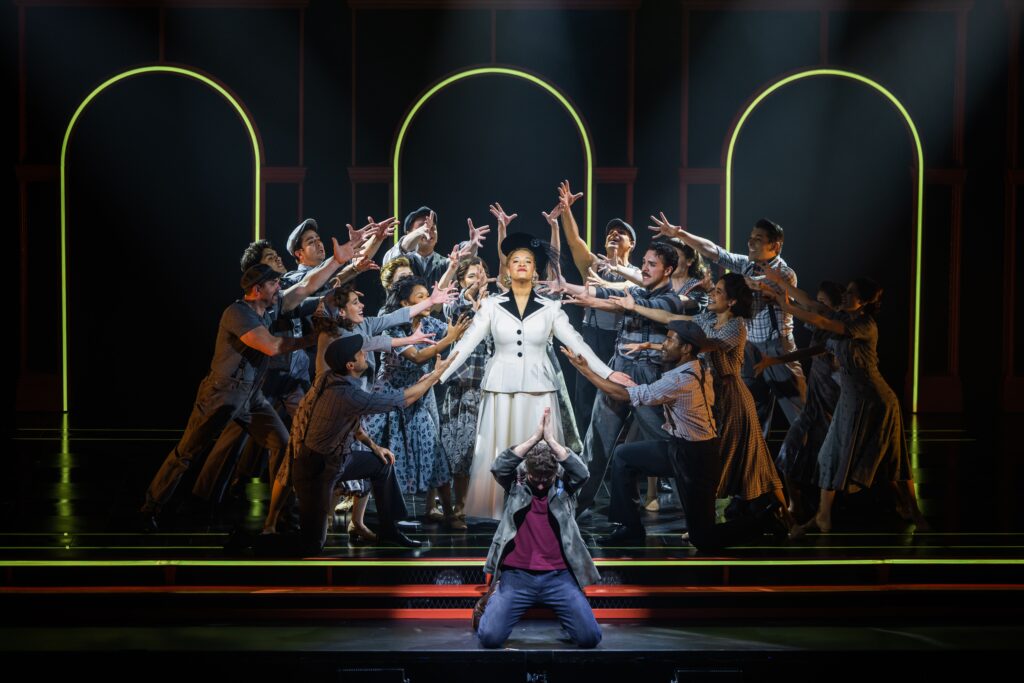
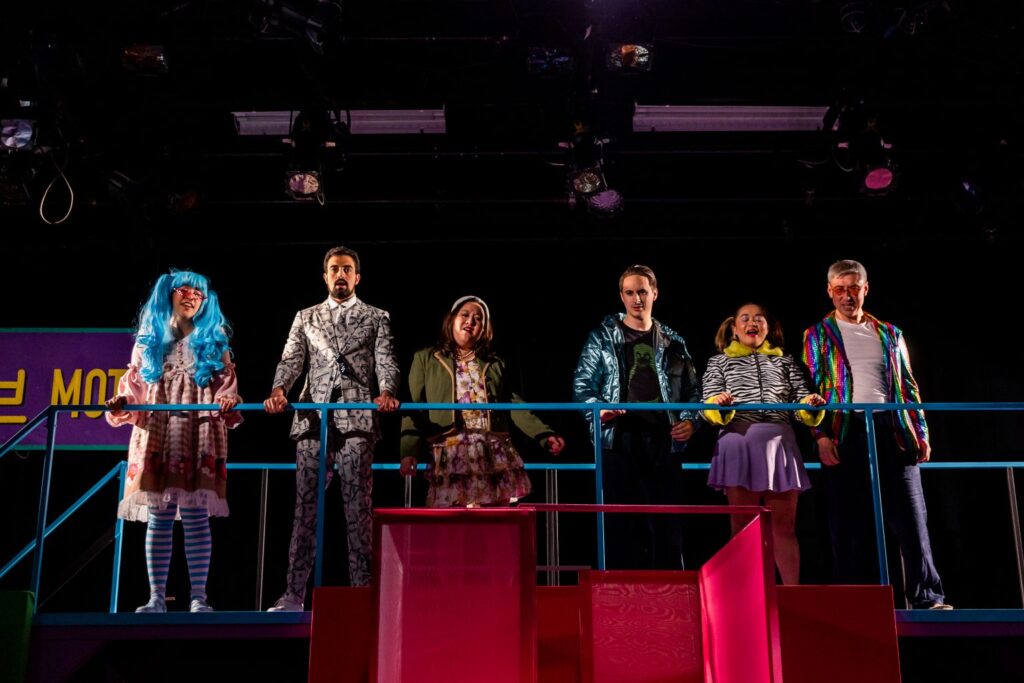
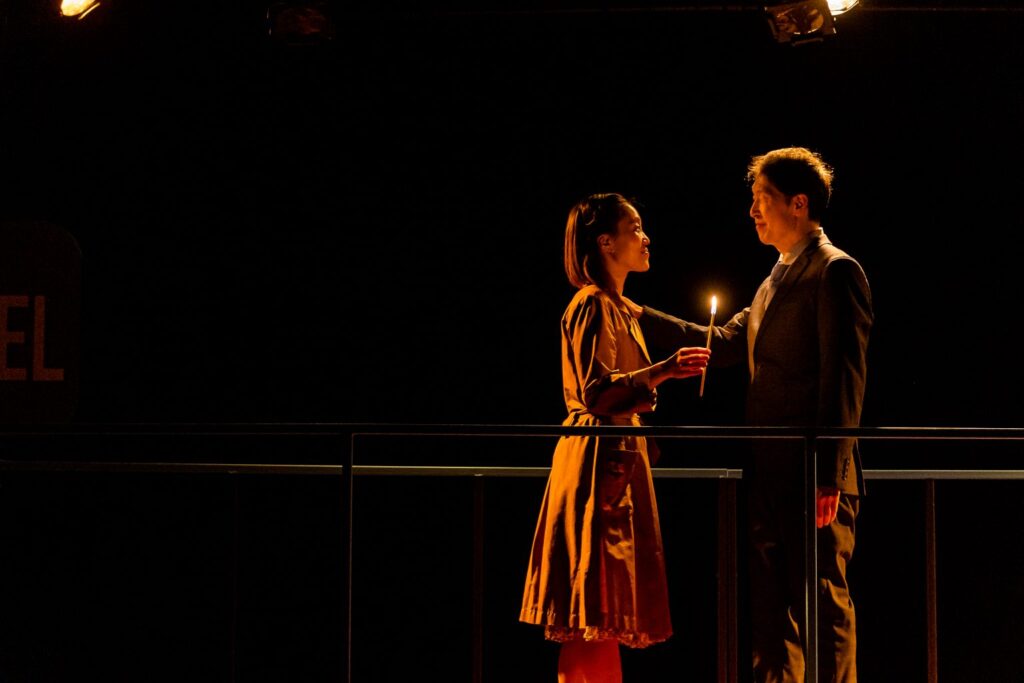
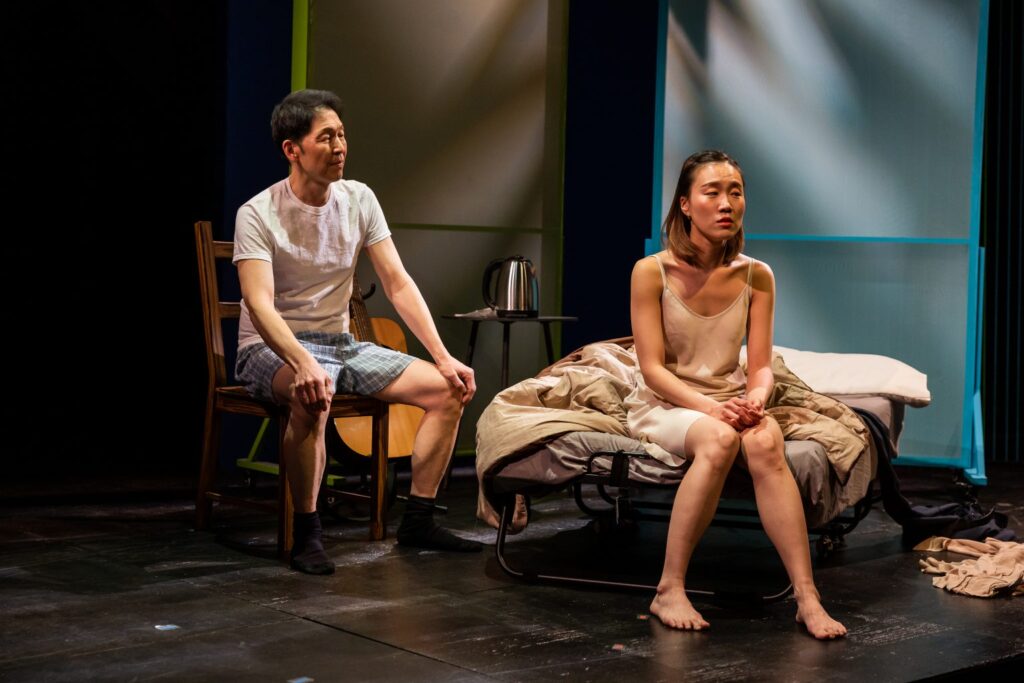
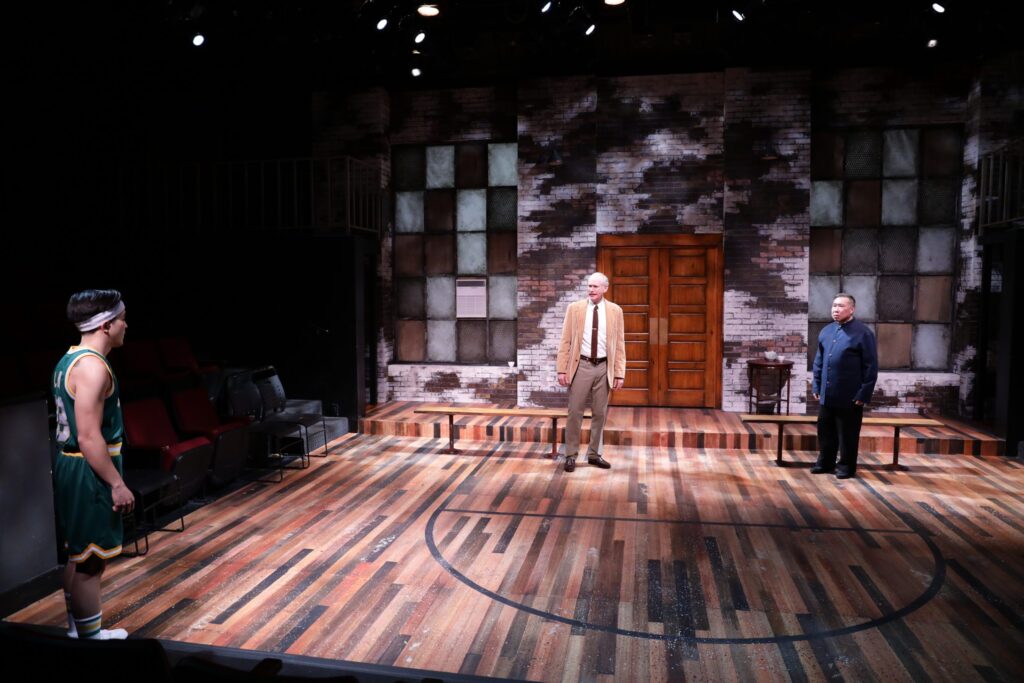
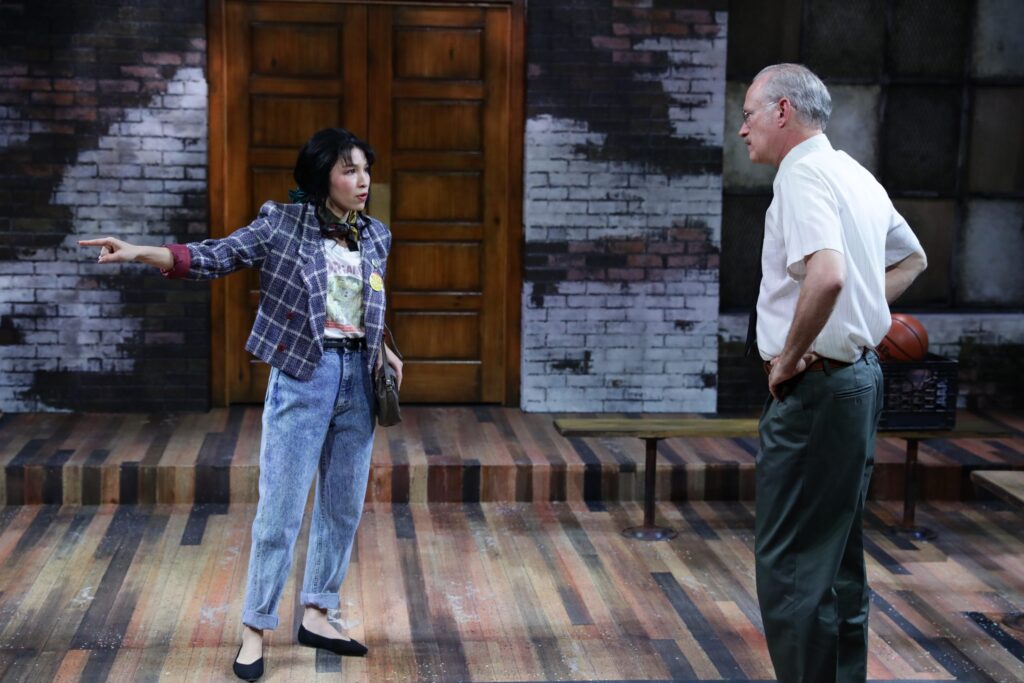
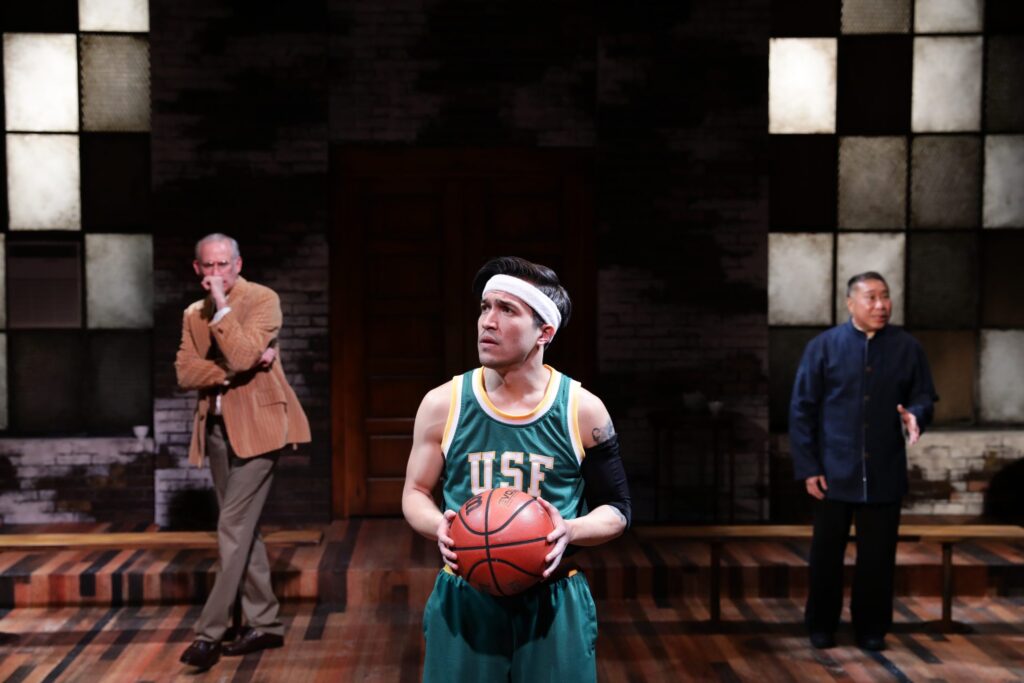
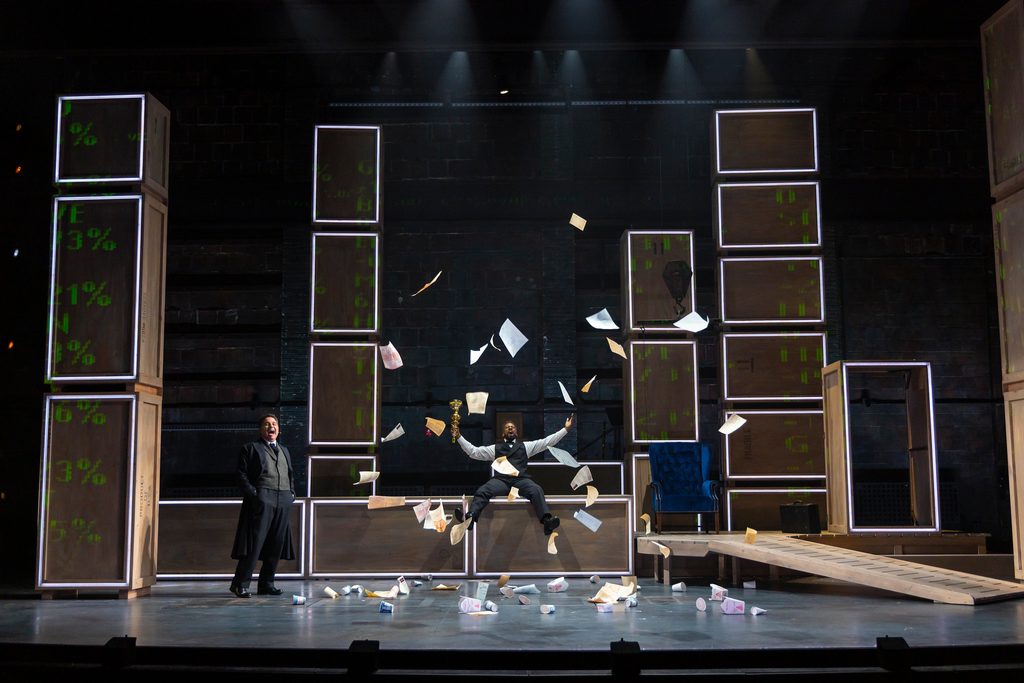
Cast of ‘The Orchard’ at Emerson Paramount Center

by Shelley A. Sackett

Anton Chekhov’s play, ‘The Cherry Orchard,’ opened at the Moscow Art Theatre on January 17, 1904, under the direction of the actor-director Konstantin Stanislavski. During rehearsals, the director rewrote Act Two, changing the play from Chekhov’s intended light and lively comedy into a tragedy. Chekhov is said to have disliked the Stanislavski production so much that he considered his play “ruined.”

One can’t help but wonder what the Russian playwright would make of ‘The Orchard,’ Igor Golyak’s creatively incomparable and technologically unparalleled reimagining of this iconic classic.

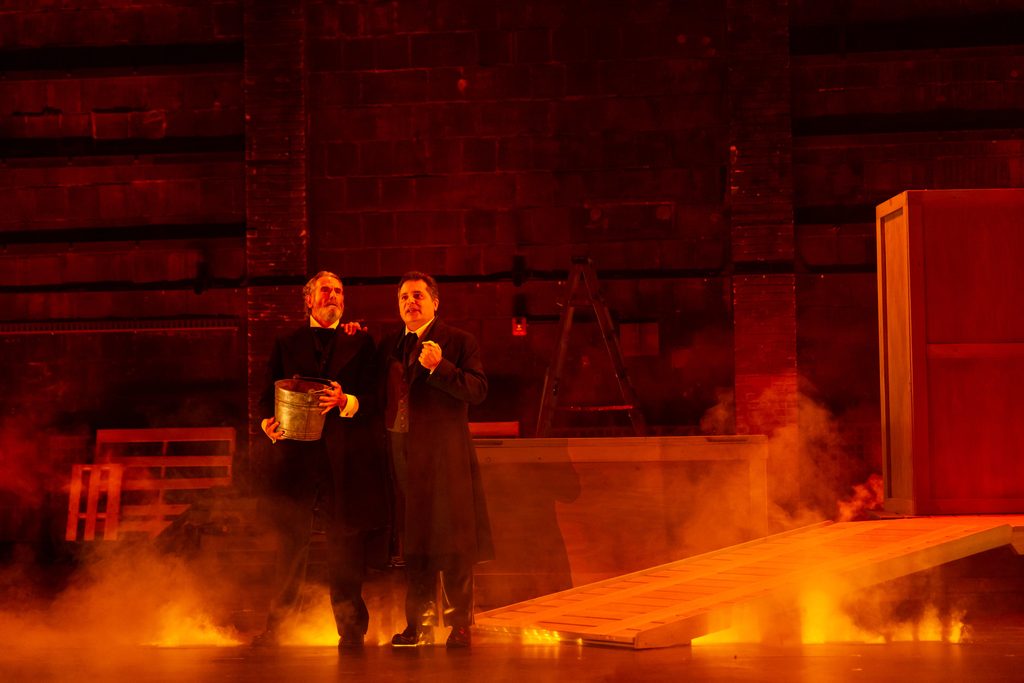
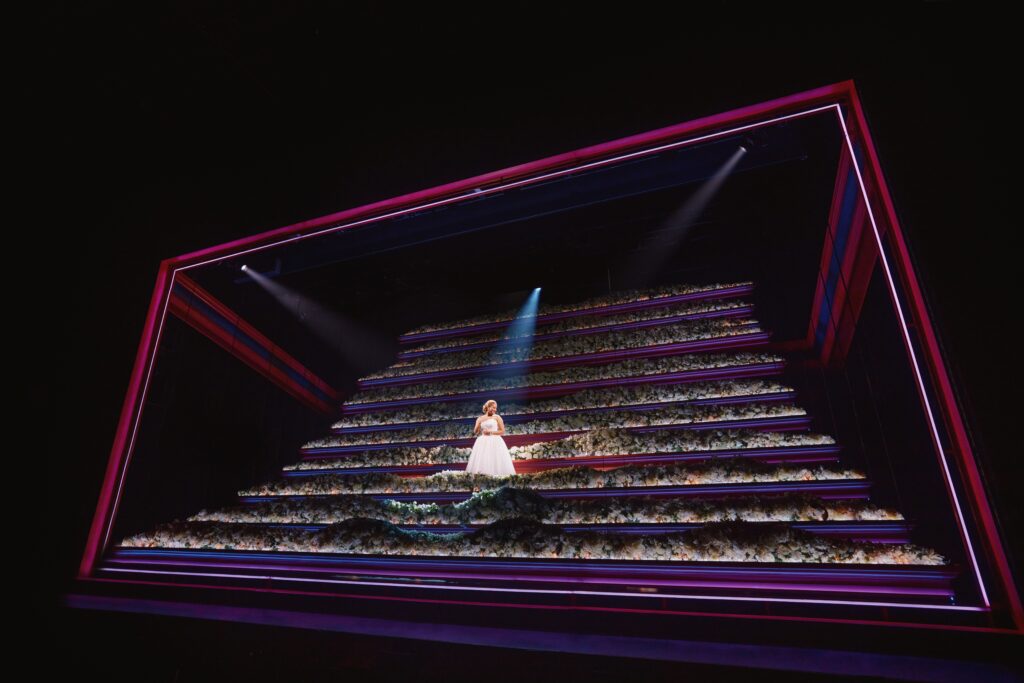
The live version (there is also a simultaneous livestream version with many bells and whistles and interactive options) takes place on a surreal, stylized stage anchored by an enormous white robot arm that is strangely animate and huggable, like the Pixar hopping desk lamp on steroids. It also has the less endearing quality of a giant dental X-ray machine or unipedal CT scan.

The stage floor is covered in fluffy piles and the entire area is flooded in a blue light that feels like a cross between a dreamy moonscape and a post-apocalyptic nightmare. Are these mounds of fallen cherry blossoms or radioactive fallout? A Holo-Gauze screen (a highly reflective and transparent projection net which supports 3D polarized projections) separates the audience from the players. Large scale projections connect live and virtual audiences with feedback loops that expand the otherworldly sense of chaos and charade.

This is not a production for literalists, purists or those unable or willing to let go of the notion of control when it comes to live theater viewing. It also helps to have a cursory familiarity with Chekhov’s ‘The Cherry Orchard’ to keep from getting totally disoriented when Golyak takes us on a chaotic journey down the rabbit hole of his inventive artistry.

There’s so much happening onstage that looking for plot threads is as frustrating as it is fruitless.

In a nutshell, the Chekhov version revolves around Madame Ranevskaya (played by the ethereally luminous Jessica Hecht), an aristocratic Russian land-owner who returns to her family estate (which includes a large and well-known cherry orchard) just before it is auctioned to pay the mortgage. Unresponsive to offers to save the estate, she allows its sale to the son of a former serf named Lopakhin (played by the prodigiously talented Nael Nacer). As they struggle with the destruction of their world as they knew it, Ranevskaya’s family leaves their home to the sound of the cherry orchard being cut down.

Chekhov intended his comedic farce to dramatize the socioeconomic forces in Russia at the turn of the 20th century, including the rise of the middle class after the abolition of serfdom in the mid-19th century, and the decline of the power of the aristocracy.

Seeing a new riff on a Russian classic, however, is hardly what packed the house on opening night.

The real reason many attended the performance was, of course, to see the extraordinary Mikhail Baryshnikov in person performing as Firs, the 87-year-old former serf turned manservant. The esteemed actor and ballet genius did not disappoint.

The opening moments of the black-clad Firs twirling dervish-like and being blown about by the wind are worth the price of admission. Baryshnikov pirouettes across the stage with breathtaking grace and ease. For the remainder of the play, he handily steals every scene he is in.

The problem is that watching him is like trying to drive at night through the cloudy lens of a cataract. While the Holo-Gauze screen adds immeasurably to the virtual production, it is an annoying impediment for those watching live, like sitting in a seat marked “obstructed view.”

Nonetheless, ‘The Orchard’ is worth seeing if for no other reason than to follow the contemporary take the extraordinary Golyak has on the ‘The Cherry Orchard.’ His production reimagines both the classic and the ways in which the theater experience itself can be reinvented.

It is also great fun. There is a mechanical dog (Robotics design is by Tom Sepe), the captivatingly whimsical performance of Darya Denisova as Charlotta, and Anna Fedorova’s set enchantingly lit by Yuki Nakase Link. Oana Botez’s costumes are added eye candy.

Having seen both the live and online versions, I must say that rather than being duplicative or fungible, they are actually complementary visions of a single experience. Neither is complete without the other and each sheds light on its counterpart.

In the online version, for example, viewers can choose the camera angles from which they want to see the action and can exit the main stage to various other virtual rooms of the old house in which the play occupies but one part. It’s as if the audience has been put in charge of its own theatrical experience.

The live version has the opposite effect. With all the projected images and splicing in of the zoom gallery shots of the online audience, we are not only aware of the play’s concomitant virtual experience; we are captives in it.

When one of the actors say, “I have this strange feeling that I’ve just landed on the Moon,” the audience nods in agreement.

Golyak, whose family fled the Ukraine’s antisemitism in the 1990s, is a global leader in the virtual theater movement. In a press release, he highlighted the play’s personal and ongoing relevance as an analogy for so many current societal ills.

“This is a story about the delicate relationships at the center of a family facing the end of the world as they know it,” Golyak said. “We are living through an unimaginable time of change and destruction with the war in Ukraine. As humans, we are perpetually losing our cherry orchards, losing our worlds. This play is about us today.”

‘The Orchard’ — Conceived and Directed by Igor Golyak, based on ‘The Cherry Orchard’ by Anton Chekhov. Anna Fedorova, Scenic Designer. Yuki Nakase Link, Lighting Designer. Oana Botez, Costume Designer. Alex Basco Koch, Projection Designer. Tei Blow, Sound Designer. Jakov Jakoulov, Composer. Tom Sepe, Robotics Designer. Presented by Groundswell Theatricals and Arlekin Players and its Zero Gravity Virtual Theater Lab, at Emerson Paramount Center, the Robert J Orchard Stage, 559 Washington St., Boston through November 13.

For tickets and information, go to: https://www.arlekinplayers.com/the-orchard/

SpeakEasy’s ‘English’ Explores The Tipping Point Between Identity and Heritage

Cast of ‘English’ at Speakeasy Stage. Photos by Nile Scott Studios

by Shelley A. Sackett

SpeakEasy Stage’s production of Sanaz Toossi’s ‘English’ starts out simply enough. Four Iranian students are studying in Karaj for the Test of English as a Foreign Language Exam (TOEFL) , an English proficiency exam they must pass if they hope to pursue university study abroad, immigration and more. Their teacher, Marjan (a first-rate Deniz Khateri), rules her classroom with an iron fist. They will speak only English during class, and when anyone slips into Farsi, she posts a strike against them on her giant blackboard, practically snarling with scorn.

This is language immersion that is the equivalent of throwing a baby into the deep end to teach them to swim. Yet, her motive, at least in the beginning, seems pure and altruistic. She studied in Manchester, England, an experience that changed her life for the better and one she speaks of with near religious veneration. She believes that she and she alone can help her flock find this same path that opened her world, and she takes her role as their shepherd with the seriousness and zeal of a missionary.

[An effective and engaging scripted touch is that when the actors speak their native Farsi, they do so in fluent conversational English. When they practice English, their speech is more staccato, with a heavily accented cadence of a beginning foreign language student.]

Marjan insists her students leave their Iranian identities outside her classroom door. “English Only!” is underlined twice on the blackboard. The implication is clear — Farsi and all things Iranian are baggage that need to be shed if one is to “make it” in the global arena. “Speaking English is one of the greatest things two people can do together,” she coos, and she means it with all her being.

Her students don’t always agree. Roya (the splendid Layla Modirzadeh) needs to learn English so she can join her son and his family (including a granddaughter whose English name Roya can’t pronounce) in Canada, where they have emigrated and assimilated. She is the oldest of the students and the one with the longest and deepest roots in Iran.

When she learns that Marjan happily gave up her identity in England, letting others call her “Mary” for their convenience and ease, she chafes. People should not have to give up their names to learn a language, she says. “Our mothers get to name us. Not foreigners.”

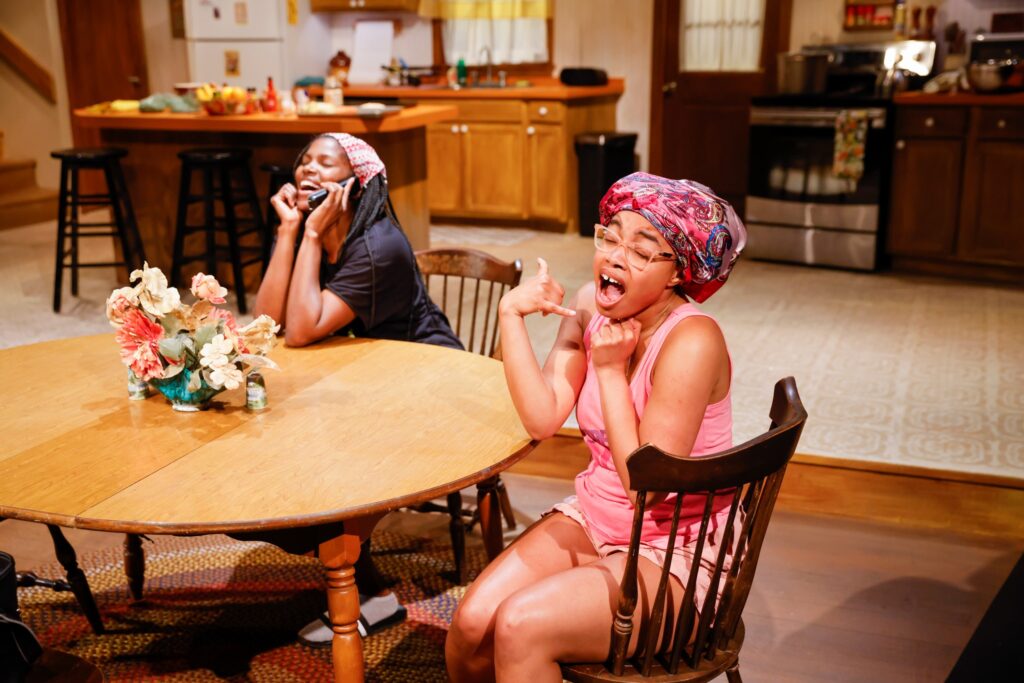
Zaven Ovian, Deniz Khateri, Josephine Moshiri Elwood

Elham (compellingly played by the feisty Josephine Moshiri Elwood) has taken the TOEFL before and failed. More than the others, she needs to pass this test to pursue her goal of studying gastroenterology in Australia. In addition to her thick Farsi accent and lack of facility with languages,  she faces two other barriers: she despises English and how her voice sounds when she speaks it, and she can’t stand Marjan and her autocratic ways. That Marjan deliberately humiliates and picks on her adds fuel to her hot-blooded flame.

Goli (Lily Gilan James, a senior at Boston Conservatory at Berklee) is a compliant and reticent 18-year-old who happily does as she is told. She is the least interesting, with no axe to grind and nothing to prove. She just wants to pass the exam so she can go to a university outside Iran.

On the other hand, 29-year-old Omid (Zaven Ovian) is an enigma. His English is better than the teacher’s, and he comes up with complex and specific vocabulary, like “windbreaker” during a word game. He and Marjan bond inside and outside class over their seeming shared love of all things foreign, but Omid has a secret he keeps tight to his vest until the play’s end. Ovian splendidly plays out the mystery.

Director Melory Mirashrafi, a first generation Iranian-American, makes the most of Janie E. Howland’s well-designed set and a script that at times moves slowly.

Playwright Sanaz Toossi (who won this year’s Lucille Lortel Award for “English”) takes her petri dish of varied and complex characters and, over 100 intermissionless minutes, seamlessly interweaves engaging theater with an existential examination of identity, heritage, assimilation and alienation.

She poses many important and timely questions. Is there is a tipping point at which the loss of cultural identity outweighs the materials of life in one’s non-native land? Is voluntary immigration something to be encouraged or grieved? What about the generations, like Roya’s granddaughter, who will grow up without hearing Farsi or understanding her cultural heritage?

Is it worth leaving your homeland voluntarily, Toossi questions, to forever be branded a foreigner with an accent, the “other” who will always be asked, “where are you from?” [Toossi’s mother immigrated to the U.S. from Iran in the mid-1980’s following the Iranian Revolution].

When Elham returns to the classroom after taking (and passing with 99%) the TOEFL, it is not to gloat or thank Marjan, but to offer by example a lesson of how you can gain English language proficiency without losing your Iranian soul.

“You are Iranian but your English is a lot of things. It wants to be American and some of the time British and now it does not know what it is. When I speak English, I know I will always be a stranger,” Elham tells Marjan. “I hear my home. What do you hear?”

English’ –Sanaz Toossi, Playwright. Melory Mirashrafi, Director. Janie E. Howland, Scenic Designer. Nina Vartanian, Costume Designer. Amanda E. Fallon, Lighting Designer. Ash, Sound Designer. Emme Shaw, Props Designer. Presented by SpeakEasy Stage at the Roberts Studio Theatre, Calderwood Pavilion, Boston Center for the Arts, 527 Tremont St. Boston, through November 19, 2022.

For tickets and information, go to: https://www.speakeasystage.com/

Bill Irwin Is Brilliant in ArtsEmerson’s Not-to-Be-Missed “On Beckett.”

Bill Irwin in “On Beckett” at ArtsEmerson

‘On Beckett’ — Conceived and Performed by Bill Irwin. Produced by Octopus Theatricals; Scenic Design by Charles Corcoran; Costume Consultation by Martha Hally; Lighting Design by Michael Gottlieb; Sound Design by M. Florian Staab. Presented by Arts Emerson at the Emerson Paramount Center, 559 Washington St., Boston, MA through October 30.

by Shelley A. Sackett

Bill Irwin is a legendary actor, writer, director and clown artist. The Tony award-winner is as known for serious theatrical roles on Broadway as he is for his beloved Mr. Noodle on television’s “Elmo’s World.”

With “On Beckett,” his solo exploration of his decades long relationship with the Irish playwright, Samuel Beckett, Irwin takes on yet another role — that of compassionate guide through the sticky wickets of Beckett’s intimidating and often baffling prose and plays.“Here is what I am proposing to you this evening,” he tells the audience with an intimacy and earnestness that has them in the palm of his hand from the get-go. “I’m not a scholar or a biographer,” he says almost apologetically, implying that those who expect a pedantic lecture from the head will be disappointed. “I am an actor and a clown and what I have is an actor’s knowledge” of Beckett, he says. And what a trove of treasures that is.

What Irwin brings to the table and generously shares is of far greater value and infinitely more enjoyable than a straight out lecture. He discloses what it has been like for him to experience Beckett’s language from the inside out, as one who has been entrusted with the sacred task of memorizing the writer’s words, processing them through his Bill Irwin persona, and then speaking them to a contemporary audience as he imagines Beckett himself intended.

For an absorbing, enlightening and entertaining 90 minutes, Irwin shines his inner light on four works by Beckett: Texts for Nothing, Watt, The Unnamable and Waiting for Godot. He peppers his readings/performances with anecdotes and observations, revealing what it feels like as an actor and as a human being to mouth the words of the great existentialist and arguably the greatest playwright who ever penned a line of dialogue.

His approach blends the physical (often hilarious) and emotional as he digs deep into Beckett’s “character energy,” managing to keep the evening challenging enough for aficionados of the work and light enough for novices. “These are like people I’ve known. Like my own mind — me, myself and I in conversation,” he says, bringing Beckett’s often lofty language down to earth.

Which is not to say he doesn’t pose heady questions meant to expand our thinking about Beckett, ourselves and the world we live in. “Was Beckett a writer of the body or mind?” he asks. Midway through the enjoyable and impactful evening, Irwin addresses the elephant in the room. “Is this a portrait of existence?” he asks of a passage in The Unnameable. “What is it?”

eckett

He then gives an easy-to-digest short treatise on existentialism, pithy and humorous, yet also the product of a deep thinker who has spent years pondering these questions both on and off stage. It is no surprise to learn he has won Fulbright, Guggenheim, National Endowment for the Arts and MacArthur Fellowships. His explanations and analyses are brilliant. “These are the precise but undefinable questions that keep us awake,” he says before adding,” and put us to sleep.”

As expected of a lauded actor and director, his timing and punctuation is perfect. But Irwin is also a clown, and when he grabs his bowler and baggy pants, the evening shifts gears. Although Beckett’s words carry no less weight and Irwin’s performance embodies that gravitas, it is now clothed in the shimmering gossamer of physical comedy, taking the sting out of some of the words by allowing us to laugh at them and, by extension, at ourselves. Sure, existence is tough and death is even tougher, but let’s not forget that we were also created to laugh, Irwin reminds us.

Irwin appeared with Steve Martin and Robin Williams in the Lincoln Center Off-Broadway production of Waiting for Godot in 1988, in the role of Lucky. Lucky’s only lines consist of a famous 500-word-long monologue, an ironic element for Irwin, since much of his clown-based stage work was silent.

He treats us to a remarkable rendition and, at the end of the show, frankly admits that even after all these years, some of Beckett’s language remains beyond his grasp. “I keep discovering new things in the words,” he says. “I don’t know why. I don’t know how an airplane stays up in the air either, but I still want to climb onboard.”

Act NOW and you might just be lucky enough to catch one of the last Boston performances. Whether you’re encountering the Nobel Prize winner’s writing for the first time, or building on a body of Beckett knowledge, this dynamic showcase is not to be missed.

A Magnificent ‘Joe Turner’s Come and Gone’ Heralds the Huntington’s Jubilant Homecoming 

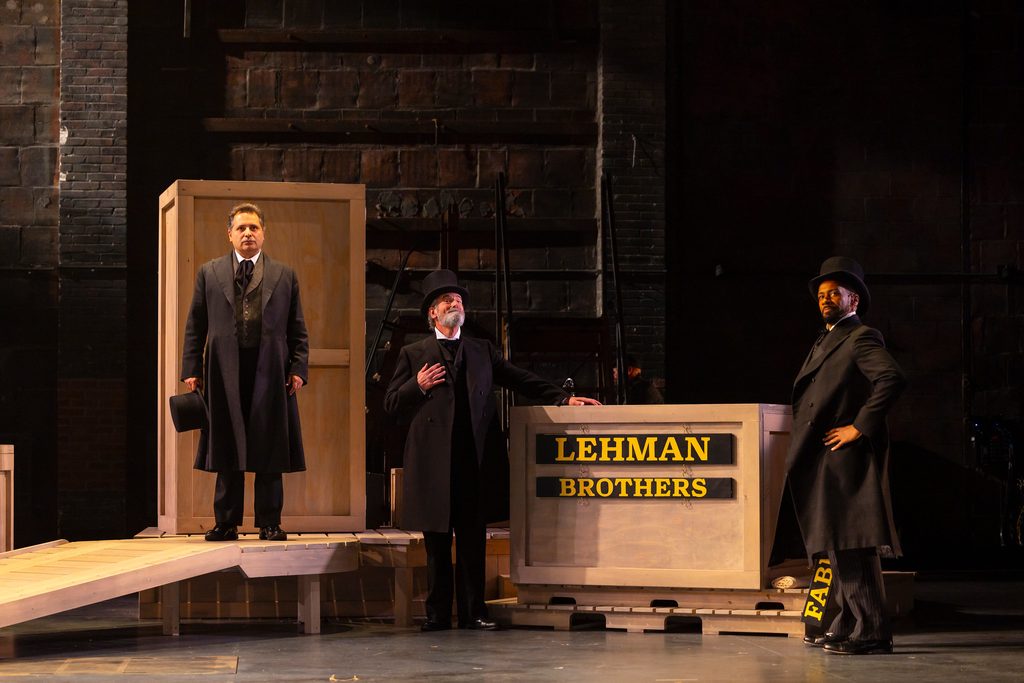
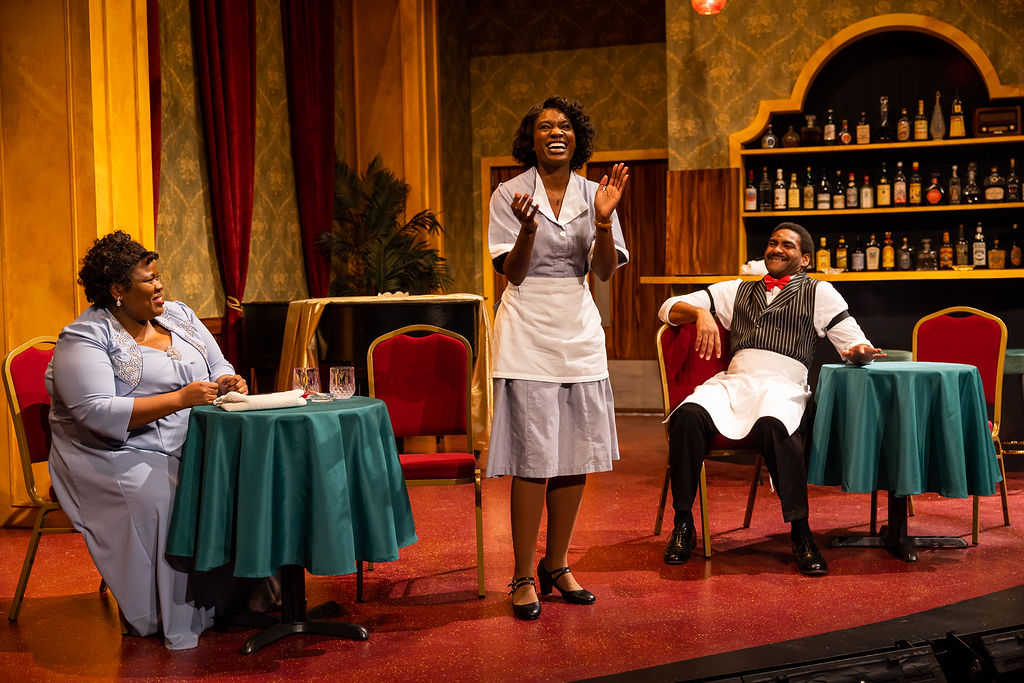
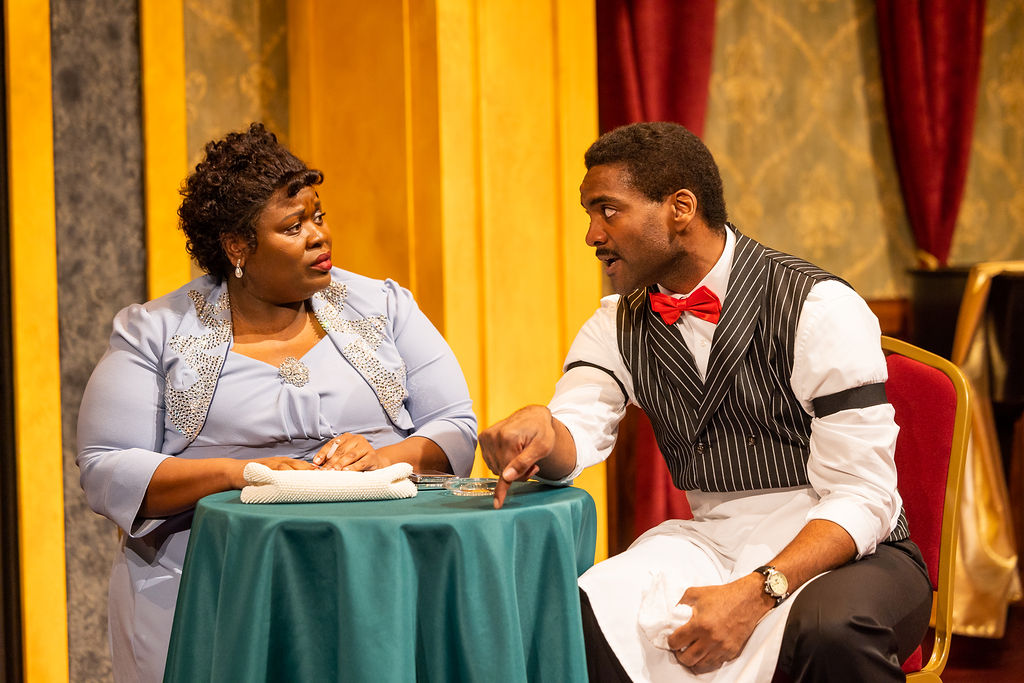
Patrese D. McClain and James Ricardo Milord (foreground) and cast in ‘Joe Turner’s Come and Gone’ at The Huntington.

‘August Wilson’s Joe Turner’s Come and Gone’ by August Wilson. Directed by Lili-Anne Brown; Arnel Sancianco, Scenic Design; Samantha C. Jones, Costume Design; Jason Lynch, Lighting Design; Aubrey Dube, Sound Design. Presented by The Huntington Theatre through November 13.

by Shelley A. Sackett

What a pleasure it is to have the Huntington Theatre Company back. With its sleek Narragansett Green walls, gold domed ceiling and cherry red extra legroom seats, an always pleasurable theatrical experience is now also one full of creature comforts. Even more stunning, however, is the magnificent production of August Wilson’s Joe Turner’s Come and Gone, with which the Huntington christened its reopening. If Joe Turner’s footprints lingered long after he had gone, it’s because Wilson’s unforgettable presence (and titular title as the Huntington’s creative patron saint) enveloped the stage.

Other than sporadic trouble understanding and hearing some of the actors, the production is flawless. Arnel Sancianco’s set captures the pressed oak Victorian glory of an architectural era resplendent in its attention to eye candy detail, including a grand staircase and welcoming dining room table. A crystal clear sound system does justice to Aubrey Dube’s acoustic period selections (always a pleasure to hear Mississippi John Hurt sounding authentic but not like he’s singing underwater). And Samantha C. Jones’s costumes (especially the women’s hats) and Jason Lynch’s lighting (which manages to track the sun’s movement) are icing on the cake.

And that’s before we get to the cast’s universally brilliant acting and Lili-Anne Brown’s spot-on, outstanding direction.

First, though, a little historical background is in order. The title, Joe Turner’s Come and Gone, refers to Joe Turney, the brother of former Tennessee Governor Peter Turney. In the late 19th Century, Joe Turney was responsible for transporting black prisoners from Memphis to the Tennessee State Penitentiary, located in Nashville. Instead, Turney abused his role by running a network of “convict leasing.” He was also known for swooping down on innocent freed blacks and illegally enslaving them for seven years, often to work on his own farm. When men turned up missing in black communities, word quickly spread that “Joe Turner’s come and gone.”

Against this harsh backdrop of the Jim Crow lawless post-Civil War America, Wilson introduces us to his cast of vivid characters.

It’s 1911 and Seth and Bertha Holly run a “respectable” boardinghouse in Pittsburgh. Seth (played with pitch perfect comedic timing by Maurice Emmanuel Parent), its owner, inherited the property and business from his parents. He was born to free African-American parents in the North and is a real killjoy. Set in his ways, he is happy to assimilate to the degree he is allowed, and is economically shrewd and heartlessly capitalistic.

Bertha (the sublime Shannon Lamb), his wife of 25 years, is a loving mother to her boardinghouse family. Although she knows her place, she manages to manipulate Seth’s decision-making in subtle yet effective ways. Love and laughter get her by. She embraces Northern ways (including Christianity), but her heart and spirit remain tied to her African ancestors.

Bynum Walker, a 60ish “conjuror” who practices healing arts with herbs, incense and song, is Seth’s foil. As portrayed by Robert Cornelius, Bynum is both as large as a giant and as gentle as a lamb. He is as grounded in his roots and heritage as Seth is in his denial of them. In touch with his inner soul and identity, he offers to help those lost to themselves and others with his powers to “bind.” Bynum is part shaman, philosopher and therapist — and all compassion. He has lived at the Holly’s for a while and moves about as comfortably as if he were a blood relation.  

Jeremy Furlow (an exuberant Stewart Evan Smith), 25, is trying to find his identity as a member of the younger generation of newly liberated slaves. He is footloose and itching to travel the nation with his guitar and fancy green suit. In the meantime, he works anywhere that will hire him building whatever needs building. He naively chafes at the racial injustice he encounters and will accept the company of any woman who accepts his as he tries to find his perfect mate.

Robert Cornelius, Shannon Lamb, Maurice Emmanuel Parent and Stewart Evan Smith

The only white character in the play, Rutherford Selig (a suitably sycophantic and tone deaf Lewis D. Wheeler) is a peddler known as the “people finder.” He was also a fugitive slave finder, like his father (his grandfather ran the first ships, we’re told, that captured Africans and brought them to America to become slaves). He acts as middleman for Seth’s hand-crafted dustpans and keeps a tight record of everyone he meets on his travels.

Mattie Campbell (an earnest Al-nisa Petty), a young woman who finds Seth’s when she seeks Bynum’s help in binding her to her missing boyfriend, is disappointed in the life that has left her a bereaved mother of two dead babies and a jilted girlfriend. By contrast, the last thing Molly Cunningham (the slinky Dela Meskienyar), another tenant in her mid-20s, wants is to be bound to anyone or anything — except maybe her mama. She is independent, spoiled and totally aware of the power her striking looks and wardrobe afford her.

Into this ersatz family wanders Herald Loomis (brilliantly embodied by James Milford), a former deacon and odd man who dons an overcoat in August, and his skinny 11-year-old daughter Zonia (Gray Flaherty at last Sunday’s matinée). He has the skittish mannerisms of one suffering from post-traumatic stress disorder. He has been travelling from town to town, looking for his wife, Martha Loomis. The last time he saw her was 11 years ago, right before Joe Turner captured and enslaved him for seven years. By the time he was freed, Martha had fled. He’s been on the road looking for her for four years, Zonia in tow.

Wilson is a maestro at creating masterpieces that illustrate the Black human condition in America. Armed with this rich palette of characters and his magic wand of a brush, he paints a picture rich in both human emotion and historical context. He doesn’t polemicize, castigate or lecture, yet he makes his points about racial injustice, Black diaspora, migration and the irredeemable evil and gall of kidnapping and slavery. His wholly fleshed out characters let us through the keyholes of their lives and by the end of the play, we have connected the dots.

The specific plot twists and turns are too numerous (and contain too many spoilers) to detail here, and Wilson is more about the journey than the destination anyhow. By the end of the almost three hour (with intermission) play, the audience has experienced the pain and promise of the post-slavery years and the power of community to heal and revive a broken and lost soul.

Everyone at the boardinghouse is searching for their missing piece. Unspeakable horrors and disruptions untethered men like Herald Loomis, who has lost his sense of who he is because he cannot remember who he was before he was enslaved. For men like Seth, who has only known life in the North, slavery and its consequences are more hearsay than heartache. He’s more concerned with keeping what’s his in the face of the increased competition post-emancipation northern migration has wrought. He knows the system is, and always will be, rigged against him. His mission is to squeeze through the loopholes unnoticed and differentiate himself from these newly arrived migrants.

Seth is also a pragmatic man who doesn’t feel the need to seek meaning or purpose by way of spirituality or a return to his African roots. Christianity and churchgoing is as much about fitting in as it is about religion.  Of Bynum’s shaman-like behavior, he says, “All that old mumbo jumbo nonsense. I don’t know why I put up with it.”

Bynum, on the other hand, is at peace with himself and the world as he finds it. He believes himself to be part of a “grand design,” a belief that ultimately allows him to “swallow any adversity.” For Bynum, his spirituality and helping others re-find themselves become a way of making sense and finding his own purpose in an unpredictable world.

Straddling the two is Bertha, who is as down to earth and practical as Seth but takes comfort in Bynum’s old forms of African healing and mystical practices. One of the highlights of the play is the joyful “Juba” dance around the kitchen table where all but Herald participate and lose themselves in a moment of communal ecstasy. (The Juba dance was originally brought by Kongo slaves to Charleston, S.C.).

By the play’s end, Loomis (and several others) have found their inner song and are on the path to exploring their identity, and the audience standing has found itself in thunderous applause. Wilson’s words and spirit spin a magic that will resonate long after the last cheer has faded. Highly recommended.

For tickets and information, go to: https://www.huntingtontheatre.org/

Dorset Theatre Festival Closes The 2022 Season in Triumph with Its Remarkable World Première of “Thirst”

 David Mason and Kathy McCafferty in THIRST at the Dorset Theatre Festival. Photos by Joey Moro

by Shelley A. Sackett

Arriving early for “Thirst,” playwright Ronán Noone’s dazzling new play, is a stroke of good ole Irish luck. A crisp sound system pumps toe-tapping traditional pub music, setting a jig-worthy mood. Functional period lamps bathe the livable kitchen set in warmth, creating a cozy tone for arguably the best theatrical experience of the 2022 summer season.

By the time the Irish lilted announcements herald the play’s start, the audience has been transported to another time and another place.

And what a time and place it is.

Noone sets “Thirst” in the kitchen of the Tyrone family’s seaside Connecticut home on the August day in 1912 when Eugene O’Neill’s classic tragedy, “A Long Day’s Journey Into Night” takes place. [Although familiarity with that play is not a prerequisite to “getting” ‘Thirst,’ Noone sprinkles his script with delicious breadcrumbs for those who have tasted the original to follow.]

While the Tyrones spend the day destroying themselves and each other offstage in their toile-wallpapered dining room, their cook, kitchen maid and chauffer spend theirs in the kitchen, sitting around the table together, enjoying their privacy and relative freedom while performing their demeaning menial duties. Their individual posts may have led them to this quasi-family-by-default situation, but they are genuine in their interactions. They bicker, they laugh, they tease and they worry. But they do it together, and it comes from their hearts. They genuinely need and enjoy each other’s company.

Each brings a different, but similar, back story to the mix.

Bridget Conroy emigrated from Ireland 16 years ago to become the Tyrone’s cook. Her outer shell is brittle and cynical, but she saves her harshest criticism and reproach for herself, especially for her closeted alcoholism. Yet, the only time she emerges from her carapace is when she’s juiced enough to black out the shame and regrets that poison her every sober breath and thought. Only then can she express — and admit to — the love and need she has for Jack.

Meg Hennessy, McCafferty

For his part, Jack Smythe, a local native and the Tyrone’s chauffeur, grew up poor in this place that is playground to the spoiled rich. He yearns to leave his hometown with its paper trail witnessing his past transgressions and finally, as he approaches middle age, set out to secure his independence and happiness.

Last, but hardly least, is the winsome new arrival, Cathleen Mullen, Bridget’s 18-year-old niece who miraculously survived her trip over on the ill-fated Titanic. She is feisty and blindly optimistic, determined to climb the golden ladder of American success.

These three flawed characters bring real troubles and equally real compassion to their shared  table. Bridget was banished from her home after giving birth at age 16; that birth is only thing she has done in her life that she’s proud of, in spite of its personal cost. Like the penitent sinner she believes herself to be, she dutifully sends money and a letter to her family every week. In 16 years, she has received not even a postcard in return. Although she loved the beach in Ireland, she won’t go to the sea just down the street, either because it makes her too homesick or because she must deny herself all pleasure as penance for her sin, or — most likely — both.

Jack was a drunk, so far gone he couldn’t face his wife’s illness and death and even missed her funeral, when Bridget found him in the street and, like a sick stray, took him home and nursed him back to physical and spiritual health. In return, Jack is determined to offer her the same life raft and save her from a life of self-pity and recrimination — a life he knows too well — not because he owes her, but because he loves her.

Cathleen’s bubble is burst when, shortly after arriving in America, she receives a letter from her fiancé announcing he is ditching her for a woman with property. She’s more annoyed and humiliated than heartbroken. Young, ambitious and resilient, she naively throws herself behind a ditzy plan to become the next “it” girl on Broadway.

These three have more in common than their woes, regrets and heartbreaks. They are survivors and they share a determination to live, no matter the consequences. They also really care about each other. Noone, with his well-tuned ear and light touch, pens robust yet sleek dialogue that tackles a lot of big ticket topics (shame, redemption, assimilation, discrimination to name a few) while staying grounded in the here and now of these three individuals and their intertwined daily lives.

By Ronán Noone Directed by Theresa Rebeck, Scenic Design: CHRISTOPHER & JUSTIN SWADER, Costume Design: FABIAN FIDEL AGUILAR, Lighting Design: MARY ELLEN STEBBINS, Sound Design: FITZ PATTON, Stage Manager: AVERY TRUNKO

Rebeck’s direction is economical, efficient and effective, and she lets each actor spread their wings and breathe life and individuality into their characters. They inhale, they exhale, they react, interact and bring each other lightness and laughter. Kathy McCafferty, as Bridget, is a whirling dervish of anger and productivity, and the kitchen is her made-to-order stage. She cooks (making real scrambled eggs over a real range), scrubs, arranges, rearranges and throws pots and pans, all while letting fly mouthfuls of rapid-fire heavily accented lines.

David Mason brings a lanky self confidence and Kevin Costner-esque genuineness to his Jack. He is a regular, decent guy who made a mistake, acknowledges it and just wants a shot at the brass ring with the girl of his dreams — nothing more, but nothing less.

Rounding out the trio is the lithesome and impossibly creamy-skinned (think yogurt, not heavy cream) Meg Hennessy as the vivacious Cathleen. She brings comic timing, physicality and a gift for facial mood changes that are as talented as they are entertaining.

If there is a flaw, it is that the women’s accented rapid-fire delivery is often muffled or lost, a shame (and annoyance) considering the richness of Noone’s craftmanship. A little microphone could go a long way.

That aside, there are too many positives to give them all justice. Mary Ellen Stebbins’ lighting paints the day’s passing with a sun shape shifting across the kitchen walls. Fitz Patton makes optimum use of a terrific sound system. And Christopher and Justin Swader’s set design, with its punctuating swinging back door, adds more than a mere scenic element — it is an escape route from all the Tyrone kitchen represents to a world of fresh air and fresh starts.

That door swings both ways. Jack and Bridget, after two plus hours, finally manage to cross over the threshold to the land of hope and promise. And Cathleen? Only time — and perhaps a sequel — will tell.

‘Thirst’ — Written by Ronán Noone. Directed by Theresa Rebeck; Scenic Design by Christopher and Justin Swader; Sound Design by Fitz Patton; Lighting Design by Mary Ellen Stebbins, Costume Design by Fabian Fidel Aguilar. Presented by Dorset Theatre Festival, Dorset, Vermont. The run has ended.

Gloucester Stage’s ‘Grand Horizons’ Asks, “After 50 Years of Marriage, What’s Love Got to Do with It?

Cast of Gloucester Stage’s ‘Grand Horizons’

by Shelley A. Sackett

Nancy and Bill (played by real life spouses and stellar actors Paula Plum and Richard Snee) are introduced in their cookie cutter split level house as they go about their chores preparing for dinner. Silently and robotically, they perform their choreographed rituals. Bill sets the table; Nancy dishes out the food. Is this a couple so in sync after so many years that they don’t need to talk or is each seething with rancor just below their calm demeanor?

Finally, Nancy speaks. “I think I would like a divorce,” she says matter-of-factly. “All right,” Bill responds.

With all the subtlety of a network TV sitcom, their thirty-something sons, Ben (Jeremy Belize) and Brian (Greg Maraio) burst through the front door of their Grand Horizons independent-living home, outraged and sputtering about their parents’ obligation to stay together for the sake of the kids, especially since they’re almost dead anyway. “You’re almost 80. How much else even is there?” asks the stereotypical and bossy first-born Ben. Brian, the self-absorbed, whiny, indulged “baby,” just wants the nest he grew up in and never really left to remain intact.

Paula Plum, Greg Maraio, Richard Snee

Nancy, a retired librarian, has other ideas. After a loveless marriage, she feels like time is running out. “I want to be seen, praised and appreciated,” she says. She also wants to change the role she plays with her sons from their caregiver to adult peer. “You have to hear this,” she tells a resistant Brian as she reveals details of her intimate life he would rather not hear. “I will be a full person to you.”

For his part, Bill just wants to tell a decent joke and to that end has enrolled in a comedy class at the recreation center. A grump with questionable timing, his future as a stand up comic is less than assured.

Paula Plum, Greg Maraio

The remainder of the two hour (including intermission) production examines what happens to this family when its foundation cracks. The sons rant, rave and pout in a cardboard two-dimensional orbit. Ben’s wife, Jess (Marissa Stewart), a caricature of a touchy-feely therapist, urges her in-laws, who were never physically close, to begin the healing by holding hands. The “kids” prefer their la-la land of denial to facing the mature realities and responsibilities of adulthood. Their parents’ actions are a shot across the bow of their own lives they are unable to appreciate.

Nancy and Bill are written with more complexity and their calm acceptance and assessment of life’s vicissitudes is a welcome respite from the slapstick, hit-or-miss dirty jokes and gratuitous gay romp scene. Plum’s comedic physicality is understated (the sandwich scene is a knockout) and her verbal timing and intonation are, as always, impeccable. Snee brings a relaxed and easy calm to Richard, letting his softer and more vulnerable side quietly seep through his hardened, gruff exterior.

Snee, Plum

It is through them that Wohl asks the big ticket questions she wants us to consider: What is a “great” marriage? When (if ever) does a couple’s duty to sacrifice their own happiness and stay together for the sake of their kids shift? At what point do parents have a responsibility to treat their children like the adults they are and force them to grow up and stand on their own two feet? Is it ever too late to shift gears and change the course of a life-long marriage?

And, perhaps most important, what exactly is love?

Although the play at times seems to wander in search of its genre, Wohl’s underlying messages, the terrific Plum and Snee and a killer ending to Act I save the day.  For tickets and information, go to: https://gloucesterstage.com/
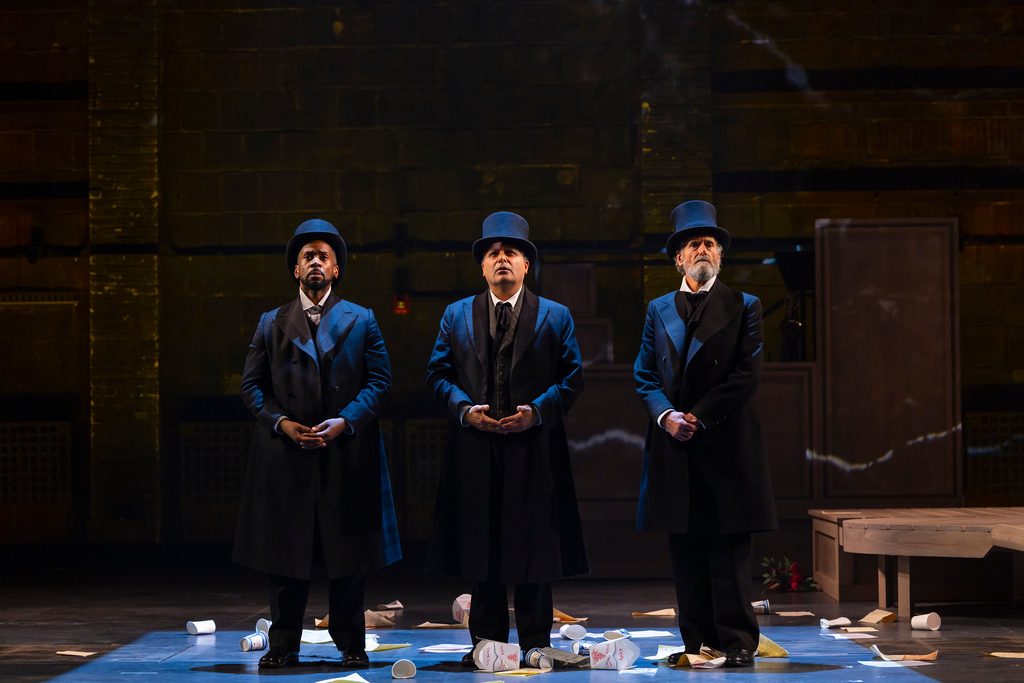
Written by Bess Wohl; Directed by Robert Walsh; Scenic Design by Jenna McFarland Lord; Costume Design by Chelsea Kerl; Lighting Design by Anshuman Bhatia; Sound Design by Dewey Dellay. Presented by Gloucester Stage through August 21.

Gloucester Stage Company’s ‘Gloria’ Provocatively Asks, “Who Lives, Who Dies, Who Tells Your Story?”

Cast of Gloucester Stage’s production of “Gloria” by Branden Jacob Jenkins. Photos: Shawn G. Henry

by Shelley A. Sackett

‘Gloria’ takes us on a ride inside the rollercoaster that is the essence of a 2010s Manhattan cultural magazine’s editorial assistant bullpen subculture. (Its playwright, Branden Jacobs-Jenkins, worked at The New Yorker for three years). These players are unapologetic and clear about their singular goal: to leave their dead end stepping-stone jobs, climb out of the low prestige depths of editorial assistantship and secure a book deal before turning thirty. Each is constantly on the backstabbing prowl in search of that tipping point moment that will catapult them out of their murky office pit.

Reminiscent of the long-running television hit, “The Office,” the first act of ‘Gloria’ is an entertaining mash-up of deadpan humor, smart and provocative language and near slapstick-caliber physicality. The dialogue is full of wit, sarcasm, social commentary and sharp insight, delivered at breakneck speed. Competitive malice is the glue that binds these folks; shredding insults is their common language. No one is happy and no one is to be trusted, from the Harvard intern (Miles) who wears headphones as a decoy to the jaded almost-30 closet memoirist (Dean), the acid-tongued spoiled shopaholic narcissist (Kendra) and the spiritually eviscerated factchecker (Lorin) and over-educated, underpaid receptionist (Ani) .

Yet, in their individual and collective ways, this motley crew of wannabes somehow endears themselves as they bare their fangs, souls and vulnerabilities. They become like family — with all its good, bad and ugliness —and we accept and appreciate the way they unapologetically let it all hang out. Bryn Boice’s thoughtful and affective direction exposes their naked underbellies, yet still elicits our caring and empathy.

Into this mix enters Gloria, a pathetic and classic spinster loner who has dedicated her life to the magazine. An editor, she is the butt of more than one cruel joke and the object of the bullpen’s venomous envy. The night before, she threw herself an extravagant birthday party, complete with DJ and catered food. She invited the entire staff of the magazine; only one editorial assistant showed up, adding salt to an already unhealable wound.

Michael Wood, Ann Dang

The repercussions of this slight go beyond hangovers and lame excuses, but it would be truly criminal to reveal what they are. Suffice it to say that Act I’s ending guarantees that no one is likely to leave during intermission.

Act II shifts gears so dramatically the audience is at risk of whiplash. Eight months later, the same characters are still front and center, but as individuals leading separate lives away from the magazine. All are dealing with the aftermath of a shared trauma that each exploits their own way. Gone is Jacobs-Jenkins’ spicy, electric-paced dialogue, replaced by the dull and relentless thrum of boundless, humorless ambition.

Jacobs-Jenkins does not hide the ball. His message — that we live in an age of exploitation that has no bottom — weighs heavy and depressingly without the fleet-footed wit he brought to his first act, and it’s a weary audience that welcomes the play’s end.

Ann Dang, Theresa Langford, Michael Broadhurst

Despite an uneven script and inconclusive ending, Gloucester Stage’s production is definitely worth seeing. Small touches add a lot. Props such as Asus and Toshiba laptops (remember those?) and a sound track of J. S. Bach: Mass in B minor ground us in the moment. The cast is terrific, and does its best to articulate Act I’s rapid-fire monologues clearly (strong standouts are Michael Wood as Dean and the talented Teresa Langford as Ani; Michael Broadhurst’s meltdown as Lorin gives Peter Finch’s classic “Network” stiff competition). Esme Allen brings an unpretentious ease to Act II’s Nan. And Boice misses no chance to add meaningful touches; under her direction, even changing sets becomes an opportunity for whimsical choreography.

‘Gloria,’ a Pulitzer Prize finalist in 2016, raises important issues for this era of continuing confusion and division over what constitutes news and how it should get disseminated. Should writers only create their own stories, or is it okay to co-opt someone else’s? Whose story is a shared event to tell and who decides what the “true” version of that story is? What are the differences between storytelling as catharsis, opportunism and exploitation and does it even matter anymore? Do those lines still exist?

Perhaps Lin-Manuel Miranda summed it up best in his peerless “Hamilton” when he wrote, “You have no control, Who lives, who dies, who tells your story.”

‘Gloria’ — written by Branden Jacobs-Jenkins. Directed by Bryn Boice. Scenic Design by Jeffrey Petersen; Costume Design by Rachel Padula-Shufelt; Lighting Design by Aja M. Jackson; Sound Design by David Remedios. Presented by Gloucester Stage Company, 267 East Main St., Gloucester through June 26.

For more information and tickets, go to: https://gloucesterstage.com/
Actors’ Shakespeare Project’s ‘The Bomb-itty of Errors’ Brings out The Bomb in The Bard

Cast of Actors’ Shakespeare Project’s ‘The Bomb-itty of Errors’

by Shelley A. Sackett

Actors’ Shakespeare Project’s “The Bomb-itty of Errors” is perfect pre-summer fare. Hip-hop and rap, a live DJ, a brilliantly exhaustive (and sometimes exhausting) script, some sublime acting and — as if that’s not enough — the Bard himself, camouflaged but hardly hidden. All wrapped neatly in a 90-minute intermission-less package that is as invigorating as it is boisterous.

The brainchild of four final-year students at New York’s Tisch School of the Arts, “Bomb-itty” started as a university project in 1998. It was so popular that it received enough support to return to New York the following year for a seven-month run, which in turn led to a lengthy Chicago run.

“Bomb-itty” is true to Shakespeare’s style of rhyming couplets, (sometimes bawdy) humor and historical references. The language often mirrors Shakespeare’s with references to other works sprinkled here and there to stroke the egos of those who recognize them. But the real star of the show is the vibrant, beatbox soundbox and the actors who manage to memorize a super-sized number of lines, which they deliver at break-neck speed.

The result is a theater experience unlike any I’ve experienced. (No, “Bomb-itty” is not a “Hamilton” clone. It’s way more fun.)

Based more than loosely on Shakespeare’s “The Comedy of Errors,” the plot involves two sets of identical twins with identical names, mistaken identities, misfortunes galore and a slew of stereotypes (some more offensive than funny). To get the most out of the rapid fire lines and delivery, either arrive early enough to read the playbill’s summary (twice, at least), or spend some time digesting the on-line Cliff Notes version of the original. Trust me, it is time well spent.

Despite first appearances (the prologue is a gem), “Bomb-itty” adheres closely to Shakespeare’s play.

In the original, a merchant of Syracuse, Egeon, suffered a shipwreck some years ago in which he was separated from his wife, Emilia, from one of his twin sons, later Antipholus of Ephesus, and the son’s slave, Dromio of Ephesus. The other slave’s twin, Dromio of Syracuse and Egeon’s remaining son, Antipholus of Syracuse, remained with Egeon.

When he came of age, Egeon allowed Antipholus of Syracuse and his slave Dromio of Syracuse to go in search of his lost brother. When they didn’t return, Egeon set out after his remaining son, and the play begins as we learn of Egeon’s capture and his condemnation to death by Duke Solinus in the hostile city of Ephesus. The details of Egeon’s story move Solinus to pity, and he grants a reprieve until nightfall, by which time a ransom of a thousand marks must be raised.

Unbeknown to all, the missing Antipholus and Dromio landed in Ephesus after the shipwreck and have thrived there. Antipholus of Ephesus and his servant Dromio are thrown into confusion when, unknown to each other, their twin brothers of the same names arrive in town from Syracuse.

In “Bomb-itty,” the Antipholus and Dromio twins are now quadruplets, put up for adoption after their father, a famous rap MC (Master of Ceremonies), committed suicide. The time is today and Ephesus and Syracuse have been replaced by the US East and West coasts.

Antipholus and Dromio of Ephesus visit Syracuse, New York, to take part in an MC competition. In the ensuing mayhem, one Antipholus is called home to a wife he never married, only to fall in love with her sister, Luciana. Meanwhile, the other Antipholus runs afoul of a policeman who enjoys a questionable relationship with his horse.

Four actors play most of the roles. Henry Morehouse as Dromio of Ephesus and Luciana chews up the stage. He has a natural physicality and stellar delivery and is comfortable and confident. He hands-down steals every scene in which he plays Luciana. A recent graduate of Boston University with a BFA in acting, Morehouse is a talent to be watched. His stage presence is spot-on and magnetic.

Likewise, the veteran actor Malik Mitchell brings the same charisma and acting chops to this production that those of us lucky enough to see him in SpeakEasy Stage Company’s “Once on this Island” have already experienced. His Dr. Pinch, the Rastafarian herbal “doctor,” is a show-stopper.

Anderson Stinson, III is all sinew and smiles in his many roles, shining as Antipholus of Syracuse. DJ Whysham strikes all the right beats and Victoria Omoregie rises to the challenge of her many character and costume changes.

Notwithstanding its gratuitous sexism, misogyny and anti-LGBTQ+ rhetoric (and a truly baffling and unforgivable antisemitic portrayal of a Jewish jeweler), the play is worth seeing for its high-energy, rowdy fun and for showing us what hip-hop and rap in the right hands can produce: a unique and exciting contemporary art form. If you listen carefully, you can feel the Bard’s ghostly presence, his sandaled toes tapping out the beats. For tickets and more information, go to: https://www.actorsshakespeareproject.org/

x

MICHAELHOBAN

Cast of Actors’ Shakespeare Project’s ‘The Bomb-itty of Errors’

‘The Bomb-itty of Errors’ — Written by Jordan Allen-Dutton, Jason Catalano, Gregory J. Qaiyum, Jeffrey Qaiyum and Erik Weiner. Based on ‘The Comedy of Errors’ by William Shakespeare. Directed by Christopher V. Edwards. Scenic Design by Baron E. Pugh; Costume Design by Zoe Sundra; Lighting Design by Max Wallace; Props Design by Steve Viera, Sound Design by Abraham Joyner-Meyers. Presented by the Actors’ Shakespeare Projectat the Charlestown working Theater, 442 Bunker Hill St., Chares through June 26.

by Shelley A. Sackett

Actors’ Shakespeare Project’s “The Bomb-itty of Errors” is perfect pre-summer fare. Hip-hop and rap, a live DJ, a brilliantly exhaustive (and sometimes exhausting) script, some sublime acting and — as if that’s not enough — the Bard himself, camouflaged but hardly hidden. All wrapped neatly in a 90-minute intermission-less package that is as invigorating as it is boisterous.

The brainchild of four final-year students at New York’s Tisch School of the Arts, “Bomb-itty” started as a university project in 1998. It was so popular that it received enough support to return to New York the following year for a seven-month run, which in turn led to a lengthy Chicago run.

“Bomb-itty” is true to Shakespeare’s style of rhyming couplets, (sometimes bawdy) humor and historical references. The language often mirrors Shakespeare’s with references to other works sprinkled here and there to stroke the egos of those who recognize them. But the real star of the show is the vibrant, beatbox soundbox and the actors who manage to memorize a super-sized number of lines, which they deliver at break-neck speed.

The result is a theater experience unlike any I’ve experienced. (No, “Bomb-itty” is not a “Hamilton” clone. It’s way more fun.)

Based more than loosely on Shakespeare’s “The Comedy of Errors,” the plot involves two sets of identical twins with identical names, mistaken identities, misfortunes galore and a slew of stereotypes (some more offensive than funny). To get the most out of the rapid fire lines and delivery, either arrive early enough to read the playbill’s summary (twice, at least), or spend some time digesting the on-line Cliff Notes version of the original. Trust me, it is time well spent.

Despite first appearances (the prologue is a gem), “Bomb-itty” adheres closely to Shakespeare’s play.

In the original, a merchant of Syracuse, Egeon, suffered a shipwreck some years ago in which he was separated from his wife, Emilia, from one of his twin sons, later Antipholus of Ephesus, and the son’s slave, Dromio of Ephesus. The other slave’s twin, Dromio of Syracuse and Egeon’s remaining son, Antipholus of Syracuse, remained with Egeon.

When he came of age, Egeon allowed Antipholus of Syracuse and his slave Dromio of Syracuse to go in search of his lost brother. When they didn’t return, Egeon set out after his remaining son, and the play begins as we learn of Egeon’s capture and his condemnation to death by Duke Solinus in the hostile city of Ephesus. The details of Egeon’s story move Solinus to pity, and he grants a reprieve until nightfall, by which time a ransom of a thousand marks must be raised.

Unbeknown to all, the missing Antipholus and Dromio landed in Ephesus after the shipwreck and have thrived there. Antipholus of Ephesus and his servant Dromio are thrown into confusion when, unknown to each other, their twin brothers of the same names arrive in town from Syracuse.

In “Bomb-itty,” the Antipholus and Dromio twins are now quadruplets, put up for adoption after their father, a famous rap MC (Master of Ceremonies), committed suicide. The time is today and Ephesus and Syracuse have been replaced by the US East and West coasts.

Antipholus and Dromio of Ephesus visit Syracuse, New York, to take part in an MC competition. In the ensuing mayhem, one Antipholus is called home to a wife he never married, only to fall in love with her sister, Luciana. Meanwhile, the other Antipholus runs afoul of a policeman who enjoys a questionable relationship with his horse.

Four actors play most of the roles. Henry Morehouse as Dromio of Ephesus and Luciana chews up the stage. He has a natural physicality and stellar delivery and is comfortable and confident. He hands-down steals every scene in which he plays Luciana. A recent graduate of Boston University with a BFA in acting, Morehouse is a talent to be watched. His stage presence is spot-on and magnetic.

Likewise, the veteran actor Malik Mitchell brings the same charisma and acting chops to this production that those of us lucky enough to see him in SpeakEasy Stage Company’s “Once on this Island” have already experienced. His Dr. Pinch, the Rastafarian herbal “doctor,” is a show-stopper.

Anderson Stinson, III is all sinew and smiles in his many roles, shining as Antipholus of Syracuse. DJ Whysham strikes all the right beats and Victoria Omoregie rises to the challenge of her many character and costume changes.

Notwithstanding its gratuitous sexism, misogyny and anti-LGBTQ+ rhetoric (and a truly baffling and unforgivable antisemitic portrayal of a Jewish jeweler), the play is worth seeing for its high-energy, rowdy fun and for showing us what hip-hop and rap in the right hands can produce: a unique and exciting contemporary art form. If you listen carefully, you can feel the Bard’s ghostly presence, his sandaled toes tapping out the beats. For tickets and more information, go to: https://www.actorsshakespeareproject.org/

‘The Bomb-itty of Errors’ — Written by Jordan Allen-Dutton, Jason Catalano, Gregory J. Qaiyum, Jeffrey Qaiyum and Erik Weiner. Based on ‘The Comedy of Errors’ by William Shakespeare. Directed by Christopher V. Edwards. Scenic Design by Baron E. Pugh; Costume Design by Zoe Sundra; Lighting Design by Max Wallace; Props Design by Steve Viera, Sound Design by Abraham Joyner-Meyers. Presented by the Actors’ Shakespeare Project at the Charlestown working Theater, 442 Bunker Hill St., Charles through June 26.

BLO’s ‘Champion: An Opera in Jazz’ Tackles Fate, Faith, Forgiveness and Redemption

by Shelley A. Sackett

Switching gears overnight due to pandemic-related issues, Boston Lyric Opera is to be commended for its recent perseverance and quick-footed adaptability. Instead of offering three performances of “Champion: An Opera in Jazz” as a full opera as rehearsed and planned, the company pivoted to only two concert-style productions with the masked orchestra on stage, costumed chorus in balcony box seats and main performers making do with a sliver downstage.

The only downside to the downsizing was that fewer people were able to experience this ambitious, modern masterwork that brings to life boxer Emile Griffith’s complicated story through a heart-rending melding of music styles and poignant lyrics. By the show’s end — at least in my row — there was not a dry eye. And isn’t that, after all, why we go to the theater and especially to opera? To feel?

The synopsis provided in the playbill is not a spoiler, but an essential guide. The scenes flip from present to past (with the magnificent Brian Major and Markel Reed respectively playing Emile today and during his boxing hey days of the 1960s) and without a roadmap, it’s easy to get lost.

Emile Griffith was not your typical boxer. Born on St. Thomas in the 1950s, he and his many siblings are abandoned by his mother, Emelda. As a youngster, Emile dreams of reuniting with his mother and becoming either a hat maker, a singer or a baseball player. Eventually, he finds her in New York and she introduces him to the hat manufacturer, Howie Albert. But, instead of offering Emile a job making hats, Howie focuses on Emile’s physique and pegs him as a welterweight boxer. He offers to train Emile, and with Emelda’s encouragement (and nose for money), Emile’s artistic dreams fade away.

The trouble is, Emile is gay at a time and in a profession where that is simply not an option. When Benny “Kid” Paret taunts Emile about being a “maricon,” (a Spanish insult for homosexuals) before and during their high-profile match in 1962, it is as if Benny has waved a cape during a bullfight. Emile literally sees red and in seven seconds delivers the 17 blows that will send Benny to the hospital in a coma, where he will die 10 days later.

Emile sits outside Benny’s room those long 10 days, wanting to say he is sorry and begging for forgiveness. His request is denied, and for the rest of his life, that lack of closure will wrack his soul and shake his faith.

Markel Reed, Terrence Chin-Loy and Brian Major from Boston Lyric Opera’s production of “Champion:An Opera in Jazz.”
Courtesy of David Angus, Boston Lyric Opera

Fifty years later, Emile struggles with the chronic traumatic brain injury, the result of “boxer’s brain” and a brutal beating he suffered outside a gay bar. The opera opens as Luis, his caregiver/adopted son/partner, helps dress him, reminding him of a special meeting they are scheduled to attend. Emile’s mind is afloat, uneasily alighting on memories of his fight with Benny and his own beating at the hands of bigots. He is  confused over the smallest action, such as putting on his shoes. He sometimes doesn’t know who or where he is.

Yet during moments of clarity, he remembers his past and the twist of fate that transformed his prized fists into weapons, forever rewriting his legacy from Champion Boxer to murderer.

During these times, he poses some very deep and heart wrenching questions.

“What makes a man a man; the man he is?” Emile wonders. “Who is this man who calls himself me?” Resigned to a life where redemption is beyond his grasp, he accepts his fate, believing he deserves it. “I go where I go,” he explains.

Blanchard’s music keeps the audience riveted and guessing as he winds from the full-throated operatic to slinky, smoky note-bending jazz to a gospel-tinged chorus to a N’awlins style second line. It’s the musical analog to Alvin Ailey’s “Revelations.”

The cast relishes every note. Baritones Major and Reed are nothing short of spectacular as Emile, both as actors and opera singers. Major is a big guy (think Paul Robeson), yet he controls that physicality to appear graceful and vulnerable. Reed is his foil, a compact pretty boy, all sinew and chartreuse satin. And man, can these guys sing.

The rest of the cast are equally noteworthy, from Tichina Vaughn as Emelda to Terrence Chin-Loy as Benny, Jesus Garcia as Luis, Stephanie Blythe as Kathy and Wayne Tigges and Neal Ferreira as Howie and the Ring announcer.

At the end of the day, however, we can’t help but wonder how Emile, in hindsight, might answer this question: was it worth it?

“Champion: An Opera in Jazz.” Music by Terence Blanchard; Libretto by Michael Cristofer. Music Direction by David Angus; Music Conductor – Kwamé Ryan; Set Design by Sara Brown; Costume Design by Trevor Bowen; Lighting Design by Marcus Doshi. Produced by Boston Lyric Opera at the Emerson Cutler Majestic Theatre, 219 Tremont Street, Boston. (Run has ended)

SpeakEasy’s ‘Once on This Island’ Is A Magical Tour of A Mystical Place

Peli Naomi Woods, Kenny Lee, and the cast of SpeakEasy Stage’s Once on This Island (2022). Photos by Nile Scott Studios.

by Shelley A. Sackett

‘Once On This Island’ is such a happy, toe-tapping, brightly colored musical, it’s easy to forget that its overarching tragic themes are Caribbean colonialism, racism, and slavery. Part ‘Romeo and Juliet’ (which didn’t end well for those star-crossed lovers, either), part Little Mermaid and part multi-cultural folk fable, the show explains the history of the Island Hispaniola and its eventual split into Haiti and the Dominican Republic.

Yet, the show is not heavy. There is also a contagious high-spirited cheerfulness that amounts to one of the most enjoyable theatrical experiences of 2022 (and there has been some stiff competition). Erik D. Diaz’s set is eye candy. Pink tiles, a shimmering crescent moon, lush vegetation and outdoor patio dining evoke the laid back magical vibe of island living.

Malik Mitchell, Peli Naomi Woods, Davron S. Monroe, Christina Jones, and Yewande Odetoyinbo

Under the direction of the talented David Freeman Coleman, live calypso music has the audience smiling and seat dancing before the play begins. The cast slowly moseys onto the stage, dressed in bright island finery. They engage and joke with audience members and each other, bantering in clear, easy to eavesdrop patois. The scene is set and the audience is primed.

Then suddenly, the horseshoe shaped stage is on fire, a burst of simultaneous music, song and dance. While there are a dozen individuals who are a “who’s who” of Boston’s finest actors/singers/dancers, in the prologue number, “We Dance,” they are a single, well-oiled ensemble. Voices blend seamlessly in strong, crisp and tuneful harmony. Jazelynn Goudy’s choreography is exciting and even more eye candy. There is so much to absorb sensorially, it’s hard to take it all in.

And that’s before the outstanding Peli Naomi Woods (Ti Moune) explodes onto the stage, commanding its center with confidence and grace while demonstrating her formidable vocal and dancing prowess.

Davron S. Monroe

The overlapping stories of Ti Moun and Haiti (referred to as “the jewel of the Antilles”) unfolds for the next 90 intermission-less minutes as an operetta, (a form of theatrical light opera) that includes spoken dialogue, songs, and dances. Told as a Hans Christian Anderson type of fairy tale fable, we learn about the history of the island and the caste system that divides people according to skin color, origin and wealth. The Beauxhommes, descendants of European colonialists, have the money, the power and the land. The native islanders are poor and stuck in their station. There is no possibility of fraternization, let alone marriage, between the two. Their futures are indelibly tracked.

Still, they all serve the caprices of the local gods, praying to them, fearing them and dancing to their music.

Through Lynn Ahrens (book and lyrics) and Stephen Flaherty’s (music) magnificent libretto, we learn Ti Moun’s story. It all starts with a big storm that left her an orphan. The gods spared her life for a purpose; they chose her for a magical adventure.

She is cared for by Ton-Ton Julian and Mama Euralie and grows up into the magnificent Woods. All is fine until Daniel, son of a wealthy Beauxhomme landowner, catches her eye as he races through her village in a splashy sports car. She becomes convinced they are each other’s destiny. She is determined to find a way for them to be together.

Peli Naomi Woods, Reagan Massó

One day, Daniel crashes his car and Ti Moun finds him. She decides the gods orchestrated this, revealing their plan for her and the reason she survived the storm. She goes into hiding with him, resolved to nurse him back to health. Papa Ge, the Demon of Death, comes to claim him, and Ti Mouns makes a bargain: her life for Daniel’s, payable at Papa Ge’s whim.

Ti Moun believes that love’s force can overcome all, even a bargain with the death god. Like Romeo and Juliet, these two really do love each other but, notwithstanding Ti Moun’s faith, no love is strong enough to overpower social and political mores.

To call “Once on This Island” enjoyable is like saying the Taj Mahal is a nice space. This production sparkles on every level. The musicians are first class. The choreography is inventive and inspired. In one knock-out number, Goudy arms the dancers with silver, shimmering umbrellas. The effect is otherworldly — are they jellyfish? Protective kites? Homage to Alvin Ailey’s “Revelations?” Or are they just there because it’s raining?

It’s hard to know where to begin to give shout outs among the cast. Woods (Ti Moun) is an undergraduate senior at Boston Conservatory at Berklee with a bright future that we hope will remain in Boston — at least for a little while. Anthony Pires, Jr. (Ton-Ton Julian) brings a lithe physicality, knock ‘em dead pipes and an irresistible twinkle in his eye to his role. Christina Jones (Erzulie) possesses a quiet substance and the voice of angel. And Becky Bass  (Steel Pannist and narrator/storyteller) is fresh, nuanced and natural. Her facial expressions and body language are magnetic. Kenny Lee, who plays the pivotal role of Daniel, could use a little more seasoning, but that’s something that additional stage time should cure.

Don’t miss this balm of a show. It is a four course, five star theatrical feast.

Once On This Island.” Book and Lyrics by Lynn Ahrens. Music by Stephen Flaherty. Directed by Pascale Forestal. Music Direction by David Freeman Coleman; Choreography by Jazelynn Goudy; Scenic Design by Erik D. Diaz; Costume Design by Chelsea Kerl; Lighting Design by Aja M. Jackson; Sound Design by Andrew Duncan Will. Presented by Speakeasy Stage, Boston Center for the Arts, 527 Tremont Street, Boston, MA through April 16.

For more information and tickets, go to: https://www.speakeasystage.com/