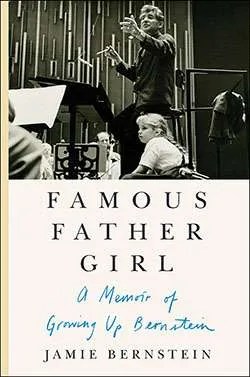
Daughter offers glimpse inside private world of Leonard Bernstein

by Shelley A. Sackett

Leonard Bernstein, whose global 100th birthday celebration has invigorated his reputation as one of the great musicians of modern times, was best known as a composer, conductor, pianist, teacher, and humanitarian. With the publication of her memoir, “Famous Father Girl: A Memoir of Growing Up Bernstein,” oldest daughter Jamie Bernstein shifts the spotlight to his least examined – but to her – most important role: that of father.

Jamie, a writer, broadcaster, filmmaker, and concert narrator, paints a detailed portrait of a complicated and sometimes troubled man, plumbing the emotional complexities of her childhood and inviting the reader into her family’s private world of celebrity, culture, and occasional turmoil.

North Shore Leonard Bernstein fans will have a chance to hear Jamie speak about her book and answer questions at 7 p.m. on Sunday, April 7, at the newly renovated Temple Emanu-El, 393 Atlantic Ave. in Marblehead. In addition, there will be a screening of the documentary, “Leonard Bernstein, Larger Than Life,” followed by a dessert reception. The event is co-sponsored by the Jewish Community Center North Shore Jewish Book Month and International Film Festival committees.

One of Jamie’s goals in writing her memoir was “to answer the frequently asked question: WHAT WAS IT LIKE?!” she told the Journal by email. “What was it like growing up in that family, with that father? The short answer: not boring. The longer answer: read my book!”

In her 400-page memoir, chockfull of spicy details and intimate family pictures, Jamie paints an eyewitness portrait of the 1960s and 1970s she lived. “I grew up in amazing times. They were turbulent and shifting. It was a particularly intense time to be a young woman,” she said. She also dishes about the extraordinary circle of characters that populated the Bernsteins’ lives, including: the Kennedys, Mike Nichols, John Lennon, Richard Avedon, Stephen Sondheim, Jerome Robbins, and Lauren Bacall.

Her two siblings, Nina Bernstein Simmons and Alexander Bernstein, also have been involved in preserving their father’s legacy. Jamie showed them every draft of her memoir. “All along, I told them that they had complete veto power. They were amazingly supportive; I don’t think they ever asked me to take anything out,” she said.

Their mother, Chilean pianist and actress Felicia Montealegre, raised her three children to be bilingual, which serves Jamie well when she narrates concerts in Spanish in locations such as Madrid and Caracas. “Our mother was not only beautiful, elegant, and talented, she was also the stabilizing force for our family in general and [for] our dad in particular,” she said.

Giving new meaning to the phrase, “the apple doesn’t fall far from the tree,” Jamie communicates her own love affair with classical music through her roles as speaker and concert narrator. She writes and performs the script for “The Bernstein Beat,” a popular and successful program of family concerts about her father’s music modeled after his own groundbreaking “Young People’s Concerts.”

Leonard Bernstein conducting the Boston Symphony Orchestra at Tanglewood in 1970. Photo by Heinz Weissenstein, Whitestone Photo, BSO Archives

“I’m not exactly channeling him [her father], since I’m only doing half of his job – the writing and talking part,” Jamie said. “But I do feel a similar urge to reach out and communicate to my audiences. I love sharing the stuff I’m excited about.”

While on her book promotion tour (“a considerable amount of schlep”), she has talked to many people who experienced her father’s mystique, either through concerts at Tanglewood and the New York Philharmonic or through recordings, TV, and Broadway productions. “It has been incredibly touching. The attendees are curious and attentive and quite emotional. And so many of them have stories!” she said.

Izzi Abrams, president of the JCC in Marblehead, is among those with stories. Her family had an indirect relationship with the Bernsteins through her uncle, Rabbi Israel Kazis of Congregation Mishkan Tefila in Brookline, where the Bernsteins were members when Leonard was a boy. Abrams also taught a course on Bernstein last fall and winter. “I’ve been excited ever since I heard a couple of summers ago that Tanglewood was going to celebrate Bernstein’s 100th birthday in 2018,” she said.

With over 5,000 events worldwide, Jamie acknowledges that her book is just a small piece of the LB Centennial celebration that she and her siblings hope will remind those who lived in their father’s era of the enormous legacy he left behind.

“We also hope that young people will discover Leonard Bernstein, and be excited to know more about him, his music, and his music-making,” she said.

For information or to buy tickets to the April 7 event, visit jccns.org or call 781-631-8330.


Swampscott scientist lands top MIT award

On Thursday, March 21, Dr. Mercedes Balcells-Camp’s colleagues will recognize what they describe as her extraordinary contribution when she receives the MIT Excellence Award for Advancing Inclusion and Global Perspectives.

By Shelley A. Sackett


SWAMPSCOTT — As the oldest of six children growing up in an apartment in bustling Barcelona, Spain, Dr. Mercedes Balcells-Camps shared a room with her three sisters and took public transportation or walked to school. From grades 1 through 12, she attended La Vall School, a girls-only charter school that met from 9am to 5pm and required students to wear a brown uniform.


On the first day of seventh grade, Dr. Balcells-Camps’ life changed forever when her science teacher, Mrs. Ustariz, told the class that their textbooks were only the tip of the iceberg and that there were more things waiting to be discovered than were written in those books. “I became a scientist that day. I wanted to discover the unknown in nature,” she said from the Swampscott home she shares with her husband and two daughters.


And become a scientist she did, earning a BS in chemical engineering, an MS in organic chemistry and a Ph.D. in macromolecular chemistry before moving to the US for a post-doctoral fellowship at MIT. “I was supposed to be in Cambridge for three years and then return to Spain,” she said. Instead, she became good friends with a colleague who introduced her to both her husband and to Swampscott.


Today, some two decades later, Dr. Balcells-Camps is Principal Research Scientist at MIT’s IMES (Institute for Medical Engineering & Science), a hub that brings together the community of students, postdoctoral fellows and faculty who work at the convergence of engineering, science and translational medicine. Through dual appointments at MIT and her alma mater, Institut Quimic de Sarrià in Barcelona, she has promoted innovative research and educational exchanges between both institutions and countries.


As a result of this collaboration, she created the International MIT-Spain Program and co-founded the Spanish start-up Regenear. She also chairs the MIT IDEA2 Global program, which provides mentoring and connections to biomedical innovators around the world to develop and realize their project ideas. “Science doesn’t work in isolation. It requires multidisciplinary and international approaches,” she noted.


On Thursday, March 21, Dr. Balcells-Camps’ colleagues will recognize her extraordinary contribution when she receives the MIT Excellence Award for Advancing Inclusion and Global Perspectives. The award is presented in six categories and represents the highest honor presented to MIT staff.


Since the day she found out she won the award, Dr. Balcells-Camps has been thanking her family, extended family and collaborators inside and outside the US. “You cannot build a bridge if you don’t have help in each side,” she said. Professionally, she hopes to harness the visibility of the award to continue growing programs to tackle global health problems through culturally sensitive patient-centric approaches. “What works here in the US may not work in a rural place like Latin America,” she explained.

unnamed-1

Dr. Mercedes Balcells-Camps, far left, and her daughters Swampscott High School freshman Isabel and Swampscott seventh grader Sofia.


She credits her daughters, Isabel and Sofia, with the resiliency and sense of humor to embrace their mom’s work, which has had them cross the Atlantic over 50 times and host hundreds of exchanges students and faculty. “I’m glad I make them proud because there have been sacrifices along the way,” she said.


While the excellent public schools, proximity to family and ocean views lured her to Swampscott, the more serious opportunity to fight disease and discover new tools that physicians could use to solve unmet clinical needs is what brought her to MIT. “MIT is the paradise of science, engineering and innovation and full of extremely motivated students and faculty. Early in my career, it became a dream of mine to come here,” she said.


Working with physicians and clinicians and industry partners to accelerate the path of new technologies, Dr. Balcells-Camps’ work has focused on building artificial organs and tissues made of biodegradable materials and human cells from donors. “I hope that in the future, in the same fashion we replace a tire on our car, we can replace the diseased artery when we have a stroke because of a blocked artery,” she said.


Currently, her research focus is development of a new model to understand the blood-brain barrier. This work is important for treatments of brain disorders, certain diseases (ALS, Alzheimer’s and MS) and drug abuse, such as opioid addiction.


Remembering the importance of her seventh grade teacher’s encouraging words, she offers this advice to young people thinking about pursuing a career in science.


“GO FOR IT! It is humbling and hard work but it is amazing what you can do when you unravel ‘science mysteries.’ The impact on society is tremendous. We need young talent in science and engineering if we want to understand how cells work and defeat disease, find better solutions to generate clean energy or create new smart materials for a better daily life.”


Still Standing: A Musical Survival Guide’

By Shelley A. Sackett

While most of her 21-year-old colleagues were busy planning their post-college lives, Anita Hollander was undergoing chemo and radiation therapies after her first bout of cancer in her left leg.

When she returned to Carnegie Mellon University for her senior year, she played a cabaret evening of songs by popular singers. A favorite teacher who was in the audience changed the trajectory of her life when she challenged Hollander to use her recent life experience to write and perform her own material instead.

Hollander wrote “The Choice,” about the options one makes when faced with a deadly disease. By the time her cancer reappeared five years later in 1977 – this time necessitating amputation – Hollander was well on her way to creating her show, “Still Standing: A Musical Survival Guide to Life’s Catastrophes.”

The solo 15-song cabaret chronicles Hollander’s story, from her initial diagnosis to the post-amputation continuation of her career as a musical theatrical performer. Each song, packed with humor, intelligence, and musicality, describes resources that helped her endure and persist.

“Sense of humor, great imagination, chutzpah, perspective, family, love, children, art – there’s nothing you have to buy or get,” said Hollander by phone from her Manhattan home. “Anyone who sees the show can use these tools to get through difficult times, obstacles, whatever is in front of them.”

“Still Standing” has played at the Kennedy Center, the White House, Off-Broadway, and in theatres around the country.

The New Repertory Theatre at the Mosesian Center for the Arts in Watertown will present it from Feb. 9 through March 3 during Jewish Disability Awareness, Acceptance and Inclusion Month.
Since 2009, every February has represented a unified effort among Jewish organizations worldwide to raise awareness and foster inclusion of people with disabilities. Last February, the Ruderman Family Foundation helped finance a performance of the show at Kerem Shalom, an inclusion congregation in Concord.

Hollander is as much a disability activist as a performer. “My whole career is playing roles that were not necessarily meant to be disabled, but I happened to be playing them with one leg,” she said. As national chair of the SAG-AFTRA Performers with Disabilities committee, Hollander keeps a “watchdog scorecard” of disabled people showing up in every form of media. While she thinks film still “woefully” lags behind, she is encouraged by the great strides theater and TV have made over the last 10 years.

Hollander and her three sisters grew up in Cleveland, the daughters of a part-time cantor who organized them into a four-part harmony group that “started singing before we could speak,” she said, doing shows at temple and singing at services. When Hollander married, she joined the Village Temple in New York, where she has been children’s choir director for 23 years.

She and the children collaborate to write songs about holidays and Tikkun Olam (“repair the world”). The kids came up with the idea for “Share the World,” a song that features them saying “welcome” in 20 languages that represent countries where Jews live (it’s available on YouTube).

“Working with the children’s choir has been one of the best things in my life,” she said.

Asked whether she could envision anyone else playing her part in such an intimate autobiographical piece, Hollander said she is writing a new show, “Spectacular Falls,” with the idea that someone else could perform it. However, she added that she is about to do 26 performances in a row of “Still Standing” without an understudy.

“It’s like being out on a wire without a net on one leg,” she said with a laugh.

The Mosesian Center for the Arts is located at 321 Arsenal St., Watertown. For tickets, visit newrep.org or call 617-923-8487.

Uptick in Swampscott seniors landing early acceptance


shs1

Pictured are some of the SHS seniors who have received early acceptances for college. Front Row, from left: Sarah Ryan (Vassar College); Chloe Howe (Bowdoin College); Sara Hamada Mohamed (UMass Boston, Stetson and St. Michael’s U.); Yelena Jeffries (Boston U.). Back Row, from left: Aveen Forman (Marist College); Grace DiGrande (Bucknell U.); Isaac Dreeben (Oberlin College); Kyle Lenihan (Syracuse U.), and Ivan Kadurov (Pratt Inst. And Wentworth Inst. Of Tech.)[Photo by SHELLEY A. SACKETT]


By Shelley A. Sackett


Aveen Forman was drawn to more than Marist College’s bucolic Hudson Valley campus when she decided to apply for early action to the Poughkeepsie, N.Y. school. What piqued her interest about the school was 3,140 miles away in Dublin, Ireland, where she will spend her first year as a member of the Marist College Freshman Dublin Experience.


“None of the other schools I applied to had anything like it. It was such a cool opportunity, I had to apply,” the Swampscott High School senior said. She needed to submit separate applications to the college and this special program. “Thankfully, I got into both. It was my top choice.”


For Maddy Foutes, one visit to Northwestern University was all it took to convince her it was the perfect fit for her. “The lakefront campus is stunning, with incredible access to Chicago. And Northwestern’s quarter system allows students to pursue several areas of academic interest at once,” she said. She returned home, applied early decision and was accepted. “I couldn’t be more excited!” she added.


Architecture is Kyle Lenihan’s passion and intended major, and the Syracuse, N.Y. native decided to return to his birthplace to pursue his interest in his “old stomping grounds. The Syracuse University School of Architecture gave a sense of challenge and prestige that no other school had. It consistently ranks among the best in the country for undergraduate architecture,” he said. His early decision application was accepted, based in part on a portfolio of artistic works he was required to submit. “I would not have been accepted to this program if it were not for the art program at SHS,” he added.


Early decision plans are binding — a student who is accepted as an ED applicant must attend the college. Early action plans are nonbinding — students receive an early response to their application but do not have to commit to the college until the normal reply date of May 1.


Director of Guidance Emily Zotto-Barnum noted a marked uptick in early acceptance application over last year. The Class of 2019 saw 15% of the senior class applying ED (vs. 6% in 2018) and 55% applying EA (vs. 37% in 2018). While she’s not sure why there was such a huge jump in the numbers, she suspects running more Naviance and Common App boot camps may have prepared students earlier than in past years. [The

Common App Recommender System and Naviance are on-line

systems used to submit recommendations and school forms].


“During these boot camps, we do a lot of hand holding and walk the students through each step of the process one on one. It has been a great opportunity for us to be with the students and really understand where they are at,” she said, noting that the 14 before school, after school and evening sessions all attracted robust attendance.


Yelena Jefferies, who will attend Boston University where she plans to study sociology, is thankful for the guidance she received in filling out her college applications. She strongly believes the opportunity SHS students have to take Advanced Placement and Honors classes is of equal importance in preparing them for college.


“I was able to build skills that I know will be useful in a college classroom setting,” she said. She equally praises her non-AP class experiences with preparing her to be more confident in the kind of discussion-based classes she expects in college. “One major example is Mr. Reid’s Media Lit classes, which has helped me articulate critical thinking skills in class discussions and improved my informal writing skills,” she added.


In 2018, one-third of eligible students (Grades 10-12) took at least one AP level course. Every student enrolled in an AP class must take the AP test. 162 students took 372 tests in 19 subjects and 80% of them scored 3 or better. Many colleges award college credit for AP scores of 3 or higher, saving students (and their parents) tuition expenses and permitting them to skip introductory level classes their freshman year.


While academics are arguably the most important prong to a student’s portfolio, Zotto-Barnum stresses that SHS values and supports students’ non-traditional choices, too. She has noticed an increase in students electing to take a GAP year between graduating from high school and entering college.


One student chose a Semester at Sea; another will teach skiing in Japan. “We’re all about the path,” Zotto-Barnum said, referencing the SHS Guidance Department’s philosophy — Embrace your path, make your own pace! “While not all students choose the same path, everyone does have a place. It’s important for parents and students to hear this message,” she said.


Other students who have received early acceptances include: Diego Lucruz (Suffolk U. in Madrid, Spain); Isaac Green (George Washington U.); Ivan Kadurov (Pratt Inst. and Wentworth Inst. of Tech.); Harry Katz (Stanford U.); Molly Delaney (Emerson, Keene State, Salem State, Suffolk and Whitworth U.); Grace DiGrande (Bucknell U.); Sara Hamada (St. Michael’s College, UMass, BU and Stetson U.); Isaac Dreeben (Oberlin College) and Chloe Howe (Bowdoin College).


Some student-athletes who have been accepted to college plan to continue their athletic careers. These include: Sarah Ryan (field hockey at Vassar College); Nikki Rosa (basketball at Roger Williams U.); Ryan Graciale (baseball at Salve Regina U.); Hannah Amato (field hockey at Salve Regina U.), and Tim Perlin (lacrosse at Franklin Pierce U.).


Lest anyone think these seniors are coasting through their last semesters at SHS, think again. In addition to their regular course loads and studying for their AP exams, these students are spending time participating in band and chorus concerts, participating in the SHS Spring Musical “Sweet Charity”, working at a preschool three days a week and, as Foutes said, “trying not to let senioritis affect me too much.”


‘Heartland’ goes straight to the heart


heartland-2

Dr. Harold Banks (Ken Baltin) and daughter Getee (Caitlin Nasema Cassidy) enjoy each other’s company in Gabriel Jason Dean’s riveting new play, “Heartland.” [Photo by Christopher McKenzie. ]

By Shelley A. Sackett

Dr. Harold Banks has a guilty secret.

The renowned Afghan scholar and retired professor at the University of Nebraska lives in Omaha, the “heartland” of America, with his beloved adopted daughter, Getee. Orphaned in Afghanistan, Getee yearns to return to her birth home both to reconnect with her biological roots and to offer humanitarian aid by teaching children outside Kabul.

While there, she discovers a dusty box of old primary school textbooks from the 1980s with messages that promote violence, hatred, and jihad. Nazrullah (Naz), an Afghan Muslim math teacher she befriends, remembers using the same book as a child. To her horror, Getee learns that Americans authored these books.

To Harold’s deeply buried shame, he was on the CIA-led team from the University of Nebraska that created and imbedded those same propaganda-laden books in Afghanistan as part of a Cold War strategy to counteract the Soviet invasion.

Playwright Gabriel Jason Dean’s riveting and recommended new play, “Heartland,” presented by the New Repertory Theatre at the Mosesian Center for the Arts in Watertown through Feb. 9, plunges its audience into the personal and political tornado that encircles these three people. The tormented history of the relationship between Afghanistan and the United States is the invisible but pivotal fourth character, and it casts its shadow over every scene.

The play opens as an elderly and ill Harold, wearing boxers, a tropical-themed shirt, a baseball cap and flip flops lays on a chaise dictating semi-comprehensible lecture notes into a mini-recorder. Naz (portrayed with equal parts humor and gravitas by the gifted Shawn K. Jain) shows up on Harold’s doorstep with a message from Getee (ably played by the perky Caitlin Nasema Cassidy). Harold mistakes Naz for the air conditioner repairman, setting in motion a common thread of false impression, mistaken identity, and misunderstanding that runs throughout the 105-minute intermission-less production.


heartland-3

Dr. Harold Banks (Ken Baltin) and Nazrullah (Shawn K. Jain) get to know each other. [Photo by Christopher McKenzie]

Through flawlessly interwoven flashbacks and dramatized memories, the linked stories of Getee’s adoption, her nascent interest in Afghanistan, her romantic relationship with Naz, and her ultimate death in a Taliban-led attack unfold beside revelations about Harold’s unwitting complicity in creating a generation of ruthless fighters. Ironically, those children raised on Harold’s textbooks grew up to become the Taliban that killed Getee. With her blood on his hands, Harold is at last forced to face his involvement in a failed foreign policy that reaped great sorrow for so many, including himself.The intimacy of the Mosesian Center for the Arts’ 90-seat BlackBox Theatre and Afsoon Pajoufar’s spare but effective set provides an immersive experience for the audience, which is transported from Kabul to Omaha with the flick of spotlights. When Naz moves in and takes care of Harold, their increasingly honest conversations explore the consequences of misguided US foreign policy while exposing Harold’s emotional rollercoaster ride through love, loss, denial, and pain.

“The man thought he was performing tikkun olam [healing the world] for a country he had come to love. He realizes that while he solved one problem, he created another enormous problem,” said Ken Baltin, the Needham resident whose portrayal of Harold’s inner conflict is spot-on. “How to manage these kinds of circumstances and still live with yourself is one of the main points of the play.”

“Heartland” is Dean’s second play about Afghanistan. His self-described “obsession” with the country began in 2006, when his brother-in-law’s girlfriend and her family were shot down near Kandahar while visiting her father, a civilian contractor.

“It wasn’t until I was holding my sobbing brother-in-law that a conflict in Afghanistan became personal to me,” he said by email. While researching another play set in Afghanistan, he came across several articles about these textbooks. “I knew I wanted to write about them immediately,” he added.
He hopes audiences will leave the play questioning U.S. policy of intervention in foreign countries with a critical eye to examining how Americans address their culpability when those policies fail.

“If we had the courage to face our failures, to say we are wrong, we are sorry, ask for forgiveness, and actually commit to better policy, then that would be the first step to righting these wrongs we seem to have a habit of repeating,” Dean said.

However, the more complicated issue of whether good intentions can trump unforeseen bad consequences is never quite black and white, even when the contrast between objective and outcome is stark. Despite his patriotic and selfless motives, the sympathetic Harold suffers in agony in a gray limbo area between damnation and redemption, trapped in a personal spiritual struggle.

“We made decisions that were in the best interest of the U.S. and Afghanistan,” he explains to Getee when she discovers his collusion. “Hindsight makes it easy to have morality.”

The Mosesian Center for the Arts is located at 321 Arsenal St., Watertown. Visit newrep.org or call 617-923-8487.

Erasing gender and race barriers puts a new face on ‘1766’

32__1776

Bobbie Steinbach (as Benjamin Franklin) and Benjamin Evett (as John Adams). [All photos by Andy Brilliant/Brilliant Photography]

By Shelley A. Sackett


Digging deep into the history of the United States reveals a largely unrecognized fact: Jews played a role in the events that launched the American Revolution. Like their fellow early settlers, they were divided in their loyalties, but there is no denying they had skin in the game.

The most famous revolutionary Jew was Polish-born Haym Salomon, a successful foreign securities dealer who helped finance the American cause. Francis Salvador was the first Jew elected to public office in the colonies. He was also the first Jew killed in the American Revolutionary War, fighting in 1776 on the South Carolina frontier. Abigail Minis was a Savannah, Ga., businesswoman and landowner who helped supply provisions for the revolutionary forces.


Don’t hold your breath, however, waiting for these unsung Jewish patriots to appear in The New Rep Theatre’s production of the 1969 Broadway hit, “1776.” The Tony-award-winning musical now onstage in Watertown focuses exclusively on the tumultuous political machinations that led to the signing of the Declaration of Independence on July 4. Our Jewish revolutionaries are not even a footnote.


173__1776

The cast of 1776


Nonetheless, co-directors Austin Pendleton and Kelli Edwards (the same team that breathed new life into the thread-worn “Fiddler on the Roof”) manage to shake things up by launching the play into the 21st century and casting it as gender and race neutral. Women play men, men play women, and the racial diversity on stage rivals that of “Hamilton.”

The strategy is, for the most part, clever and effective. The always-outstanding Bobbie Steinbach is dazzling as Ben Franklin. She steals every scene she is in (which is most of them) with her impeccable timing and gestures. It also doesn’t hurt that her character’s lines are the script’s best crafted.

The three-hour show takes place during a long, steamy Philadelphia summer. The Second Continental Congress, an unruly, exhausted and petulant group of men representing the original 13 colonies, meets day after day in a stifling room ‒ the windows can’t be opened or the chamber would fill with flies. Front and center on their agenda is deciding whether to declare national independence and unite formally in rebellion against British rule or remain separate sovereign colonies.

John Adams of Massachusetts is desperate to persuade this ill-tempered and motley crew that time is running out. If Congress doesn’t act now as a united front to throw off Great Britain’s tyranny, he fears General George Washington’s ragtag and outnumbered army will suffer crushing and lethal defeat.

The stumbling block is that Adams (in a spot on performance by Benjamin Evett) is, even by his own admission, obnoxious and disliked. Few take him or his ideas seriously. As the days pass, the room temperature and tempers flare, threatening to derail Adams’ dream. “It’s a revolution. We’re going to have to offend someone!” he bellows as yet another delegate proposes a self-serving amendment.

The script, based on the book by Peter Stone, is at times a starchy history lesson, unwavering in its emphasis on facts and chronology. The lackluster score and competent but uninspired choreography and lighting do not lighten the load. Although the audience leaves chock-full of knowledge, the lingering aftertaste is of a snack chosen for nutritional value rather than flavor.

White men comprised the real Second Congress. In this modern version, half the delegates are women, dressed as ‒ and playing the roles of ‒ men. Although initially distracting, the novelty soon wears off and everyone becomes a co-equal delegate. Suddenly, what really matters are the words they speak, not how they look or sound.


The directors succeed in creating a truly representative body, one that is color blind and gender neutral, united by the simple commonality of humanness. Basking in that possibility, even if it is only make believe, is well worth the price of admission.


Through Dec. 30 at the Mosesian Center for the Arts, 321 Arsenal St., Watertown. Tickets are $22 (student) to $72. Visit newrep.org or call 617-923-8487.


Salem’s Root celebrates three years of helping at-risk youth

AG18-ROOTNS-3rdAnn-1269

Peter Endicott, the owner of Salem’s Cheese Shop and Root graduate Henrique Corminas prepare the hors d’oeuvre that they created especially for Root’s 3rd Annual Celebration. [All photos by Alyse Gause Photography

By Shelley A. Sackett


Last Wednesday evening, over 200 people filled Root’s elegant HarborPoint event space overlooking the harbor at Shetland Park, enjoying fine food, stylish table settings and festive lights. The well-heeled patrons were not gathered for just another holiday party. Rather, they were attending a third birthday party fundraiser for Root, a non-profit culinary-based training program for at-risk youth. They also celebrated honoree Deborah Jeffers, Root advisory council member and school nutrition director for Salem Public Schools, who received the 2018 Root Community Leadership Award.


AG18-ROOTNS-3rdAnn-1549

Founder and Board Chair Jennifer Eddy, Root graduate Nicky Lebron of Salem, Nutrition Director for Salem Public Schools Deborah Jeffers and 2018 Root Community Leadership Award Recipient, parent of Root graduate Leticia Carrasco, Root graduate Cassandra Bartolo of Beverly, Salem Mayor Kim Driscoll and Root Executive Director M. Scott Knox were all speakers during the program at Root’s 3rd Annual Celebration.


Mayor Kim Driscoll hosted the Third Annual Gala and presented the award to Jeffers. “Who doesn’t like an organization that helps kids?” Mayor Driscoll asked rhetorically as she kicked off the formal program.


The Mayor spoke of Salem’s relationship with Jeffers, who eleven years ago proposed a food program in the public schools to provide fresh, wholesome, scratched-cooked meals with locally sourced ingredients. Today, this initiative has gained national attention and provides more than 900,000 nourishing meals a year. Every Salem school student gets free breakfast and lunch, regardless of need.


Jeffers also connected early on with Root founder and chairman of the board Jennifer Eddy to offer advice about setting a program that could both serve Salem Public School kids and be successful. “She is an exceptional partner and it is a pleasure to honor her,” Mayor Driscoll said.


Jeffers spoke briefly about the importance of food growing, preparation and sharing as a community to help lift us all up. “I don’t usually speak in front of a group. I’m more of a back room kind of person,” she admitted.


AG18-ROOTNS-3rdAnn-1213

Table of hors d’oeuvres in the kitchen for Root’s 3rd Annual Celebration includes Root’s own pickled vegetables and “Oat-eez” along with other catering items that are sold at the Root Café in Shetland Park. [Photo by Alyse Gause Photography]

Root is a social enterprise that focuses on the food industry as a training tool for at-risk youth ages 16 to 24 who have significant barriers to employment. Through a rigorous 12-week, 200-hour, work-force training program, students (called Program Partners) learn career and life skills through hands-on experience. “Root is the on ramp for youth in Essex County with an obstacle to success,” said M. Scott Knox, Root executive director.


Proceeds from the event will help support Root’s Essex County job skills training program.


It all started when Eddy had an idea she wanted to pursue to give at risk youth an opportunity to build a better life and break the cycle of poverty. She had visited and was impressed with D.C. Central in Washington, D.C. and Liberties Kitchen in New Orleans, two successful programs that use the culinary arts to train motivated young adults to access employment and education, and develop their skills as leaders and mentors.


When she returned, she put together a group of people, including her friend Elisabeth Massey, who serves on the Root board as community volunteer. They used the same structure and training program model Eddy encountered in D.C. and New Orleans. “She took the best of those two organizations and tailored it to our needs in Salem,” Massey said.


The result is Root, which operates a training program as well as several lines of food service-based businesses out of its Shetland Park facilities. These provide a training environment for the students and also generate revenue to support the mission. They include: The Root Café, which offers breakfast and lunch items; Catering By Root, and HarborPoint at Root, a new 2,200 square foot special event site. “Kids in the program learn by working in a real business,” Massey said.


Training is an intensive curriculum that runs Monday-Friday with four-hour morning and afternoon shifts. Program Partners attend life skills workshops, one-on-one career readiness coaching, and culinary training in Root’s on-site full catering kitchen. Root graduates are equipped with industry-certified credentials and direct skills that give them a sense of accomplishment and an advantage in seeking employment. “They leave Root with the skills not just to get a job, but to keep a job,” said Knox.


Referrals to the program come through the school system, the Department of Children & Families, social workers and word-of-mouth. Candidates who demonstrate a “barrier to success”, such as socio-economic level, housing status, or learning disability, go through an application and interview process. The average age is between 18 and 19 and Root just graduated its fifth cohort, marking almost 100 graduates in three years. “We really try to do whatever we can to be successful,” Massey said.


AG18-ROOTNS-3rdAnn-1562-crop

Root graduate Nicky Lebron of Salem, Root graduate Arianna Couturier from Salem, Root Founder and Board Chair Jennifer Eddy, Root graduate Jayla Bryant from Salem, Root graduate Nevada Winter from Salem, Nutrition Director for Salem Public Schools Deborah Jeffers and 2018 Root Community Leadership Award Recipient gather at Root’s 3rd Annual Celebration. 


Recent graduates Nicky LeBron and Cassandra Bartholow praised the program. “For the first time, I felt like I was able to accomplish something for myself. I learned to be more proactive. I learned what I’m good at is working with people,” said Bartholow, whose mother works in Shetland Park and heard about Root.


LeBron is a 2018 Salem High School alum. On the last day of school, his class took a field trip to Root, and he knew immediately Root was for him. “What I loved about Root is — everything!” he exclaimed. “My mentors also felt like my friends. I could go to them about anything, not just cooking.”


Root is located in Shetland Park, 35 Congress Street, Building 2, Third Floor. For more information or to volunteer or make a donation, visit rootns.org or call 978-616-7615.

Inaugural Salem pumpkin drop draws crowd

download

Hundreds of pumpkins, diverted from landfills and incinerators, will become compost for local gardens and farms. [Courtesy Photo/Marilyn Humphries]

By Shelley A. Sackett

Last Sunday at Dead Horse Beach, the sun shone brightly, the air was Fall-crisp and pumpkins were flying through the air as over 100 people participated in Salem’s first Great Pumpkin Drop and Toss.

Scotia Hunter, 10 and a fifth-grader at Carlton Innovation School, never imagined she would be throwing her jack-o’-lantern into a barrel four days after she carved its face.

“I think it’s really fun,” she said, despite hers landing a little short of its mark.

Sponsored by SAFE (Salem Alliance for the Environment), SalemRecycles and Black Earth Compost, the community event promoted composting with the goal of signing up more Salem households to participate in the fee-based service. It also provided the opportunity for people to find out if they had the skills to shoot their pumpkin through a basketball hoop.

A blue tarp in front of the truck bore the slimy remains of those former Jack o’ lanterns whose owners didn’t score.

Justin Sandler of Black Earth Compost with is glad he put down a tarp in front of his “basketball hoop” truck.


“I feel like people are underestimating how much force it takes to get a 10-pound pumpkin up and over into the truck,” said Justin Sandler, Short Stop at Black Earth Compost of Gloucester, which donated its services. “We lowered the hoop for the kids, but some people have been adventurous,” he added with a chuckle.

Black Earth Compost CEO Conor Miller, who has done post-Halloween pumpkin pick ups in other towns and has handled Salem’s for the past couple of years, knew the city was ripe for just such a special event.

“Salem’s amount of pumpkins is triple any other town’s, and I always wanted to shoot one through the basketball [hoop],” he said. “We’re trying to get as many people in Salem on board to participate in curbside composting. It’s the right thing to do.”

The idea to host a free community composting event grew out of a SAFE board meeting last summer where members set reducing residential composting rates and increasing participation as one of its top priorities for the coming year.

Initially, a grant allowed Salem to offer composting at no cost during a pilot program begun in April 2014. By that December, about 1,500 homes had signed up. When the grant ran out and the city had to start charging for the service, household participation rates took a tumble.

Current subscribers pay $8/month, but the cost could be reduced to $6.50 per month with the addition of fewer than 100 more households, according to Miller.

SAFE Chairman Pat Gozema, who has been active in SAFE since its 2001 founding, says her group is concerned about the existence of methane gas coming from landfills and the incineration of organic material, particularly food.

“We need to increase composting so food waste goes to the growing of more food rather than producing more methane gas that causes climate change,” she said.

Gozemba organized an initial event planning session shortly after last summer’s SAFE board meeting. She invited Miller, Salem Business Manager Julie Rose, and members of SalemRecycles, the all-volunteer committee appointed by Mayor Kim Driscoll in 2008 to develop ways to increase recycling and decrease waste.

Miller suggested doing a pumpkin drop off.

“He said after Halloween, the compost bins are very heavy, straining his collectors’ backs. He thought this would be helpful,” said Shelley Alpern, SAFE board member and longtime volunteer.

The group decided to make the event community-wide and free, so they could amass hundreds of pumpkins and reintroduce people to composting. Black Earth agreed to absorb the cost of the pick up in return for gaining the organic material. Coffee Time Bake Shop on Bridge Street and Honey Dew Donuts and Dunkin Donuts, both located on Washington Street, donated treats and donuts. SAFE absorbed remaining costs.

Miller started Black Earth Compost in 2010 after working in the recycling and composting fields in Wisconsin and Wyoming. He is passionate about eliminating wasted materials and committed to doing his part to make that goal a reality.

“I think of composting like a soil bank. If you’re only drawing from it, in other words sowing but not recycling the nutrients, then we’re all going to be broke,” he explained. He refers to food bank and animal feed donations as alternatives to composting, but is adamant that consumers not throw away food that came out of the ground “or we’re going to run out of nutrients.”

He too hopes more people sign up for curbside composting services after attending Sunday’s event.

“Driving from one house to the next is more efficient than driving from one neighborhood to the next. It becomes cheaper and cheaper the more people that do it,” he said.

Judging from the almost full container of names entered into a raffle for a free one-year compost pickup, the event sponsors succeeded in whetting people’s appetites to participate more in composting. The free cider and treats didn’t hurt either.

“Instead of letting pumpkins sit on the sidewalk for three weeks and rot, the city collects them and makes them into compost,” said Salem resident Craig Barcelo between bites of a donut. “This is fantastic. I’d definitely do it again.”

Student of Elie Wiesel shares his story in Marblehead

Burger-1024x699

Rabbi Ariel Burger leads a workshop at the 2008 Covenant Foundation meeting at the Museum of Jewish Heritage in New York City.


NOVEMBER 1, 2018, MARBLEHEAD – Rabbi Ariel Burger was 15 when he met Elie Wiesel for the first time. His stepfather, a conductor who worked with Wiesel on a musical project, introduced the two after a lecture in New York, sparking a connection that would span over a quarter of a century.

As Wiesel’s undergraduate student, doctorate candidate, and teaching assistant at Boston University, Burger developed a relationship with the Romanian-born American Jewish writer, professor, political activist, Nobel laureate, and Holocaust survivor that transcended protégé. The two became close friends.

During his five years as Wiesel’s teaching assistant, Burger witnessed the transformative power of his mentor over hundreds of students. He lets the public peek through the keyhole door into this classroom dynamic in his newly published book, “Witness: Lessons from Elie Wiesel’s Classroom,” a detailed chronicle of student interactions and Burger’s personal conversations with Wiesel about intellect, faith, tolerance, and truth.

Rabbi Ariel Burger’s art includes illustration and multimedia works, and deals with themes of language and its limits.


Light

“Light”


“A lot of people had the chance to study with my teacher, or at least to hear him lecture or speak publicly,” Burger said via email. “But we can no longer do that. So it’s up to us who knew him and learned with him to share what we learned.”

Wiesel, who passed away in July 2016 at age 87, supported Burger’s project. “I think he was excited whenever his students created new work, especially books. And I was able to share with him some very early sketches of the book, chapter titles, things like that for his feedback,” Burger said.

A true Renaissance man, Burger has been drawing, painting, and illustrating since he was a young boy. He works in a variety of media, from acrylic portraits to pen and ink illustrations, to digital collages.

Referring to himself as “an educator and artist whose focus is leadership, spirituality, and creativity,” Burger strives to empower others to access their spirituality, or “the less common inward-facing stuff. We’re meant for more than plodding through our days with shopping breaks. And the problems we face as human beings demand better and deeper responses.”

The master storyteller and rabbi also began studying conflict transformation after spending time in Israel from 1998 to 2003, where he experienced the Israeli-Palestinian conflict firsthand. He was unsatisfied by the prevailing attitudes he encountered: the “us v. them” mentality and others that seemed to avoid the real issues altogether.


aleph

“Aleph”

“I came away with a sense that we needed to deepen our approach to otherness, to difference, to competing claims and stories,” he said. “I wanted to know what my own tradition, and especially the hidden side of our tradition – the mysticism – had to say about how we might transform conflict.”

After studying in several other yeshivot, Burger finished his rabbinical studies at the orthodox Bat Ayin Yeshiva in the West Bank and was ordained in 2003. Wiesel neither encouraged nor discouraged this pursuit. “In general, he didn’t push me in any specific direction. He usually answered my questions with other questions. But this helped me a lot, because his questions were so much more precise, and asking them helped me clarify what I wanted,” Burger said.

As Scholar-in-Residence at Temple Sinai in Marblehead this year, Rabbi Burger will bring all his hats to wear leading the audience in three sessions devoted to learning and growing. “The Temple Sinai community and Adult Education Committee feel a responsibility to provide exciting programs to the whole area that will inspire people to continue evolving and learning as part of leading a Jewish life,” said Rabbi David Cohen-Henriquez.

Freedom

“Freedom”

A member of the committee had met Burger and thought his fusing of text and traditions with the arts would be a good fit for the temple’s program. “And as a student of Wiesel, Rabbi Burger also focuses on one of my favorite passions — the power of storytelling,” Cohen-Henriquez added.

At the first session on Oct. 21, which was part of the Jewish Book Month speaker series, Burger spoke about “Witness” and his personal and professional experiences with Wiesel. “I always hope to connect listeners to themselves, to each other and to wisdom,” he said. “I feel very committed to helping heal our broken civic discourse through sharing stories and studying text. I’m continuing to travel and teach, learn, listen, and share stories about a man who continues to have so much to teach us.”

Rabbi Burger wants people attending his sessions to leave with two takeaways. “Hope, and new questions,” he said, echoing his mentor’s mantra.

The winter and spring sessions will integrate text study, art, and storytelling. For more information, go to templesinaiweb.org or call 781-631-2763.

Marblehead bar mitzvah boy boosts hockey in Israel


Hockey(3)

Jacob Aizanman in a sea of hockey equipment he secured to donate to CIHS as his bar mitzvah project.

Ice hockey is not the first thing that comes to mind when most people think of Israel. Not so for Marblehead resident and hockey player Jacob Aizanman, who secured more than 200 pieces of equipment to bring to the Canada-Israel Hockey School for his bar mitzvah project.

It all started four years ago when Jacob’s mother, Melissa, was at the Western Wall in Jerusalem during an Eim Chai Jewish Women’s Renaissance Project trip. She asked a woman who was wearing a hockey shirt with a Canadian symbol to take her picture. The two started chatting, and Melissa learned the woman was an Olympic gold medalist who was in Israel to promote the documentary, “Neutral Zone.”

“My husband [Darren] is Canadian. Jacob loves playing hockey. It felt ‘beshert’ [meant to be],” said Melissa. She couldn’t wait to get home and suggest the Canada-Israel Hockey School as a possible mitzvah project for Jacob’s bar mitzvah, which would be held in 2018 at Temple Sinai in Marblehead.

“Neutral Zone” (vimeo.com/70459909) documents a program at the Canada-Israel Hockey School in Metula, a town in the northernmost tip of Israel, smack between the Syrian and Lebanese borders. The program’s goal is to promote peace between the next generation of Israeli Arab and Jewish kids through playing hockey together.

“You’d think there would be bombs coming at us,” said Sidney Greenberg, who helped launch the CIHS and is vice president of one of Canada’s largest media companies. “Instead, here’s a hockey rink in the center of it.”

The kids who participate include Druze and Muslims from villages in the Golan Heights, Jews from kibbutzim and nearby towns, and Christian Arabs from Nazareth.

Many area Arab kids had never met a Jew. Many Jewish kids thought only of rockets screaming across the sky from Lebanon toward their homes when they thought of Arabs. Now those same kids are teammates, several even self-described “best friends.”

“Is that going to get us peace in the Middle East?” asked CIHS Head Coach Mike Mazeika in the film’s first minutes. “Probably not. But if you don’t start small and take tiny steps, you’ll never be able to take a big step.”

Jacob Aizanman, who plays hockey at Veterans Middle School and in Marblehead Youth Hockey, watched the documentary and knew contributing to the school was going to be the mitzvah project for his bar mitzvah. “I love hockey. I’m Jewish. And it’s cool to learn they play hockey in Israel,” he said.

With his mom’s assistance, Jacob contacted the CIHS to find out how he could help. He learned they needed specific gear (neck guards and jock straps). Luckily, his uncle, Jeffrey Volk, has spent his career in the sports media industry, and connected them with the right people to get the donations. The NHL and Pure Hockey agreed to support the project.

“They wanted to get involved. They wanted to promote hockey in countries not usually associated with the sport,” Melissa said.

Over 200 pieces of equipment arrived at their Marblehead home in four huge boxes. The entire family schlepped it all to Israel and on July 10, Jacob presented it in person to CIHS. The highlight for Jacob was being invited to skate on the ice and hang out in the locker room. He even received an offer to return next summer and coach hockey.

Jacob is proud that he was able to provide the school with fresh gear and promote his favorite sport in his Jewish homeland. “It was really meaningful and still has an impact on me,” he said.