Holocaust Symposium prompts Danvers students and adults to become “Upstanders”

Tenth grader Nora Hass and her father Mike Hass attended the symposium.

by Shelley A. Sackett

DANVERS — When Danvers High School Principal Adam Federico decided to partner with Lappin Foundation to host a six-week Intergenerational Holocaust Symposium on Zoom, his hope was that the students and adults who attended would feel empowered to call out and fight against biased and hateful language and actions.

He more than got his wish. Based on comments during the final session on February 17, Danvers now has a community of activists ready and willing to confront hatred and ignorance.
“This is unique and special,” Deborah Coltin, Lappin Foundation’s Executive Director, told the 73 participants. “There was a call to action and you showed up. I hope you’ll rely on each other and respond,” said Lappin, who ran the symposium.

The event was created in response to antisemitism, swastikas and racist graffiti appearing more frequently in schools and community settings. Last fall, Danvers was victim to a rash of such incidents. Students who attended all sessions will receive a Certificate of Completion and credit for nine hours’ community service.

The curriculum included curated materials, primary sources, films, survivor testimony, a book read and discussion, and a closing lecture by Dr. Chris Mauriello, Salem State University history professor and Director of its Center for Holocaust and Genocide Studies. “Be an upstander, not a bystander,” he told the group. “Ask yourself, ‘What am I taking away from this?’”

Danvers tenth grader Norah Hass and her dad, Mike Hass, both attended and talked with each other after class, discussing the Holocaust and what is happening in Danvers and society as a whole. “Norah is forming her politics and thoughts on the world now, and I love seeing her think critically about history as well as current events,” Mike said.

“We don’t normally have conversations like that, so it was cool to see a new side of him. He would sometimes ask me how the meeting made me feel, and asked what I thought about it,” Norah added.

Listening to and interacting with survivors rendered the Holocaust and its horrors more real and left the deepest impact on most participants.

“Actually hearing survivors recount where they were during the Holocaust and how it affected their life is so much different from reading about it. These stories made me more aware of how it felt to be a Jew during the Holocaust. They need to be heard by more students, and the world,” said tenth grader Isha Patel.

“It takes the Holocaust from being a crime of epic proportions and personalizes it, a reminder that every person killed or who survived had a prior life, interacted with people in the town, and struggled through each day to get to the next,” said Mike Hass.

Coltin will expand this program to other communities. A community wide six-session online course begins March 2 and is open to any high school student, regardless of faith or town, who is interested in learning about the Holocaust. Newton South High School plans to host its own symposium this spring.

Also, she is working with Marblehead Village School to develop a professional development program for teachers and is assembling a team to train Salem High School to facilitate its own symposium. “The plan is to make it widely available to high schools and middle schools beginning in the fall of 2022,” she said.

In Danvers, all participants expressed both hopes for their community and a personal action plan to make that happen.

Danvers Chief of Police James Lovell, the father of two middle school students in Danvers, attended the symposium and said he was surprised to learn how much hate in our society is still rooted in the thoughts and beliefs of the Nazi party. He plans to engage community members in conversation about the difficult national and local issues facing them.

Principal Federico plans to expand experiences like the symposium to the greater community, with Danvers High School leading the way for more understanding and kindness.

To that end, he and Tess Wallerstein, a Jewish tenth grader, are already in the process of planning a project to help bring the lessons of the symposium to more students and adults. “It’s imperative for everyone to understand major historical events so they don’t repeat themselves,” she said. “I hope that residents of Danvers will continue to educate themselves and others about these important lessons in history.”

Dave McKenna, co-founder of the Danvers Human Rights and Inclusion Committee and Superintendent of Jewish Cemeteries of the North Shore, plans to continue speaking out when he sees division. “I am continually amazed at just how close beneath the surface is our ability to be divided and encouraged to hate someone else over the slightest difference of opinion, appearance, religion, belief or lifestyle,” he said.

Students Patel and Hass will stand up and encourage their peers to do the same.

“Now that I know how far racism can go, I want to make sure some of the students at my school don’t continue with their racist behavior,” Patel said. “They need to learn how harmful it is.”

“I have a job to bring awareness and act as a representative for the Jewish community at Danvers High School, especially since there are so few Jewish students,” Hass said. “I want to tell the students they aren’t alone in this fight.”

Millennial brings Talmud to TikTok

Miriam Anzovin

by Shelley A. Sackett

NATICK — It’s not easy to pigeon-hole Miriam Anzovin of Natick.

The middle of three children, Anzovin, 36, was born in Englewood, NJ and grew up in Amherst in a ba’al teshuva family, moving from secular to orthodox Judaism by her 11th birthday. She attended Chabad day school from grades 6-8.

Yet she considers herself an atheist. She chose to home school herself in high school yet works hard to create learning communities so learners don’t feel alone.

She is a millennial yet her interests span millennia. She is “obsessed” with 21st century social sharing media platforms, especially TikTok. So she uses the platform to take deep dives into another of her passions, the 6th century with Daf Yomi, a regimen of learning the Babylonian Talmud by covering each of the 2,711 dafs (double-sided pages) in sequence. Under this schedule, the entire Talmud is completed, one day at a time, one page at a time, in a cycle of approximately 7.5 years.

The first cycle of Daf Yomi commenced on the first day of Rosh Hashana 5684 (September 11, 1923), with tens of thousands of Jews in Europe, America and Israel learning the first daf of the first tractate of the Talmud, Brachot. Today, hundreds of thousands of Jews from all sects and social sectors worldwide take advantage of the free course.

Her chevruta (learning partner) is a former colleague and dear friend. Although the pandemic prevented them from learning in person, they connected over Google Chat.

As they shared responses to the text, Anzovin realized that many of her comments made her partner laugh. “I thought, ‘Well, I’m doing Daf Yomi anyway, and I only share my reactions with my chevruta. What if I made those reactions into short TikTok videos?’” she said, via email. “‘If he laughs, maybe other people will too.’”

Last December, she posted her first “Daf Reactions” on TikTok. The episode opens with Anzovin introducing the tractate she will discuss. She records from her desk in her room at home surrounded by personal items, including a white stuffed doll wearing huge pink headphones. Viewers are invited to share comments and questions, which Anzovin promptly answers.

The response was immediate and positive. “These Daf Reactions are definitely the most Torah I’ve learned in 7 years,” one person wrote. “Forget the Daf! This parody is awesome, we need more like this!” said another.

One look at Anzovin, who describes herself as a “petite blonde makeup aficionado,” and it’s obvious that she is not your typical Talmud commentator. She is saucy, her language is sometimes spicy and her delivery has more in common with Valley Girl speed speak than a Rabbinic sermon. (“This is the daf to end all daf!”) Serious about her Talmud, she sprinkles her posts with slang and humor that make her intellectually challenging topics accessible and unique.

She also knows her way around social media. She spreads “Daf Reaction” content across TikTok, Twitter, Instagram and YouTube. She says she has tens of thousands of followers and hundreds of thousands of total views.

Occasionally, she departs from her standard Daf Reac­tions, as she did shortly after Ukraine was invaded. “I’ve been busy doomscrolling about Ukraine. It’s too hard to focus on anything else,” she told followers. Then she named organizations working to help those affected.

Miriam Anzovin

The seed for her TikTok channel was planted at Combined Jewish Philanthropies, where Anzovin has worked for five years as a visual artist and content creator/producer, primarily for its site JewishBoston.com. Her introduction to Daf Yomi was through a CJP-sponsored “Lunch and Learn” program. That presentation resonated with her in a powerful way, setting the stage for “Daf Reactions.”

The Talmud’s intensity and challenge appealed to her. “I love Judaism and Jewish learning; it is deeply embedded in my mind and heart,” said Anzovin, who holds a degree in Judaic studies from the University of Massachusetts.

Inspired, she decided to commit to the rigor and discipline of daily Daf Yomi. She had to wait until January 5, 2020 to start, the first day of a new 7.5 year cycle. Around that same time, TikTok also grabbed her attention. Two months later, COVID hit. She credits the social media platform and daily Talmud studies with helping her get through the pandemic.

Homeschooling in Amherst left her with a residual feeling of isolation, which she struggles with still. When it became clear that COVID was not going away quickly, she felt the rumblings of the internal panic she has worked so hard to overcome.

“For all the negative aspects of social media, it has also been an absolute balm in calming that fear of feeling shut away, and it allowed me to get to know so many people I would never have met otherwise. My thinking expanded,” she said.

Her three-minute “Daf Reactions,” which she posts every few days or whenever she feels what she calls “The Daf Muse,” take her hours to prepare. She first fully studies and wrestles with the page so she can distill it into a video that is short, funny and didactic. She learns, records and edits the episode in one day. The pace is punishing, but the rewards are worth it, especially when she gets messages from other people like herself who left Orthodoxy but still have deep and abiding love for Judaism and its heritage.

Anzovin’s path to atheism began when she was 21 and could no longer accept the explanations for some of the ways Orthodox Judaism treated women. Not being counted for minyan, the agunot crisis, where women were trapped in marriages because their husbands wouldn’t give them a divorce, and hearing men recite the morning prayer thanking God for not making them women “burned my soul every day. Believing in a God who would appoint only men as the arbiters of acceptable religious practice was too painful,” she said.

Although Anzovin agrees that today she could be considered an unaffiliated Jew, she openly identifies as an atheist because she wants Jews “who might have moments when they look inside themselves and no longer find Hashem” to know there are options to cutting themselves off completely from Judaism, that they can still learn, connect with Jewish thinking, and participate in Jewish cultural life.

“Discovering one’s internal beliefs have changed can be a source of shame and fear. I don’t want these people to feel alone,” she said. “I believe the Talmud is the cultural and intellectual heritage of all Jews, regardless of gender identity or level of personal observance. I do not believe in gatekeeping.”

She has been overwhelmed with positive messages from people who are delighted to engage in traditional Jewish learning that doesn’t bore, judge or hurt them. Messages from teenage girls who send their own daf reaction videos matter the most to Anzovin, making her “sob with joy,” she said.

“They are powerful, smart, witty and brilliantly savvy. They understand the Gemara and talk about it on their own terms. They make the future seem brighter to me,” she said.

Her posts have also become a lightning rod for those who believe she is desecrating something holy and object to her “Daf Reactions” based on her millennial language, her status as a nonreligious Jew and the belief that women shouldn’t be allowed to learn — let alone teach — Talmud at all. Anzovin takes these “truly horrific” negative reactions in stride.

“The misogyny and hatred of my detractors, their fears? It only serves to fuel me more, because it means I’m doing something right,” she said.

Review: MRT’s ‘Erma Bombeck: At Wit’s End’ a Delightful Breath of Fresh Air

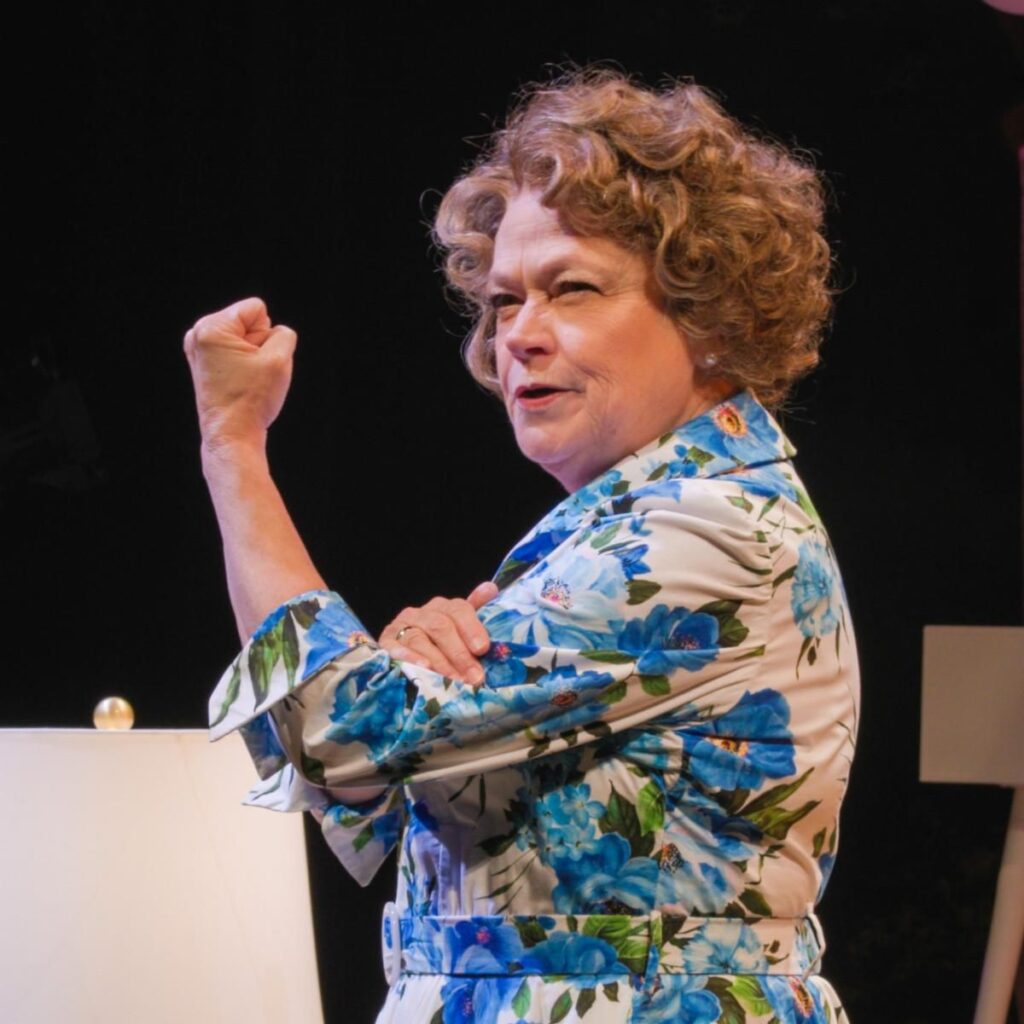
Karen MacDonald as Erma Bombeck in MRT’s ‘Erma Bombeck: At Wit’s End’

by Shelley A. Sackett

Karen MacDonald is nothing short of spectacular in the one-woman show, ‘Erma Bombeck: At Wit’s End,’ now playing at Merrimack Repertory Theatre through March 13. For 80 intermission-less minutes, she doesn’t just play Erma Bombeck; she IS Erma Bombeck, from her impeccable timing to the subtlest gesture and most delicate modulation. Don’t let this one slip away without seeing it. It is a balm of enormous power during these dark tundra days.

That power comes from Bombeck herself, whose simple, perceptive and — most importantly — funny writings are the backbone of the script. It feels so good to just relax, witness a magnificent performance, and laugh.

Daniel Zimmerman’s scenic design sets a perfect table for this theatrical feast. Complete with shag carpet (mustard and chartreuse), mid-century modern furniture and Hoover upright vacuum cleaner, we are instantly transported back to 1960s suburbia. His backdrop creation of a birds eye drone view of a typical neighborhood is as brilliant as it is effective. The effect is like being in a shadow box or viewing a large 3-D cinematic screen turned on its head.

We first meet Erma in her spotless living room, clad in a belted flowered shirtwaist dress, apron, pearls and heels, enjoying a moment’s peace before she starts ironing, vacuuming and folding laundry. MacDonald establishes rapport with the audience before she even utters a word. Yes, she really IS that good an actor.

By the time Erma utters her first line, she has the audience in the palm of her hand. “How,” she asks half in earnest, half rhetorically, “did I end up in suburbia?”

The rest of the monologue traces Erma’s life, from Bellbrook, Ohio to Cherrywood

Orchards community and motherhood to her spectacular career as columnist, book author and nationally sought speaker. Along the way, we are treated to snippets of Erma’s insightful, playful yet always spot-on humor and advice.

A bright woman straddling a line between domestic bliss and oblivion, Erma was a self-described “willing prisoner.” She had her kids early in life and compares the drudgery and workload of stay-at-home motherhood (the second oldest profession) to prostitution (the first), the difference being that mothers don’t get paid.

“I signed up for this life sentence,” she admits (though without, she notes, the usual possibility of parole for good behavior). At the end of the day, however, she offers a one-size-fits-all piece of advice: “If you can laugh at it, you can live with it.”

She escapes her sadness and emptiness by getting back to her writing, which was interrupted by her new role as housewife. She decides to use humor to tell the truth about her life in a column. After her third (and last) child starts kindergarten, she gets started.

Her success is immediate, her popularity taking off like a rocket into space. She goes from one column in a small, local papers to three columns weekly in a syndication of 900 papers nationwide. Yet she never loses sight or grasp of who she is and what her goals are.

“There was love in every line I wrote,” she says. There is also honesty, wit, laughter and pain. Remarkable for their  absence are anger and resentment.

We learn more about how a chance lecture by Betty Friedan launched Erma on her quest to pass the Equal Rights Amendment. She travelled for two years to garner support, writing her columns while on the road. She never missed one deadline during her entire career.

Towards the end of the play, Erma waxes poetic as she wistfully reflects on her career, cancer and waning years. “I was a stay at home mom,” she says. “The key to my writing is I am ordinary. Most of us are unremarkable.”

Although she never won a Pulitzer Prize, she is proud of her columns’ status as “top billing on the refrigerator.” She is such a good sport about everything, rolling with the punches and still harboring no resentment, regrets or complaints. “My plan was to wear out, not rust out,” she admits. “I wrote for me and the other mothers waiting to be recognized. I valued what everyone else took for granted- good old Mom.”

Her final words of advice on staying upbeat through the trials and tribulations of motherhood? “Seize every moment to make a difference,” she urges. “Who wants to live with regrets? Think of all those women on the Titanic who passed up the dessert tray.”

“Erma Bombeck: At Wit’s End.” Written by Allison Engel and Margaret Engel. Directed by Terry Berliner; Scenic Design by Daniel Zimmerman; Costume Design by Teresa Snider; Lighting Design by Joel Shier; Sound Design by Scott Stauffer; Original Music Composed by Brett Marcias. Produced by Merrimack Repertory Theatre, 50 East Merrimack Street, Lowell, MA through March 13.

For tickets and information, go to: https://mrt.org/

An Interview: Meet the Star and Director of MRT’s ‘Erma Bombeck: At Wit’s End’

Karen MacDonald stars as Erma Bombeck in “Erma Bombeck: At Wit’s End. / Photo: Megpix/Meghan Moore

by Shelley A. Sackett

LOWELL — It may surprise many to learn that Erma Bombeck, the celebrated humorist, was not Jewish. With lines like, “If Life Is a Bowl of Cherries, What Am I doing in the Pits?” the big-hearted mother of three had the wit, wisdom, and chutzpah that are hallmarks of a classic Jewish mother. Her nationally syndicated column, “At Wit’s End,” ran in 900 newspapers and championed the undervalued everyday lives of millions of stay-at-home suburban moms, offering them a cathartic lifeline of truth, daring, and laughter. She boosted their spirits by poking fun at herself and her life’s ups and downs in an original, comic voice that was both sassy and satiric.

Born in small-town Bellbrook, Ohio, to a working-class family in 1927, she wrote her first humorous column for her junior high school newspaper and went on to write for the Dayton Herald. She wrote a series of columns while at home with her young children and resumed her writing career in 1965 with biweekly humor columns. Within three weeks of the first articles’ publication, she was picked up for national syndication, appearing three times a week in 36 papers under the title “At Wit’s End.”

By the time of her death in 1969, she had written 15 books and appeared regularly on “Good Morning America.”
As a timely antidote to a bleak January’s cold, snow, and COVID, Merrimack Repertory Theatre in Lowell is serving up a sunny dose of Bombeck’s humor in its one-woman show, “Erma Bombeck: At Wit’s End,” from Feb. 24 through March 13.

Boston based actor, director, and teacher Karen MacDonald will bring Erma’s larger than life personality to the stage. She remembers Bombeck as part of her family’s life from a young age. Her mother, a big fan, would laugh out loud as she read the column every morning, often posting her favorites on the refrigerator.

“You couldn’t bother Mom until she finished ‘reading her Erma,’” MacDonald said by email.

In preparation for the role, MacDonald, who loves doing research, read many of her books, a biography, and revisited “The Feminine Mystique,” a book by Betty Friedan that Bombeck credited as her personal wake-up call.

In the course of her research, MacDonald discovered that Bombeck was complex, funny, and an astute observer of ordinary life. She also discovered much to admire: Bombeck’s diligence in writing three columns a week; her deep respect for the work women do; her devotion to her family; and her commitment to the Equal Rights Amendment.

“There is a rich amount of material for an actor to work with,” said MacDonald.

While pointing out that no one could really “play” Erma but Erma herself, “You want to gather as much as you can to bring to life such a fascinating woman, MacDonald said. “Then, you synthesize all that information and, hopefully, come up with your own Erma, true to her and true to yourself.”

Director Terry Berliner is also no stranger to Bombeck’s writing. “Erma Bombeck has always been part of my life. I do not know a world without her. Her stories showed me the importance of perspective, the power of a good story, and the significance of capturing the truth,” she said by email.

Although Bombeck was the epitome of a woman’s voice being heard across America at her time, she was written off by many for that very reason – because she was a woman in a man’s world. Playwright twin sisters Allison and Margaret Engel, who primarily work as reporters, co-wrote “At Wit’s End” to amplify that voice and garner the acclaim they believe she deserves.

“She was the most widely read columnist in the history of the country, yet she never won the Pulitzer Prize and is rarely mentioned in journalism schools,” the Engels said in an interview. “Most likely, her subject matter – families and children – was not considered as important as the thoughts of political pundits. Yet she chronicled a very important transformation in the lives of ordinary women in this country.”

MacDonald hopes the play will be “just the tip of Iceberg Erma” and that audiences will leave with a curiosity to reread her work, to learn more about her life, and to reconsider her place in American humor.

On a more visceral level, she also hopes “folks will find some relief, in these strange days, with laughter. It feels good to laugh.”

The play will be available virtually throughout its run. For access or in-house tickets, visit mrt.org/ERMA. The Merrimack Repertory Theatre, located at 50 East Merrimack St., Lowell, is requiring all guests to show proof of COVID vaccination or a recent negative test and to wear masks at all times in the building. To learn more about the COVID policy, visit mrt.org/covid.

The Huntington’s Terrific ‘What The Constitution Means to Me’ Is A Timely Romp Through Murky Waters

Cassie Beck in the Huntington’s ‘What the Constitution Means to Me’ at the Emerson Cutler Majestic Theatre. Photos: Joan Marcus

by Shelley A. Sackett

What The Constitution Means to Me asks us to think about and get personal with the US Constitution, and that request couldn’t come at a more timely moment. It seems that hallowed document is front and center in our daily lives, whether we invite it or not. We read the news and, while we were aware Trump was shredding the Constitution with the hope it could never be pieced back together again, we now have to wonder — did he also flush it down the toilet?

We browse news of the Supreme Court’s latest actions and can’t help shivering at how the majority of the chief enforcers of our alleged democracy seem hell-bent on following his lead, emboldening those who would discriminate, marginalize and disenfranchise.

Which is why the Constitution is something I — and I’m sure I’m not alone — have thought about a lot lately.

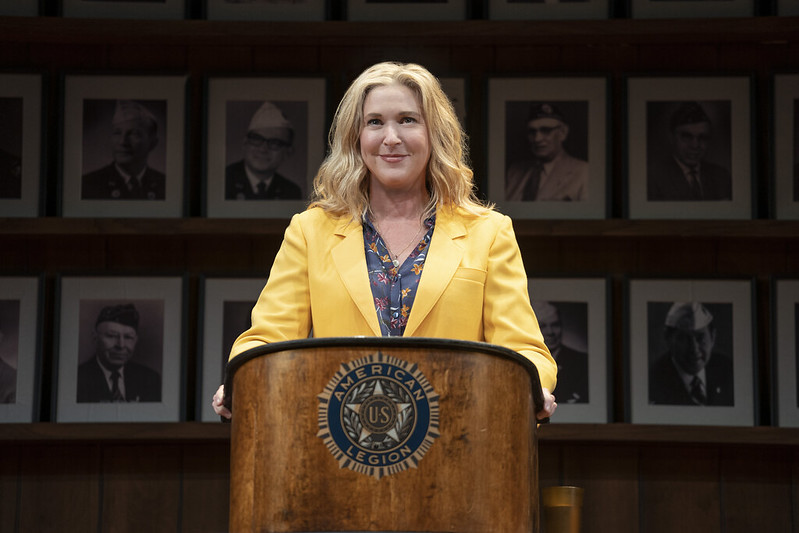
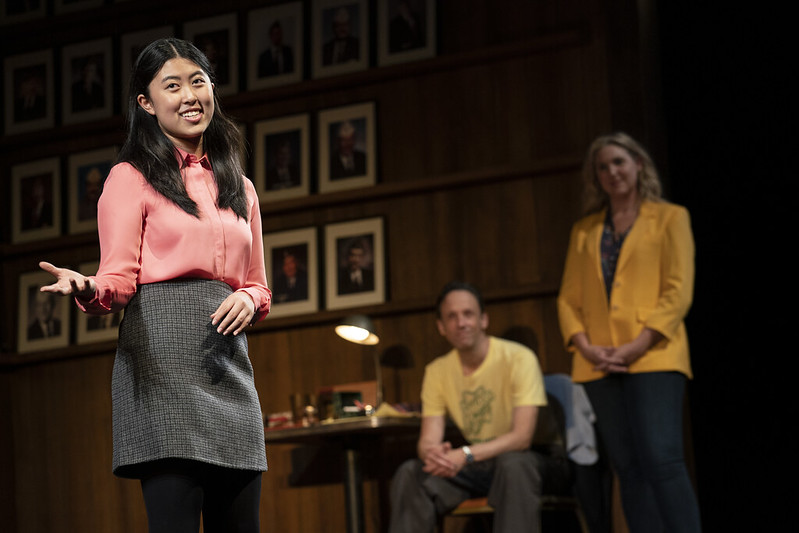
Jocelyn Shek, Mike Iveson and Beck

That experience cemented a deep love for and knowledge of the document she unapologetically venerated until she realized, as she grew older and the rose tint of her glasses faded, that its authors’ intentions were more repressive than liberating.

The spectacularly talented Cassie Beck channels Heidi, and she is a powerhouse and marvel to witness. She is a consummate storyteller, appearing extemporaneous and almost ditzy at times as she methodically lays the groundwork for some heady conclusions. She addresses the audience with warmth, humor and honesty, whether playing her 15-year-old or 41-year-old self. She confesses of late she has been troubled by an unanswered question: what was it she had loved so much about the Constitution when she was a teenager?

For the next hour of the 105-minute intermission-less production, Heidi/Cassie wanders through the Constitution, exposing its flaws and malevolent intent with stories from her own family and from Supreme Court cases. (Authentic recordings of actual Supreme Court hearings add a compelling touch). She highlights how the Framers — all white male property owners — deliberately omitted reference to anyone else when they drafted the Constitution meant to provide equal protection under the laws of the land that document would rule.

Iverson

The Constitution, she points out, “was designed to protect the men who made it and their property — which was sometimes people — from the government.”

This has resulted in sanctioned violence against generations of Native Americans, people of color and women, including her own mother, whose first memory of her stepfather was him socking her mother in the face.

Along for the ride, we learn quite a bit about the Constitution in a way that is not at all reminiscent of law school. Schreck’s understanding and appreciation of that document is deep, and her script transforms complicated concepts into easily relatable vignettes. She tells story after story about women in particular who, she notes, aren’t even acknowledged as existing until the 19th Amendment, ratified in 1920. “What does it mean if the Constitution doesn’t protect women?” she bemoans. By way of tragic example, she shares her own mother’s and grandmothers’ stories of heart-wrenching abuse, allowed by “centuries of laws that told them they were worthless.”

Later, after treating the audience to her primal scream/howling sob — her instinctive coping mechanism against rage and despair that has chased away more than a few boyfriends — she wonders aloud, ”Maybe this is just the appropriate response to everything right now?” That line drew thunderous applause.

Beck, Iverson

Lest this paint a dark and pedantic image of this dazzling production, be assured that there are as many moments of hilarity and lightness as there are of stark reckoning. Teenage Heidi doesn’t only love the Constitution; she also loves Patrick Swayze, magic spells and making out with boys. Beck is charming and engaging, and the physicality and expressiveness of her acting chops is as mesmerizing as it is enjoyable. This is Broadway-quality acting at our own back door.

The last 15 minutes of the show unfortunately break the mood and shift the pace. They are devoted to a debate about whether the Constitution should be scrapped or tweaked. A parliamentary debater, Emilyn Toffler, a 17-year-old Californian — who was annoyingly difficult to hear and understand — joined Beck on stage. The audience received pocket-sized copies of the Constitution (a nice party favor) and, after listening to both sides, was asked to vote whether to preserve the US Constitution as written or scrap it and start over. “It is because of the Constitution, not in spite of it, that we can have this debate,” said Toffler, who was arguing for preservation. In the end, the representative audience member chosen at random to deliver the verdict, agreed.

And so, at least as of last Wednesday night’s performance, the Constitution remains the ruling document of the land. For more information and tickets, go to: https://www.huntingtontheatre.org/

‘What the Constitution Means To Me’ — Written by Heidi Schreck. Directed by Oliver Butler; Scenic Design by Rachel Hauck; Costume Design by Michael Krass; Lighting Design by Jen Schriever; Sound Design by Sinan Refik Zafar. Presented by Huntington Theater Company at Emerson Cutler Majestic Theatre through March 20.

SpeakEasy’s ‘People, Places & Things’ Takes Us Into the Belly of Addiction

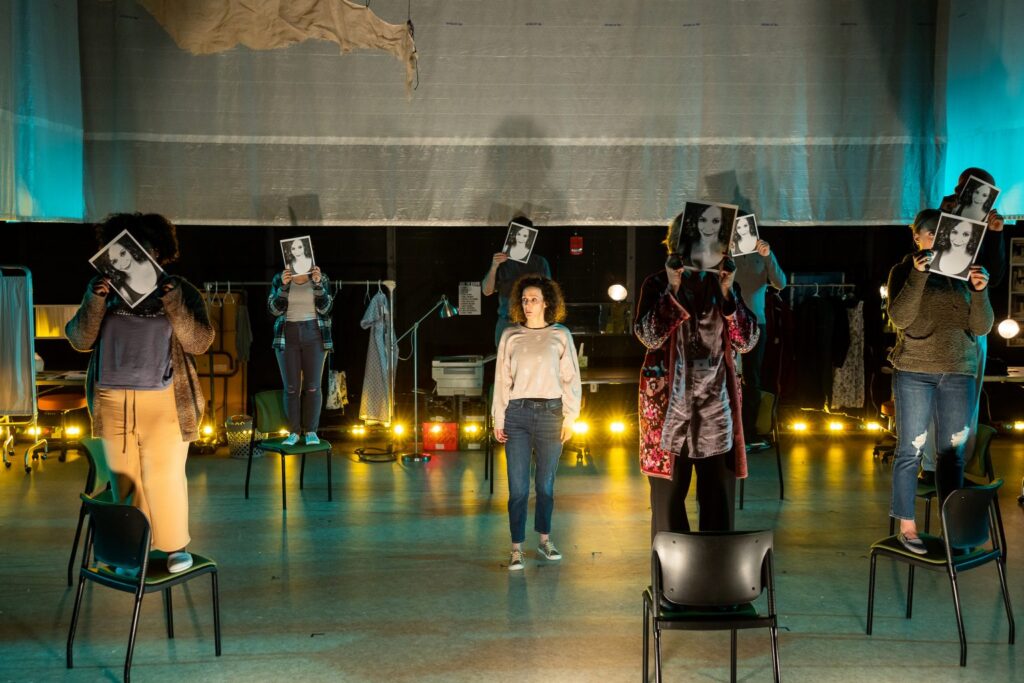
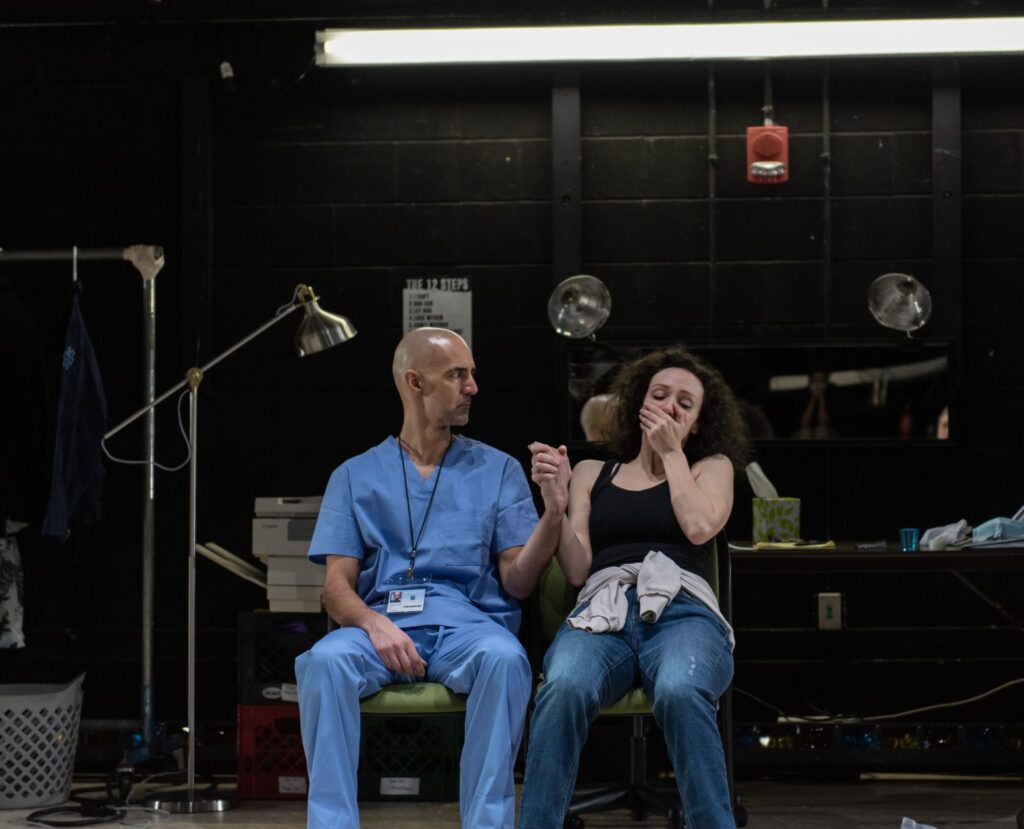
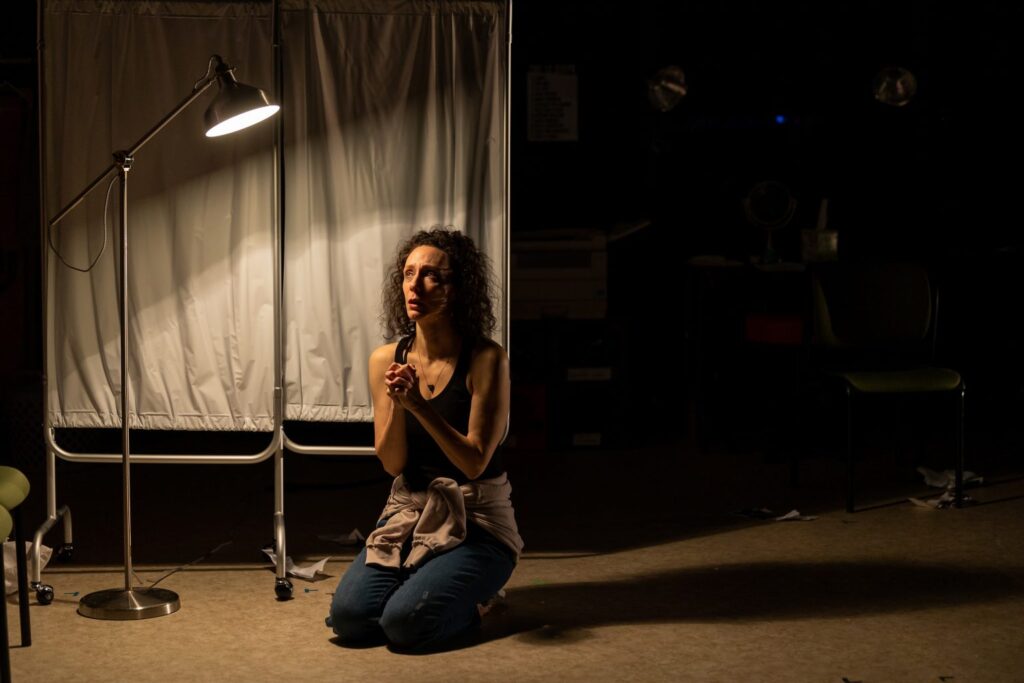
Marianna Bassham and the cast of People, Places & Things. Photos by Nile Scott Studios.

by Shelley A. Sackett

Like Jonah’s whale, addiction can swallow us whole. Unlike Jonah, however, who was freed after a mere three days of praying and repenting, those stuck in the belly of the addiction beast have a much tougher, longer and shakier road to hoe.

Some are up to the challenge and some crumble under the beast’s daunting weight. Some make it and some fake it. Some don’t know the difference and some could care less. And some will circle their self-destructive drain as long as they can, all the while ferociously denying they’re about to drown.

People, Places & Things, SpeakEasy Stage Company’s first-rate, must-see production, covers a lot of ground and checks a lot of boxes. Playwright Duncan Macmillan unsentimentally tackles the uncertain journey from addiction and recovery and the many shapes and forms it can take. For two and a half hours, the audience is in the thick of the raw process of rehab, detox, group therapy, relapse and the harrowing realization of what “one day at a time’ really looks like.

Nael Nacer, Bassham

If this sounds like a maudlin, predictable trope, it is anything but. Working with Macmillan’s sharp, incisive script, director David R. Gammons has created a phantasmagoria with flashing strobes (light design by Jeff Adelberg) and vibrating sounds (David Wilson) that make us feel like we are marching right beside these crumbling, addicted minds on the verge of self-destruction. He has also amassed a splendid ensemble cast to bring the script to life, most notably the exceptionally talented Marianna Bassham as Emma. Her performance alone is reason enough to high tail to BCA.

The play opens as a play within a play, with a backstage section with costumes and make up tables visible behind a curtain that bisects the sparse set. In the forefront, an area rug and furniture mark the set of Chekhov’s The Seagull, which the audience is plopped into as if dropped from a time machine. It is the final act and the main character Nina (played by Emma/Bassham) is on stage, holding a stuffed seagull and delivering a tragic speech. All seems normally Chekhovian until it becomes obvious that this Nina is completely out of it. She stumbles, blunders and eventually falls, taking the entire stage with her and plunging the set into darkness.

As the lights come back up, we are in the reception area for rehab and Emma is about to let us through the keyhole of what it means to live in her chaotic inner and outer world. The impossibly willowy Bassham is mesmerizing. Her staccato cadence and flawless timing, fluid physicality and frantic attempts to minimize the seriousness of her addiction are simultaneously heartbreaking and hilarious. Macmillan knows his way around clever dialogue and director Gammons has a powerhouse to deliver them in Bassham.

Kadahj Bennett, Bassham

The intake scenes with the Doctor (an excellent Adrianne Krstansky, who also plays the therapist and Emma’s mother) clue us in to the obstacles Emma will face on her road to recovery, which demands truthfulness as a non-negotiable first of 12 steps. She is an actress, we slowly realize, whose stage is both life and theater. The lines between acting and living her life have become so blurred that when she gives her name as “Nina,” her most recent role, we half believe she believes it.

In fact, she thinks she just needs “a tune up” and is only checking into rehab because no one will hire her unless she is certified as clean. This is all one colossal opportunity for her to both write the script and star in it. She’s not even willing to talk the talk, let alone walking the walk,  “Drugs and alcohol have never let me down,” she declares. “Addiction is a parasite. It will eat you until you’re dead,” the Doctor counters.

Once she is admitted, the bulk of the play is a behind-the-scenes look at residential rehab, from group therapy sessions to tragic relapse and back again. As always, the immensely talented Nael Nacer (Mark) is a standout. A fellow addict, he befriends Emma and holds her feet to the fire. He really cares about his recovery and he cares about her.

Mark has been around the rehab block and knows that recovery cannot happen without honesty, both with oneself and with others. Nacer brings confidence and decency to the role, a casual elegance that makes Mark seem genuine and transparent. He is the perfect foil to Emma’s desperate hiding behind defiance and lies. “If I’m not playing a character, I’m not sure I’m really there,” she finally admits.

There are moments of real surprise and pathos. In particular, a powerful scene when post-rehab Emma tries to make amends to her parents sheds unexpected light on the possible underlying reasons for Emma’s addictions and low self-esteem.

Macmillan has certainly given us plenty to chew on and posed some provocative, core questions. How do we make sense of a world that feels like it’s spinning out of control without self-medicating? How do we live an honest life in a world built on lies, where people reinvent themselves on social media and the “news” embraces alternative facts? How do we let go of control in the midst of chaos? How do we learn to love and be kind to ourselves? And, most importantly, how do we acknowledge those people, places and things that render us powerless over addiction — and then have the courage to leave them behind?

‘People, Places & Things’ — Written by Duncan Macmillan. Directed by David R. Gammon;, Scenic Design by Jeffrey Peterson; Costume Design by Gail Astrid Buckley; Lighting Design by Jeff Adelberg; Sound Design by David Wilson, Video Design by Adam Stone. Presented by SpeakEasy Stage Company at Boston Center for the Arts through March 5.

For more information and tickets, go to: https://www.speakeasystage.com/

Music lifts the spirit at Congregation Shirat Hayam

Clockwise, from left: David Sparr, Jeremiah Klarman, Lautaro Mantilla, and Noam Sender

by Shelley A. Sackett

SWAMPSCOTT — Those who attend Holy Happy Hour and Saturday morning Renewal services know firsthand the beauty and grace four professional musicians bring to the experience. Some travel from afar; most also work in other congregations. Other than being musicians, the one thing they all share is their love for the welcoming Shirat Hayam community and its innovative approach.

“To walk into a job with a long roster of professional musicians already in place is such a gift,” said Cantor Sarah Freudenberger. “The history these musicians have in working with previous cantors and Rabbi Michael Ragozin, and the congregants knowing and loving them, is a great help to me as the new person in the mix. Each musician brings his own feelings and style, and our collaboration is special and new with every service.”

Pianist David Sparr, who lives in Nahant and joins Shirat at both services, has performed professionally for 47 of the 63 years he has been playing. He is music director at Temple Ohabei Shalom in Brookline and also performs in jazz clubs, churches, synagogues, senior living facilities, and concert halls. He first came to Shirat through his acquaintance with Cantor Emil Berkovits z”l. The two performed together and Cantor Emil later recorded at David’s studio. He continued the connection with Shirat Hayam’s clergy.

“The spirit of the clergy and the welcoming embrace of the congregation always inspires me to perform at a high level,” he said.

Bostonian Jeremiah Klarman has played piano for 25 years and percussion for 15 years. He plays both at Shirat during Renewal services. He also plays at Temple Emanuel in Newton – where he is Artist in Residence – and recently started playing at an African Methodist Episcopal church. Other engagements have included weddings, concerts, and even accompanying an improv group.

Through a joint concert in 2017 at Temple Emanuel, Jeremiah met Cantor Elana Rozenfeld. She invited him to play for an event at Shirat. He joined her at Renewal service and has played there ever since.

“Among all the synagogues I’ve played at, Renewal at Shirat is unique. It has a mystical, more ‘song leader’ element [which speaks to me because I grew up in a Reform synagogue]. There is also a more Hasidic, “yearning” element. The repertoire we do is varied and speaks to this diverse approach of what Renewal offers for so many people,” he said.

His favorite part is when he, the cantor, and the rabbi are in sync about when and how a song should continue, get faster, get slower, etc. “There’s no planned formula and it just happens. As a musician, those are some of the moments I live for, and it’s very special to share those moments with others,” he added.

Lautaro Mantilla travels from Framingham to play guitar at Holy Happy Hour and Renewal services. The native Colombian guitarist and composer comes from a family of musicians and artists, and started playing when he was 3 years old. He has been playing for over 20 years and teaches at the New England Conservatory. He performs frequently at Jordan Hall and several other smaller venues in Boston and New York.

A couple of years ago, Lautaro was invited to play a classical guitar concert after a Yom Kippur service at Shirat, and “right from the start, the congregation was extremely welcoming and opened their hearts to me and my music, for which I feel very grateful and blessed,” he said.

What he likes best about playing at Shirat are “the incredible depth, energy, and powerful feelings that every service has, and how these feelings go with you after you perform. It’s a unique feeling that I always have performing there.”

Noam Sender is a multi-instrumentalist from Waltham who has been singing and playing hand percussion, guitar, and ney (Turkish flute) for over 50 years. Although these days he plays mostly in synagogues, over the years he’s performed in university auditoriums, music clubs, museums, and community centers.

He was introduced to Shirat about 10 years ago, when congregant Michele Tamaren organized the interfaith event, “Make a Joyful Noise! Uniting our Spirits through Jewish, Islamic and Christian Music.” He played Sufi music with the Islamic Ensemble and, unexpectedly, was invited to sit in with the Jewish Ensemble, where he first met Shirat’s Cantor Elana Rozenfeld. She invited him back to play at various events, including Shabbat Olam and Selichot services. Not long after, he became a regular musician at the Shabbat Renewal service.

“I love the Shirat community, and over the years I have made many friends here. I am grateful to be a part of the Renewal service and always set my intention to bring joy, upliftment, and inspiration to the congregation. Hopefully in the process, I also help create a sacred and soulful space,” Noam said.

He also teaches Jewish spiritual wisdom once a month at Nosh & Drash right after the Renewal service. “I discuss the mystical treasures hidden within the weekly Torah portion through a Hasidic lens, providing participants with spiritual tools and understanding for everyday life,” he said.

Huntington Theatre’s ‘The Bluest Eye’ Is A Triumph

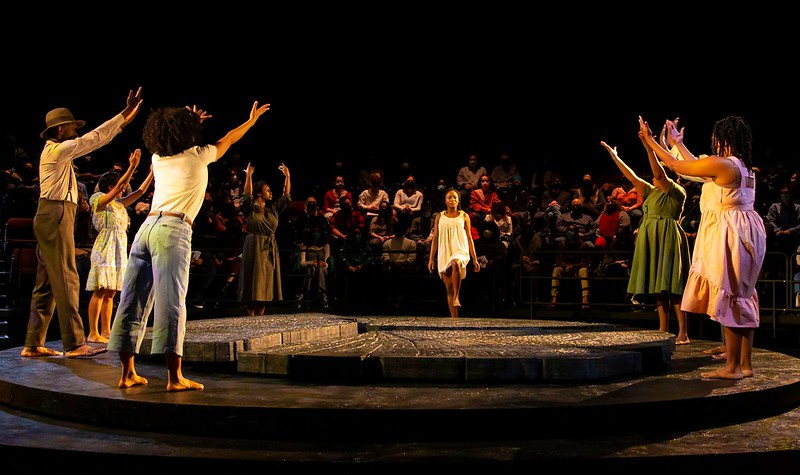
Cast of The Huntington Theatre’s production of The Bluest Eye by Lydia R. Diamond

by Shelley A. Sackett

Brimming with sparkling ensemble acting, inspired staging and soulful song and dance, Huntington Theatre’s The Bluest Eye packs a wallop. Thanks to Lydia R. Diamond’s faithful yet nuanced adaptation, Toni Morrison’s groundbreaking début novel about two poor Black families in 1940s Lorain, Ohio is brought to the stage with all its poetry, pathos and humor intact. You can almost feel Morrison’s presence in the audience, beaming pride and approval.

The story is neither easy nor pretty. Nor is it sugar-coated. A harrowing (and timely) tale about the insidious effects of racism, the 80-minute intermission-less play explores what happens to people — especially children — whose identities and self-images become distorted by the relentless oppression and cruelty they suffer.

What happens to that marginalized little Black girl who feels neglected, lonely and ugly? Whose hand local (white) shopkeepers won’t touch? Whose home life is abusive and unsafe? Whose only frame of reference for happiness, friendship and family harmony is the Dick and Jane primer she reads every day in school, the one about white, blue-eyed, blond Jane and her adoring, white parents?

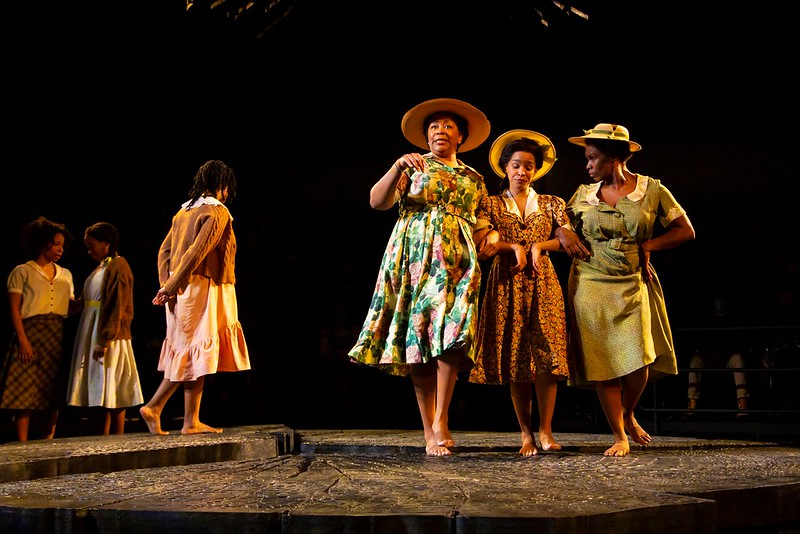
Brittany-Laurelle, Hadar Busia-Singleton, and Alexandria King

From the get go, there is a feeling of community and engagement among the actors and between actors and audience. Performed on a raised, round stage between two semi-circles of audience members, the (masked) physical immediacy and intimacy heightens the mood. No one is hidden; no one can hide.

The play opens with two feisty preteen sisters discussing local gossip. Claudia (Brittany-Laurelle, who brings a powerful but contained individuality to the role) and Frieda (Alexandria King in a magnificently physical and expressive, punchy performance) will act as narrators and guides, and their sassy, lighthearted banter is the perfect foil to the heaviness of the story that will unfold. Like vocal choreography, their voices dance with and around each other, weaving a single tapestry from many strands.

Their main topic of conversation is the Breedlove family, the ugliest family in Lorain. “Their ugliness came from a conviction that they accepted without question,” Claudia explains. Eleven-year-old Pecola Breedlove (played by the hypnotic Hadar Busia-Singleton, who manages to infuse her unbearably sad character with a whisper of hope) knows the world finds her Blackness ugly. “How do you get somebody to love you?” she asks over and over.

But she has a plan. She has figured out the key to being lovable. All she needs are blue eyes, as blue as Jane’s and Shirley Temple’s. “Then the teachers would see me and people would have to be nice to me,” she explains matter-of-factly.

R foreground: Ramona Lisa Alexander, Lindsley Howard, McKenzie Frye

Claudia and Frieda’s recollections and narrations are the backbone of the play, told with overlying reenactments of the various scenarios that have shaped and marked their and Pecola’s families. Mrs. Breedlove (McKenzie Frye) is a cleaning woman with a bum foot and missing front tooth who would go to the movies and dream of looking like Jean Harlow. Her husband Cholly (Greg Alverez Reid) suffered the kind of loss, humiliation and violence that doesn’t excuse his inexcusable acts, but at least provides context. Beneath their toughened exteriors, each carries the weight of unbearable despair. Together, they are a ticking time bomb, Pecola its collateral damage.

By comparison, Claudia, Frieda and their Mama (played by Ramona Lisa Alexander as unyielding and fussy yet kindhearted) lead a life of relative ease and stability. These three are the source of the play’s lightness and humor. As Claudia, Brittany-Laurelle brings down the house in the reenactment of a scene when she received a blond, white baby doll as a gift. To her mother’s disbelief and horror, rather than covet it, she destroys it, but only after she has humiliated and terrorized it. She hates its so-called beauty. “What was I supposed to do with that?” she asks without irony.

Through a series of events that would include spoilers, Pecola’s prayers for blue eyes and all that means seem to be answered by the magic of Soaphead Church, a charlatan soothsayer, played brilliantly by Brian D. Coats. Yet, it is at such a steep price that we are left grieving for this child whose innocent light has been extinguished.

Under Awoye Timpo’s direction, The Bluest Eye brings a lot of extras to the table. She makes wonderful use of a trio of women who appear throughout the production, imbuing them with many of the gestures and props familiar to fans of Alvin Ailey’s “Revelations.” They are welcome palette cleansers, acting as part Greek chorus, part harpies, and part goddesses. The interweaving of a capella spirituals (Frye is a knockout) and choreography (especially the slow-motion battle scene between Cholly and Mrs. Breedlove) is inspired and welcome.

The Boston theater scene is replete with many productions that are well worth seeing. Only a handful rise to the level of “must see.” The Bluest Eye is one of them.

‘The Bluest Eye’ – Based on the book by Toni Morrison, adapted for stage by Lydia R. Diamond, Dramaturgy by Sandy Alexandre. Directed by Awoye Timpo; Set Design by Jason Ardizzone-West; Costume Design by Dede Ayite and Rodrigo Muñoz; Lighting Design by Adam Honoré; Sound Design by Aubrey Dube; Original Music by Justin Ellington; Choreography by Kurt Douglas; Music Direction by David Freeman Coleman. Presented by Huntington Theatre Company at Boston Center for the Arts through March 26. Digital recordings available Feb. 14 through April 9.For tickets and information, go to: https://www.huntingtontheatre.org/

Beverly filmmakers document Alabama vaccination campaign; will screen at Sundance festival

Rachael DeCruz and Jeremy S. Levine

By Shelley A. Sackett

It was spring 2021, the second year of the pandemic, and filmmakers Rachael DeCruz and Jeremy S. Levine were depressed. They were living in Alabama, a state with one of the lowest vaccination rates in the country.

“We had nearly forgotten what it was like to make eye contact with other humans. We finally had a vaccine, but people weren’t getting the shot – at least not in Alabama,” Levine said by email.

The Massachusetts natives’ dour moods lifted, however, when they heard about Dorothy Oliver, a woman who was running a vaccination drive out of her mobile home convenience store in Panola, a rural Black town of almost 400 near the Mississippi border. Panola was too small for its own COVID vaccine center and the closest hospital is almost 40 miles away. Many residents don’t have cars; some still rely on horses for transportation.

Oliver and County Commis­sioner Drucilla Russ-Jackson hatched a plan to keep their town safe. Rather than try to bring Panola’s unvaccinated to the hospital, they would bring the hospital to Panola. They persuaded a local clinic to bring a pop-up site to the town under one challenging condition: They had to convince 40 residents to sign up for the vaccine.

Although Panola had its share of skeptics, a lot of residents wanted the shot. It was logistics – not anti-vax ideology – that kept them from getting it. As social justice advocates and activists, Levine and DeCruz were troubled by the underlying unfairness behind the public health reality of this poor, Black rural community.

They jumped into their car and drove out – unannounced – to meet Oliver at her store. “Instead of sitting on our couch in a state of existential dread, we set out to seek solutions – and frankly, some hope,” said Levine.

Oliver welcomed them like family from the beginning. “She showed us that even in trying times, even when discussing a politically fraught issue, the only way forward is with hope, warmth, and a sense of humor,” DeCruz said.

Levine and DeCruz were so struck by Oliver’s tenacity and the injustice of Panola’s situation that they decided to bring the story to a larger audience. “The Panola Project,” a 16-minute documentary they coproduced and codirected, chronicles Oliver’s campaign as she goes door to door, talking people into signing up and lightly chiding them about their fears and concerns. The film was recently named an official selection of the 2022 Sundance Film Festival.

DeCruz and Levine, who grew up in Beverly but met as adults in New York City, share a deep commitment to social justice issues. They were both raised in families grounded by Jewish values, culture and traditions. They moved to Tuscaloosa when Levine was hired as an assistant professor of media production at the University of Alabama.

Levine remembers learning about the Jews’ difficult history as a kid, when he attended Hebrew school at Temple B’nai Abraham in Beverly. “This created a deep-rooted desire to fight for justice for all. The idea of ‘tikkun olam’ was important to my worldview from early on,” he said.

DeCruz’s life and identity were shaped by both race and religion. Her mother is white and Jewish and her father is Black. Growing up, she didn’t know many mixed-race families and at home, “We never talked about race, despite the fact that it was impacting each of our lives every day in numerous ways. I spent a lot of my childhood trying to figure out my place and understand the many layers of my identity. These factors were a large part of what drove me to do racial justice work,” said DeCruz, the associate director of advocacy at Boston University’s Center for Antiracist Research.

“The Panola Project,” which spotlights the racial and social inequities behind public health policy, was a perfect fit for these two filmmakers professionally and personally, with Oliver as its perfect spokesperson. “I just felt like I had to do it because the government, nobody does enough in this area,” Oliver explains on camera. “This area here is majority Black. Kind of puts you on the back burner.”

Oliver received USA Today’s Best of Humankind/Best of Womankind Award, which recognizes and celebrates an everyday person who is making a difference in their community. Dr. Anthony Fauci thanked her, saying her work can serve as a model for the country.

DeCruz points out that, despite Alabama having one of the lowest vaccination rates in the country, 99 percent of adults in Panola have now received their shots, thanks to Oliver and Russ-Jackson’s relentless campaign. “The film showcases the incredible strength of Black women who frequently serve as the backbone holding their communities together,” she said.

For Levine, who recently began as a communication, journalism, and media professor at Suffolk University, the power of storytelling became obvious at an early age. He clearly remembers the pivotal moment that set him on his journey as a filmmaker, or “visual storyteller” as he calls it.

He was a 7-year-old, fulfilling his Hebrew school assignment to record a relative’s story. Armed with a plastic Playskool cassette tape recorder, he interviewed his great-grandmother about her journey to the United States. She told the boy how – when she was just a child – her parents hired a smuggler to sneak her out of Russia under the cover of night to escape antisemitism.

“Had I not gone that day with a tape recorder, her story would have been lost. The connections to our contemporary stories of migration would have been lost with it. This showed me, at a young age, the power of stories,” he said.

To view “The Panola Project,” go to youtube.com/watch?v=j1wI4T9SKGA.

Danvers Holocaust Symposium asks ‘What does the Holocaust have to do with me?’

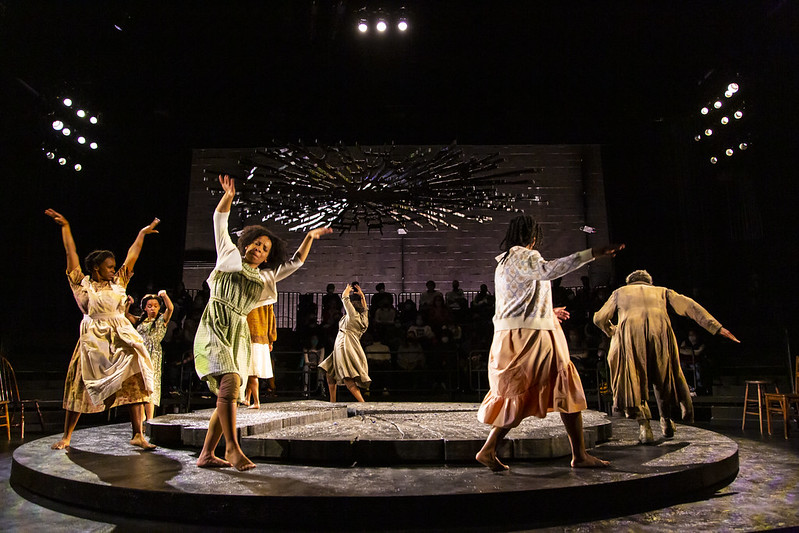
50th anniversary revival of ‘Jesus Christ Superstar’ storms the stage
Three swastikas have been found at Danvers public schools since the fall.

by Shelley A. Sackett

DANVERS — Last year, Danvers was in the news, but not for reasons that made its leaders and community members proud. Amid allegations of antisemitism, racism and homophobia in the Danvers High School hockey team, there were complaints about lack of transparency and accountability in the school and police departments. Then, in November, swastikas were discovered at the Holten Richmond Middle School and in December, a swastika was found at Danvers High School.

In response, about 200 people gathered for a “vigil of inclusion” organized by the Danvers Human Rights and Inclusion Committee and the Danvers Interfaith Partnership. But Danvers officials, especially the School Committee and administration, wanted to go further.

To that end, Danvers Public Schools partnered with Lappin Foundation to host a six-week Intergenerational Holocaust Symposium on Zoom. The free program began Jan. 6 and includes 39 students and 34 adults.

“We need to continue to work on ensuring our school has a safe and respectful climate and empower all our community members to call out and fight against biased and hateful language and actions,” Danvers High School Principal Adam Federico said in an email. “This work needs to be done by students, faculty and families.”

Consisting of curated materials, primary sources, films, survivor testimony, a book read and discussions, the symposium was created in response to antisemitism, swastikas and racist graffiti showing up more frequently in schools and in community settings. Danvers is the fourth symposium (the others were at New England Academy and Duxbury and Newton North High Schools) and the first to be open to the entire community.

“I believe education is our best hope. Opening the symposium to students and adults in Danvers to learn together has been especially powerful,” said Deborah Coltin, who is Lappin Foundation’s executive director and also runs the symposium.

So far, participants couldn’t agree more.

At the beginning of the first session, Coltin posed the open-ended question, “Why are you here?” Many answered that they wanted to make a difference in Danvers and to be on the side of not making light of recent events. “I want to be rebooted in my attitudes,” a student said.

Tess Wallerstein, an 11th grade Jewish student, took comfort in knowing there are “actually people in Danvers who genuinely care about this topic.” She believes a large percentage of people spreading antisemitism either have an incorrect understanding of the Holocaust or are rooted in ignorance. “Symposiums like this could help lots of people gain a better understanding of major issues and could bring community members together in open discussions by connecting young and old,” she said.

Parent Mike Hass wants to help raise the bar on what is acceptable behavior. He also wants his daughter to learn more about the deeper societal issues that led to the Holocaust. “I want her to see and experience that speaking up and taking an active role in society is critical to shaping the world around her,” he said in an email.

Danvers Chief of Police James Lovell believes the program can serve as a framework for additional, admittedly difficult conversations that will help Danvers grow as a community. “More importantly, I hope to learn things I can do in my role as a public official and leader to ensure we properly investigate incidents of antisemitism and help create a culture where hate is not acceptable or tolerated,” he said in an email.

The program included the movie, “The Path to Nazi Genocide,” that uses rare footage to examine the Nazis’ rise and consolidation of power in Germany. Intended to provoke reflection and discussion about the role of ordinary people, institutions, and nations between 1918 and 1945, the film did just that.

Students and adults agreed that seeing video recordings from that era was much more impactful than reading about it in books. “Nothing is left to the imagination. This is a wake-up call,” said a student. “Seeing the sophistication of the Nazis’ approach, the normalization of ‘us’ and ‘them’ and the hijacking of tradition – that really scared me,” added an adult.

For Selectman David Mills, Human Rights and Inclusion Committee co-founder, seeing the ease with which ordinary people were drawn into something so horrible disturbed him. “Do we all have that monster lurking just below the surface?” he asked.

Community member Carla King, who learned about the symposium through DanversCARES, has visited the United States Holocaust Memorial Museum and attended lectures on the topic. She thought she knew more than many about the Holocaust. After the first session, she realized and appreciated there was much more for her to learn.

She was unnerved to watch the events that led to Hitler’s rise to power. “It was very powerful for me thinking of the current climate in the U.S. and that some of what we see is how it all started,” she said in an email. “Our children need to be educated about what the swastika means. I don’t believe they really understand, and if they did, I don’t think they would be doing what they are doing.”

Mary Wermers, assistant superintendent of Teaching and Learning at Danvers Public Schools, thinks outreach like this symposium can help Danvers. “We need passive bystanders to become upstanders in the community. It is time that we call out biased remarks and/or actions, try to explain why it is hurtful and not stand by and let it happen,” she said in an email.

Dave McKenna, who co-founded the Human Rights and Inclusion Committee in 1993 and is superintendent of Jewish Cemeteries of the North Shore, would go one step further. “We need to find a way to reach those who have no interest in learning about these issues and enlighten them as to the cause and effect of divisiveness and how it leads to hatred,” he said in an email. “We still have a long way to go.”