Ruderman Summit gives voice to disabled


Above: Jay Ruderman, president of the Ruderman Family Foundation, presents Oscar-winning actress Marlee Matlin with the Morton E. Ruderman Award in Inclusion in Tel Aviv earlier this year.

BY SHELLEY A. SACKETT

NOVEMBER 2, 2017 – Over 1,000 attendees will have the opportunity to hear 50 speakers address ways to open doors for people with disabilities when the Ruderman Family Foundation holds its 2017 Inclusion Summit at the Seaport Hotel & World Trade Center in Boston on Nov. 19 and 20.

Among those who will appear are disability activist Marlee Matlin, a Jewish performer who is the only deaf film star ever to receive an Academy Award for Best Actress in a Leading Role for 1986’s “Children of a Lesser God;” Senator Maggie Hassan of New Hampshire; Richard Marriott, chairman of the Marriott Foundation for People with Disabilities; and Joyce Banda, former president of Malawi.

“These are people who spend time and effort trying to change their community,” said Jay Ruderman, president of the Ruderman Family Foundation.

For over a decade, the foundation’s philanthropic mission has emphasized both advocacy for the inclusion of people with disabilities worldwide and educating Israeli leaders on the American Jewish community. This is the second Inclusion Summit, and Ruderman expects the conference to sell out.

“Our approach to disability inclusion is very holistic and includes all aspects of life, from birth to death: entertainment, education, employment, housing, sports, politics, and more,” Ruderman said. “The purpose of the summit is to convene the movers and shakers in all these fields to share best practices and network. We want to amplify the momentum of the disability rights movement so that it can have a more prominent presence in mainstream American culture.”

Although the foundation  – which has offices in Boston and Israel – has a global reach, it has invested more than $20 million in strategic multiyear initiatives in the Metro Boston area. These programs touch the lives of people of all ages with all types of disabilities.

On the North Shore, Temple Sinai in Marblehead and Congregation Shirat Hayam are partners in the Combined Jewish Philanthropies/Ruderman Synagogue Inclusion Project, which helps create religious communities where people of all abilities can fully participate. The Jewish Community Center of the North Shore also partners with the foundation to offer a year-round early childhood education program and an inclusive summer camp that makes a fun experience available to both campers and staff with   disabilities.

It doesn’t stop there. The foundation’s partnerships with CJP and Newton-based Gateways: Access to Jewish Education provide opportunities for children with disabilities in kindergarten through grade 12 to receive a Jewish education in an inclusive community. The Morton E. Ruderman scholarship helps defray the cost of both school-based and ancillary services for students with physical and emotional challenges. The goal of both programs is to mainstream students with disabilities in Jewish educational programs.

High school students benefit from a number of Ruderman Family Foundation partnerships. Student-athletes with visual or mobility impairments can participate in high school sports across eight states through the Northeast Youth and High School Inclusive Sports Initiative, a joint program with Adaptive Sports New England. New England Yachad and the foundation sponsor high school clubs, a youth leadership board, and a Jewish youth group network that provide opportunities for participants with and without disabilities to attend retreats, leadership training, and meetings.

Young adults with disabilities can receive training and job placement though Transitions to Work, a partnership among the Ruderman foundation, CJP, and Jewish Vocational Services. Since 2011, 200 individuals have graduated from the program. Of the 72 percent who achieve competitive employment, over 90 percent stay at their jobs for at least one year.

Partnerships with the Boys & Girls Clubs of Boston and Dorchester; Brookline Community Mental Health Center; Mass. General Hospital; and the Boston Jewish Film Festival all further the foundation’s mission: inclusion of children and adults with disabilities as a social justice imperative.

Jay Ruderman feels strongly that bringing public attention to injustices suffered by people with disabilities is critical to starting a public debate. His family’s foundation’s current strategy of developing a strong advocacy presence is aimed at raising the general public’s awareness.

“We recognize that our grantees are excellent at providing services, but to change minds, and ultimately to change social attitudes, we also need advocacy,” he said.

All this activity and global impact is the outgrowth of the belief and commitment of foundation founder Morton E. Ruderman that disability rights are civil rights. When Jay Ruderman contemplates how far the foundation has come since it was established in 2002, he thinks his father, who died in 2011, would be surprised.

“We started out as a foundation that was really focused on the Jewish community in Boston, and now we’ve expanded to having worldwide reach. I think he’d be proud of that,” he said.

For more information or to register, visit inclusion2017.org.

Swampscott author explores a 430-year-old mystery


NOVEMBER 2, 2017 – SWAMPSCOTT – About five years ago, Deahn Berrini and her family were enjoying dinner at their Swampscott home. Her son, knowing of her interest in Native American people, mentioned that researchers had just discovered a clue to the lost colony of Roanoke Island, off the coast of North Carolina.
“I said, ‘That could be a good story.’ And then my son said, ‘Hey, mom. You could write that,”’ said Berrini, the daughter of an Air Force father, who was born in Wiesbaden, Germany. A member of Temple Emanu-El in Marblehead, she grew up in Ipswich and attended Brown University, where she majored in history, and Boston College Law School.

When her son brought it up, she found herself drawn to that unsolved puzzle of the mysterious disappearance of 115 British men, women, and children in 1587. Once she started her research, she knew she wanted to write the story, but not from the colonists’ point of view.

Some have speculated that Native Americans attacked and killed the English colonists. Others theorize they tried to return to England and were lost at sea, or might have been killed by Spaniards who came north from Florida. One theory suggests the settlers were absorbed into friendly Native American tribes.

When Berrini approached the story from the point of view of the people who were already there – the Croatoan Native American tribe – her heart and her imagination followed. “The characters came to me fully formed,” she said.

“When we think of the story we’re taught in middle school, it’s from the white British point of view. We’re never taught to think about the native peoples who were living there before the Europeans arrived. It was a thriving place up and down the eastern seaboard. We have very little consciousness of that.”

Four years and three rewrites later, Berrini hopes to change that with the publication of her third historical novel, “A Roanoke Story,” on Nov. 30. She will launch her book tour by reading from and discussing the book at the Swampscott Public Library from 7 to 9 p.m. on Monday, Nov. 13.

In addition to broadening our understanding of history, Berrini also sees a clear connection between “A Roanoke Story” and the abiding Jewish tenet of social justice. As head of Temple Emanu-El’s social action committee for the past five years, she has championed shedding light on unfairness and untruths.

“A lot about our country’s origins has been mythologized to make it easier to swallow,” she said. “I hope readers will look at the colonization of this country with a greater sense of the people whose land we invaded. Telling the story from the point of view of the marginalized people, that’s the social justice component.”

The Swampscott Public Library is at 61 Burrill St.
For more information, visit swampscottlibrary.org or call 781-596-8867.

North Shore task force holding forum to address anti-Semitism on college campuses

antisemitism

“Campus anti-Semitism is becoming more complex and pervasive,” says Kenneth L. Marcus.


OCTOBER 19, 2017 – SWAMPSCOTT – Rabbi Michael Ragozin was particularly fired up during his 2016 Kol Nidre sermon at Congregation Shirat Hayam. The topic was anti-Semitism on college campuses, an issue he said “Gets me in the kishkes. It was in college that my Jewish identity solidified and set me on my trajectory. I don’t know that I would have grown in the same way if I had been under attack simply for being Jewish.”

That sermon generated interest and launched the Campus Anti-Semitism Task Force of the North Shore. Its mission is to promote awareness of campus anti-Semitism; to educate teens on how to deal with situations they may encounter; and to empower students to advocate for themselves and others.

Task force participants include members of Shirat Hayam in Swampscott, Temple Emanu-El in Marblehead, unaffiliated families, and Marty Schneer, executive director of the Jewish Community Center of the North Shore.

“The issue of campus anti-Semitism is not the sole dominion of a single individual or shul,” Rabbi Ragozin said. “We must all work together to put an end to the hate, lies, disinformation, and intimidation on college campuses.”

On Sunday, Oct. 29, the task force will sponsor its fall event, “What’s Up at College,” a panel discussion about Jewish life on campus geared to parents and teens. The panel includes current college students, professionals and alumni. It will take place from 5:30 to 7 p.m. at Congregation Shirat Hayam, 55 Atlantic Ave., in Swampscott. Rabbi Ragozin will moderate.

“I hope teens and their parents will leave feeling empowered,” said Arinne Braverman, one of the panelists and the former executive director of Northeastern University Hillel. She will provide information about how the State Department defines an anti-Semitic act and will address the active role students and their families can play by participating in community responses to campus incidents.

Two alumni of the Epstein Hillel School in Marblehead, Dylann Cooper, a senior at Roger Williams College, and Zach Shwartz, a graduate of Boston University, will be joined on the panel by Tufts University sophomores Madeline Blondy and Rachel Wulf.

Last April on the night before Passover, members of the Tufts Community Union Senate passed a divestment resolution that accused Israel of being an apartheid regime and endorsed the BDS (Boycott, Divestment, Sanctions) Movement.

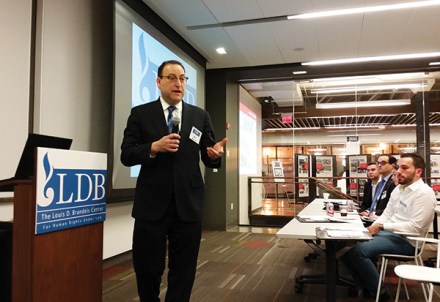
Similar issues are arising widely and more frequently, according to Kenneth L. Marcus, president and general counsel of the Louis D. Brandeis Center for Human Rights Under Law in Washington, D.C., and author of “The Definition of Anti-Semitism” and “Jewish Identity and Civil Rights in America.”

“We’re seeing four important trends lately,” he said. “First, alt-right activity is substantially increasing. Second, left wing anti-Zionist activity continues to surge. Third, in the current environment, anti-Zionist activity tends to merge with other campus protest activity, such as anti-Trump, anti-fascist, and Black Lives Matter. Finally, campus anti-Semitism continues to spread throughout the country, no longer focused on a few states or regions.

“Campus anti-Semitism is becoming more complex and pervasive,” Marcus said.

Nationwide, there have been 457 incidents so far in 2017, including 27 in Massachusetts, according to the AMCHA Initiative, a California-based nonprofit that tracks anti-Semitic acts at institutions of higher learning (amchainitiative.org).

Nonetheless, Marcus is heartened that the Jewish community is becoming more aware of the problem and is ready to take action. “There are now increasing numbers of Jewish, pro-Israel, and counter anti-Semitism events at many colleges,” he said. “While it is true some problems are worsening, it is also true that we are getting stronger and better able to fight them.”

Jahna Gregory, a North Shore task force member and Marblehead mother of three, is pleased the group is fulfilling its mission of awareness, education, and advocacy. At its next event, the task force will invite Braverman to lead a one-day workshop of tools and strategies for dealing with campus anti-Semitism that she developed while at Northeastern.

“It is important that the Jewish community not isolate ourselves after anti-Semitic incidents and that we send an unambiguous message to our Jewish young adults that they should never allow themselves to be intimidated into silence or hiding their Judaism,” said Braverman.

“As Elie Wiesel said, ‘Silence encourages the tormentor, never the tormented.’”

For more information, email Marylou@shirathayam.org, call 781-599-8005, or visit bit.ly/CASTF-NS.

Swampscott library hosts tea sommelier

Tea sommelier brings book to life at Swampscott library

By Shelley A. Sackett

IMG_4986

Hillel Bromberg, a certified tea sommelier, as he prepares to present his tea tasting at the Swampscott Public Library.


Last Wednesday night, over 50 people sat and chatted in the Swampscott Library at tables set with white cloth tablecloths, teacups, tea lights and tea biscuits. Promptly at 6:30 p.m., a spry, bearded man in a colorful vest stepped behind a table adorned with a variety of artistic teapots and addressed the crowd.


“Thank you for coming to take tea with me,” said Hillel Bromberg, certified tea sommelier.


For the next 90 minutes, Bromberg talked about the history of tea, its many heath benefits and the proper (and improper) way to brew an authentic cup of tea. He also conducted a tasting of several distinctive styles of teas. “I really like tea, and it turns out I’m not alone,” he said.


IMG_4989

Bromberg carefully pours water heated to just the right temperature into the cast iron tea pot.


The inspiration for the program came from the book, “The Tea Girl of Hummingbird Lane” by Lisa See, which was the library’s Popular Titles Book Group selection for September.


Laurie Souza, head of circulation, had just read the book and wanted to learn more about tea. She had heard about Bromberg from other libraries and suggested to the Friends of the Library that they bring him to Swampscott. “They thought it was a great idea,” she said.


Bromberg, who lives in Newton with his coffee-drinking wife, was introduced to tea as a child. He grew up in an observant Jewish home where the family and guests enjoyed a “full-blown Shabbat dinner” every Friday night. After dinner, they would sit around for quite a while, sipping tea, eating dessert and “schmoozing.”


“We drank your basic Lipton that I usually loaded up with lemon and sugar,” Bromberg recalled. He has continued that ritual in his own home. When his son and daughter left for college, he made sure they left home with a hand-selected supply of their favorite teas.


He received his tea sommelier certification from the International Tea Masters Association. During the four-month training (one intensive weekend of study and three months of weekly online assignments), he learned about different teas from different countries. “When I started drinking tea, the whole world opened up to me,” he said.


Bromberg captivated the audience with his lively condensed version of the history of tea, peppering the fascinating chronicle with amusing tidbits such as the difference between high tea and afternoon tea, and the Lexington Tea Burning, which pre-dated the December 16, 1773 Boston Tea Party by three days.


The audience learned what is tea (white, green, yellow, oolong, black and post fermented teas, which all belong to the camellia sinensis species) and what is not tea (all fruit and herbal teas, known as tisanes).

IMG_4992

A proper cup of tea can only be brewed using a proper tea strainer which, according to Bromberg, allows the tea leaves to “stretch out.”


In addition, properly steeped tea must take into account three specifics that differ with each variety of tea leaves: the amount of tea leaves in the strainer; the temperature of the water, and the amount of time the tea steeps before drinking.


Throughout the presentation, Bromberg demonstrated the proper way to brew a pot of tea, which can only be accomplished with a proper tea strainer. He brewed five different teas, including white tea, oolong tea, a pineapple flowering tea and black tea. He set his electric teakettle to different temperatures for each, and poured a taste into each participant’s white ceramic teacups.


Somehow, he magically made a small teapot stretch to accommodate all.


Next came instruction in the proper way to taste tea. Since 80% of the taste of tea is from its aroma, smelling it is an important first step. So is slurping — and the more noise the better.


One thing the mild-mannered Bromberg is unequivocal about is his abhorrence for tea bags. “They are horrible, vile and disgusting,” he said with the trace of a shudder. “They were invented in the United States by two women who tired of cleaning leaves out of pots.”


Strainers are designed to let tea leaves come to life; tea bags are designed to steep quickly with macerated, tightly packed leaves that lose their flavor. “Tea wants to stretch out,” he emphasized, as he passed around the strainers with post-steeped tealeaves as evidence.


Bromberg had just borrowed “The Tea Girl of Hummingbird Lane” from his local library when Souza contacted him to arrange the Swampscott tea tasting, so the timing was perfect. He liked the writing a lot, especially the way the author described the hard work the tea pluckers, who were almost all women, did for very little pay. “I like to make people aware of the strong and patient women who were at the very beginning of the tea making process,” he said.


Izzi Abrams, who has run book groups at Swampscott Library for over 18 years and is co-director of the library’s children’s department, was delighted that Bromberg excited the crowd with his knowledge and experience. “A program like this evening makes a book come alive. It makes it experiential,” she said.


For more information about Hillel Bromberg and his Tea Oasis business, visit http://www.teaoasisboston.com


Local couple buys Swampscott-based Craft Beer Cellar

Nunnaris at store(2)

Kim and Joe Nunnari a re the new owners of Craft Beer Cellars in Swampscott, which also sells Kim’s homemade beer soap, displayed on the counter.


The Swampscott store will sell regionally brewed beer, other beverages, chocolates — and beer soap.

About 20 years ago, Joe Nunnari’s in-laws gave him a home brew kit as a Christmas gift.

“I didn’t know a whole lot about beer, but soon learned all about the craft after brewing a few good batches,” the Swampscott resident said.

“I brewed some bad ones as well,” he added with a chuckle.

Little did he realize it at the time, but that gift sparked an idea that would take two decades to ferment. Last month, Nunnari and his wife, Kim, became the new owners of Craft Beer Cellar Swampscott on 450 Paradise Road.

When CBC Swampscott opened in February 2016, Nunnari was its first hire. Eighteen months later, when the opportunity to purchase the franchise arose, he jumped at the chance.

“Being an employee here first for a year and a half has certainly helped being able to move into the ownership position,” he said.

Although the store carries ciders and some wines, it focuses on retailing craft beer from local breweries, such as Notch and Old Planters, as well as a curated selection of regional and international breweries. “Craft beers are higher-end beers. Small brewers make these beers in small amounts. They are not mass produced, so they don’t have that mass-produced taste,” Nunnari explained.

Like all CBC Swampscott employees, Nunnari is a Cicerone Certified Beer server, ensuring that his customers receive knowledgeable answers to their questions.

Although he and Kim have only owned the shop for a month, they’ve already made significant changes. They have added a larger selection of beers — including 12-packs — as well as chocolates made by CB Stuffer, a Swampscott company, and hot sauces and marinades supplied by a central Massachusetts vendor.

The most exciting beer-related merchandise, however, is Kim’s homemade beer soaps. A retired registered nurse, she has been making soap for almost 10 years, selling them at farmer’s markets and craft fairs.

“You can use any solution for the liquid when you make soap, so I started using still beer because it was on hand,” she said. “It gives a different quality to the soap, making it a little more lathery and bubbly.”

She gave them as gifts to her family and the response was so positive that the couple is now retailing them at CBC Swampscott.

Nunnari also plans to host beer tastings classes to help people increase their awareness and knowledge of “great tasting beer.” “I love talking beer with our customers, and I’m looking forward to continuing to do that,” he said.

Nunnari credits his previous careers with providing experience that help in his new venture. He spent 20 years in the airline catering business and seven years as a quality control manager in a high-end bakery production plant. “Both places were 24/7 operations that required a lot of my time. Both jobs definitely helped pave the way for my being a business owner,” he said.

Although Kim doesn’t officially work in the store, her husband recognizes that they are very much a team. “To say that she has been a huge help in getting the changes underway would be an understatement. I wouldn’t and couldn’t have done it without her,” he said.

Gesturing at his store and the beautifully displayed merchandise, he beamed. “It’s great to have an idea and be able to run with it,” he said with a proud smile.

For more information, visit swampscott.craftbeercellar.com or call 781-715-8495.

Marblehead’s Dolphin Yacht Club has survived stormy seas

By Shelley A. Sackett


Dolphin-club

George Freedman of Marblehead reflected on the history of the Dolphin Yacht Club. Photo by Steven A. Rosenberg/Journal Staff


MARBLEHEAD – John Smidt was a kid from Marblehead who loved sailing and being around the harbor. His dad, Phenny, bought a boat in 1948 and John remembers they joined the Salem Willows Yacht Club, even though his hometown harbor was miles closer.

“The way the story has been passed down, there was no place in Marblehead Harbor for a Jew with a boat,” John said over coffee and a muffin at an outdoor café on a recent sunny morning. “I didn’t know the politics of what was going on, but I watched what was happening.”

Although there was no written ban, realtors steered Jewish buyers away from Marblehead. “‘You probably wouldn’t be comfortable here’ was the phrase most commonly used,” said retired psychiatrist George Freedman, who grew up in Marble­head.

That discrimination extended to Marblehead Harbor and its yacht clubs, which in 1950 denied fuel, mooring, or launch service to Jewish boaters. Like Phenny Smidt, they either joined clubs in nearby harbors or had to moor at a spot unaffiliated with any of the Marblehead clubs.

Fed up with the status quo, a group of Jewish boaters decided to take matters into their own hands. In January 1950, 14 men formed the Dolphin Yacht Club and sent letters soliciting charter members “with the main qualification being a desire to participate in nautical activity as an avocation.” The stated purpose and scope of the club was to “promote and foster the nautical spirit among its members regardless of color, race, or creed.” Initial membership would be limited to 60.

Dolphin-founders

The founding members of Marblehead’s Dolphin Yacht Club in 1950.


The list of founding members and tentative officers who signed the letter included Harry Weinstein, B. Frederick Yoffa, Morris Jaynes, Ben Myers, Arthur Rubino, Phenny Smidt, Irving Mann, Leo Sonnabend, Dr. Adolph Sandberg, Harry Simon, Nathan Cohen, Dr. Nathan Silbert, Hy Jaffee, and John Rimer.

Nine attended the club’s first breakfast meeting on January 15 at Lynn’s Hotel Edison, according to a $12.65 bill that itemized breakfast charges at 85 cents each and room rental at $5.

Smidt remembers going with his father to the Dolphin Yacht Club’s first location, a space under the Rockmere Hotel (now Glover Landing condos) with a gravel floor and metal lockers. Boaters would grab their dinghies and row out to their moorings.
In 1955, the Marble­head Harbor Yacht Club, adjacent to the Rockmere Hotel, merged with another club and its property became available. Lewis Athanas, brother of restauranteur Anthony Athanas, offered to act as a non-Jewish “straw” – or third party – to buy the Marblehead

Harbor Yacht Club and turn it over to the Dolphin Yacht Club. “He was just open-minded,” Smidt said. “Looking back, it took guts.”

Over the next six decades, the club fluctuated in its financial solvency, physical amenities, and members, but remained steadfast in its promise to be an inclusive presence on the previously exclusive Marblehead Harbor.

In 1964, 22-year-old John Smidt bought his first sailboat, a 16-foot Bullseye, and joined the Dolphin. By 1969, he and Marvin Frank put the club on the yachting map when they raced Frank’s boat, “Bat Yom,” in the 70-hour Marblehead to Halifax race, becoming the first Dolphin boat to compete in that prestigious event.

Colorful Sunset over Marblehead Harbor

The Dolphin Yacht Club looks out onto Marblehead Harbor. Photo courtesy of dolphinyachtclub.com


By 1973, the club needed more income to remain solvent. Smidt tried to beef up membership numbers – and the club’s finances – by advertising the Dolphin as “a yacht club for all people.” He did the same thing in 1980 when membership had dwindled to 45. By the end of that season, the Dolphin had 75 members who represented a mixture of people and cultures.

“We took on a bunch of non-Jewish members,” Smidt said. But the club still struggled to make ends meet.

The situation was so dire that a 1986 article in the Jewish Journal was titled, “The Dolphin sends an S.O.S. to the Jewish community.” Marblehead pharmacist Elliot Strasnick, a member since 1975, dug in his heels, enlisted volunteers like Freedman, and “decided to go for it. We started to think outside the box,” he said. The club sold bonds, paid off its debts, and rebooted with more emphasis on social and kayak memberships and amenities.

Next, the club procured a liquor license, started offering food service, and offered social memberships. Today, social memberships far outnumber boaters, and non-Jews outnumber Jews. The club recently completed extensive renovations and hired Alan Knight, former executive chef at the Boston Yacht Club. On sunny weekends, dinner reservations on the deck are hard to get.

Despite the larger numbers and fancier digs, Freedman still feels the small club friendliness of the early years. But more than that, the 2017 Dolphin has come full circle, more closely fulfilling the original members’ intent.

“Although the club’s origins are Jewish, its original charter specifically stated that the club was open to all,” Freedman said. “Fortunately, we have lost the perception of being “the Jewish Club,” but the history is important, especially in these sensitive times.”

Neshama Carlebach headlines Swampscott inclusion celebration

By Shelley A. Sackett

Neshama1

Neshama Carlebach will headline Swampscott’s Shirat Hayam’s Shir Lanu Inclusion Initiative Celebration on October 27 and 28.


Singer/songwriter Neshama Carlebach, a passionate advocate for inclusion in synagogue, will headline Congregation Shirat Hayam’s Shir Lanu (“One Song-Every Voice”) Inclusion Initiative Celebration October 27 and 28.

“When you’re accepting people who are different than you, it means that you have acceptance and love in your heart. Period. And if you don’t have love and acceptance in your heart, that’s not a place to pray,” the six-time entrant in the 2011 Grammy Awards said by phone last week from her New York City apartment.

One of Shirat Hayam’s stated missions is to support and provide opportunities for families and individuals with special needs as well as the LGBTQ community, interfaith families, elders and everyone who seeks a genuinely respectful, compassionate and responsive synagogue experience.

“I believe that hands down, this is one of the most important missions in the Jewish world right now. Every single synagogue should have this mission attached to their synagogue statement,” Carlebach said.

Last May, the synagogue received a selective Ruderman Synagogue Inclusion Project (RSIP) grant to further its inclusion work. The Ruderman Family Foundation is a Boston-based philanthropic entity that advocates for and advances the inclusion of people with disabilities throughout society.

Michele Tamaren and Amanda Clayman co-chair Shirat Hayam’s Shir Lanu inclusion committee and attended the gathering for the cohort of new 2017 RSIP affiliates. There they met Neshama Carlebach, who performed for the group.

“We were deeply moved by her soulful ability to lift hundreds of us in that room,” Tamaren said. She and Clayman stayed and connected with her after the concert. When the Shir Lanu committee started planning the October inclusion event, Tamaren and Clayman invited Carlebach to be the weekend’s artist-in-residence and to perform a community concert Saturday night with her gospel band, The Glory to God.


Neshama2

Neshama Carlebach has sold more than one million records, and performed and taught in cities worldwide.

Neshama Carlebach is the daughter of renowned Rabbi Shlomo Carlebach, the folksy, guitar-playing Orthodox rabbi who created hundreds of uplifting melodies, including many that are part of Shabbat services in synagogues all over the world. She sang with her father until his death in 1994, when she launched her own professional career.

She has sold more than one million records, performed and taught in cities worldwide, and co-authored the Broadway play, “Soul Doctor,” based on her father’s life. In 2016, she was inducted into the Brooklyn Hall of Fame, where she received a Certificate of Congressional Recognition for her work.


Carlebach credits her father for instilling in her the desire to bring inclusivity, love and wonder to the world. “My father gave that to me in my ear and in my heart from the moment I was born. That’s what he stood for. There’s no way I could have been any different,” she said.

She has done several events with the Ruderman Family Foundation. “I have never cried so much in my life, sitting and hearing these inspirational people talk about how they have struggled in their wheelchairs and how doors have been shut in their faces,” she said.

As the weekend’s artist-in-residence, Carlebach will provide inclusion teachings at the Friday, October 27 evening “Holy, Happy Hour Minyan” and the Saturday, October 28 morning “Nosh and Drash” Shabbat services. “Her teachings will focus on the Jewish imperative of inclusion,” Tamaren said.

Saturday evening, she will perform with her band and members of the spirited New York gospel choir, The Glory to God Gospel Singers, at Congregation Shirat Hayam, 55 Atlantic Ave, in Swampscott.

Reflecting on today’s divisive political climate, Carlebach thinks her father would be broken-hearted about the pain in the world and would have tried to do everything he could to bring healing. “Under his influence and in my own heart, I hope to try to do the same,” she said.

“There’s a song I sing called, ‘Y’hi shalom b’haylech’ – ‘May there be peace in your borders and tranquility in your castles.’ My father spoke about that all the time, that true peace comes from within the castle,” she said.

She paused for a few moments, then added, “I know you can’t heal what’s going on now with a song, but it would be great if all the world was waiting for was that one right niggun (Jewish religious melody).”

For more information or to purchase tickets, visit shirat­hayam.org/Neshama or call 781-599-8005.

New app gives hope to caregivers of loved ones with Alzheimer’s disease

By Shelley A. Sackett

PR-Alix-Segil-OnLeftSide-and-Debby-Segil-Smiling-Holding-App-2-1024x591

Alix Segil and Debby Segil


Debby Segil was home in bed with the flu. Rather than using the time to pamper herself with comfort food and old movies, the 89-year-old pint-sized dynamo seized the opportunity to do what she loves best: helping others.

As a licensed independent clinical social worker with 40 years of experience, Segil is used to thinking about ways to support those in need. On this particular wintry day two years ago, her thoughts turned to home caregivers of loved ones with Alzheimer’s disease or dementia.

“No one has taught them dementia’s ABCs, so they make lots of mistakes,” she said. “They still think they can explain things. They think they can reason with someone.”
A member of Temple Emanu-El since 1965, Segil feels she is carrying on her mother’s legacy of caring. “She always cared about welcoming newcomers in the Jewish community in Hazelton, Pennsylvania, where I grew up,” she said.

Segil knows what a difficult and lonely job it is to care for someone with dementia, especially at first. As program manager of the Family Caregiver Support Program at Greater Lynn Senior Services (GLSS) since its inception 15 years ago, she has had caregivers tell her over and over again, “This is such a difficult job. I don’t know if I can do it.”

So she decided to write a poem that could give these family caregivers something to prepare them from the beginning by helping them relearn how to interact with their loved one so they could both get along.

Knowing that a pneumonic device helps people of all ages learn and retain new information, Segil distilled her advice to a mantra of five words – distract, divert, and then agree – which became the refrain in her five-stanza poem.

Once she finished the poem, Segil thought, “Wouldn’t it be better if we could set it to music?” So she contacted her friend, Rick Goldin, who writes and sings children’s songs. “I thought he would be perfect because he would write a nice, easy tune,” she said.

Goldin made a recording of their “Caregiver Ballad” and Segil brought it to some people at GLSS. They loved the song and suggested developing an app that would provide a toolset for dementia caregivers with the ballad as its anchor.

A development team was created to shepherd the project from concept to Caregivers Matter, a free app. Team members Katherine Prouty, product manager, and Larry Ehrhardt, application developer, are both Marblehead residents.

So is Alix Segil, Debby’s 18-year-old granddaughter who helped with the website caregiversmatter.org as her Marblehead High School senior project. Although the two live in the same household, their lives rarely intersected in the “real world” until Debby suggested that assisting in creating the app was a perfect way for Alix to combine her technology savvy and love of helping people with the requirements of her senior project.

Working with her grandmother was a real eye-opener for Alix, who will soon be a freshman at Ursinus College in Pennsylvania. “I know she’s a hard worker because she’s always working at home,” she said of her grandmother. “Seeing her in the office, running around all day going to meetings, I realized she has a really long day. Like, every day.”

Like her grandmother, Alix credits her Jewish upcoming with instilling in her a sense of tikkun olam. “Being Jewish, I’ve learned you’ll always have a community to go to. The app helps make sure caregivers don’t feel alone in what can be a lonely job,” she said.

Released in June, the free app currently works on Apple and Android systems, with Kindle on the wish list. Its menu revolves around the ballad and a toolset Segil developed for GLSS with the help of a grant from the Massachusetts Office of Elder Affairs.

Pep talks, activities, and tips for getting through the day are on the app’s tabs, as well as a link where caregivers can learn more about dementia and also share their ideas and feedback.

“People need to know that they are not alone, that there are ways to make the caring easier,” Segil said. The app helps them remember the importance of also caring for themselves by relaxing, refocusing, and regrouping.

The app has received positive feedback, including from a friend of Segil’s whose husband passed away from dementia 10 years ago. “She told me that at that time, she had no confidence that anything could be better or that she could do anything differently,” Segil said. “She said this app would have been so meaningful to her because it gives hope.”

For more information, visit caregiversmatter.org.

Sherman-Goldman wedding : A theme of beauty

By Shelley A. Sackett

Goldmans

Arlene “Leni” Sherman and Harvey Goldman at their wedding.


Arlene “Leni” Sherman wasn’t looking to start a relationship when she accepted a friend’s invitation to join him for dinner with his male dining club. He was curious to hear her “woman’s perspective” about the group. The Malden widow thought it would be a fun night out and nothing more.

Her friend called her back, asking if it would be OK with her if one more person joined the group. He told her she might know him since he too was from Malden. His name was Harvey Goldman.

“I said, ‘Of course I know him. My mother went to his bar mitzvah and his wedding,’ ” Sherman said.

Goldman remembered her too. He called and asked if she wanted to catch up before the dinner. “I had no inclination that we would date. I thought we were just getting together to schmooze and figure out what was going on in our lives,” Sherman said. Instead, the two really hit it off and that night turned into the beginning of the rest of their lives.

That was over 10 years ago. With three grown children and seven grandchildren between them, the couple decided it was time to make their relationship legal “for the sake of the grandchildren.” But at their ages, neither wanted a traditional – or typical – wedding.

The couple love musicals and are regulars at North Shore Musical Theatre in Beverly. “It’s one of the things we really do have in common,” Sherman said. Out of the blue, she put two and two together: What better way to celebrate the blending of their multigenerational families than at the theater?

When she ran the idea by Goldman, he was totally on board.

They checked NSMT’s schedule and realized the last matinee performance of the love story, “Beauty and the Beast,” was Sunday July 31. They confirmed with their rabbi, Rabbi Robert S. Goldstein of Temple Emanuel in Andover, that he was available to officiate. Suddenly, they not only had a wedding venue, they also had a ready-made theme. “It was bashert,” Goldman said.

When they went to the theater, general manager Karen Nascembeni and the NSMT staff helped turn their dream into a reality. They bought a section of the 1,800-seat theater so their more than 100 guests could sit together. “After all the whole thing of ‘Beauty and the Beast’ is ‘Be our guest! Be our guest!’” Sherman joked.

unnamed-1

Nascembeni helped the couple with all the logistics, including hiring Essex caterer Timothy Hopkins. The traditional Jewish wedding ceremony took place at noon in a large rehearsal space with a chuppa of yellow roses adorned with a single red rose, representative of the Beast’s enchanted red rose under glass.

For the bride and groom, however, while the theme was fun, the most important part of the day was family. “All our children and grandchildren were in the ceremony,” Sherman said.

Officiating a wedding at a musical theater was a first for Rabbi Goldstein. Although most of the weddings he has conducted over the course of his career have been in synagogues, he believes that wherever a wedding takes place, the affection that the bride and groom have for each other, and the warmth and sincere love the guests have for the couple, transforms wherever the ceremony takes place into a holy and sacred space. “Harvey and Leni are blessed. There was unbridled happiness in the room,” he said.

After an hors d’oeuvres reception, all the guests strolled across the garden area into the theater for Act One. At intermission, they returned for more noshes. After Act Two, they enjoyed an ice cream sundae bar and other desserts and drinks.

Sherman, a retired Brandeis University administrator, took the “Beauty and the Beast” theme seriously, coordinating decorations and décor. Like Belle, she and her bridesmaids wore yellow. And, like the Beast, Goldman wore blue. Each guest received a red rose as they entered the theater.

Although delighted by his themed wedding, Goldman admits it was all a little more than they originally anticipated. “The whole idea of this was for us not to be the center of attention,” he said with a laugh.

Striking a more serious note, Goldman, who owns Goldman Funeral Chapel in Malden with his son, Jay waxed philosophical: “One thing I’ve learned in this line of business is that we only have one shot. We never know what tomorrow’s going to bring. You don’t want to live your life saying, ‘Why didn’t I?’”

Teens discover their Jewish identity on Youth to Israel journey

By Shelley A. Sackett

Y2I_cover

2017 Y2I participants dance on the Haas Promenade in Jerusalem during their ‘Welcome to Jerusalem’ ceremony. The trip included 109 teens from 28 communities.


Josh Tabenkin didn’t want to go on the Youth to Israel Adventure trip. He even skipped one of the mandatory pre-trip meetings, half hoping that infraction might get him booted out of the program. He ultimately decided to go because he was afraid he would regret it if he didn’t for the rest of his life.


After two weeks in Israel, the Georgetown Middle-High School 11th grader returned a different person.


“You learn about how great Israel is over all these years, but you really don’t believe it until you see it. I now feel I have a home and a place to go where I’ll always be accepted,” he said. “Being a Jew is more than a religion. I am changed in a Jewish way.”


Which is exactly the kind of transformation philanthropist Robert Israel Lappin hoped teens would experience when he created the Y2I program in 1971.


soldier-talk

2013 Y2I alumnus Jon Cohen, who is currently a Lone Soldier in the IDF, spoke to 2017 Y2I teens and encouraged them to defend Israel by being Israel advocates. Pictured, from left: Jonah Spritz of Swampscott, Colby Tarbox, Ian Shevory of Marblehead and Cohen.


“Y2I teens come back from Israel prouder and stronger Jews and eager to support Israel. Israel builds Jewish pride in our teens where none existed before. Israel inspires kids to stay Jewish. Israel connects teens to our Jewish Family and Israel inspires them to keep the Jewish chain of tradition going,” he said.


A stated goal of Y2I is to “inspire teens to stay Jewish, to marry Jewish, and to raise their own children Jewish.” To that end, it gives local teens a means and a reason to get together. “It’s a beautiful thing to see so many North Shore teens connect with one another and become fast friends. Were it not for Y2I, most would never meet,” Lappin said.


Open to Jewish sophomores or juniors in high school who live in or are members of a temple in any of 23 cities or towns, Y2I is considered a rite de passage for Jewish North Shore teens. More than 2,500 teens have taken the fully subsidized trip since its inception as Let’s Go Israel in 1971.


The 2017 trip included 109 teens from 28 communities and 38 high schools. Y2I is open to all, regardless of level of Jewish observance, education, and affiliation and, thanks to a 2017 grant from the Ruderman Family Foundation, disabilities.


Deborah Coltin is executive director of the Lappin Foundation and has led 12 Y2I trips over the program’s life. The two-week trip combines education, adventure, history and fun in a packed itinerary that includes visits to Tel Aviv, Jerusalem, a Bedouin Village, the Sea of Galilee, and Masada.


“A big challenge is wanting to do more and see more during our time in Israel. With thirteen days on the ground and only 24 hours in a day, there is only so much we can do and see, and we do and see a lot!” she said. The 2017 trip also included activities such group building and leadership development, and Israeli dance sessions that tell the story of Israeli history and culture through dance.


Although Y2I offers participants the opportunity to have a Bar Mitzvah at the Western Wall, none from the 2017 signed up in advance. After less than a week in Israel, several changed their minds. “It was beautiful how Israel made them feel this way not even one week into the trip,” she said.


Tony Gluskin, who never had a Bar Mitzvah at home in Marblehead, pinpointed the event of wrapping tefillin, reading a prayer with Rabbi Bernie and receiving a blessing at the Western Wall in Jerusalem as the single Y2I experience that had the most impact on him as a Jew.


“I felt a connection like never before, like I was crossing a bridge and strengthening my Jewish identity,” the Marblehead High School 11th grader said. “It all came together to give me a once in a lifetime feeling.”


Being at the Wall, touching it and putting a note to his grandfather in one of its crevices was “one of the coolest experiences I ever had,” according to Tabenkin. “I just felt so connected with the country and my people.”

American and Israeli teens spent fours days together in mifgash, a Hebrew word that means, “encounter.” Coltin witnessed the strong bonds formed over such a short time. “The mifgash is about feeling part of the Jewish Family, regardless of where we live,” she said.

Gluskin was struck by how similar American and Israeli teenagers are. “We talk about the same stuff, like the same music, enjoy the same things,” he said. He was also struck by an important difference.


“Once we graduate high school, we go onto college, but once they graduate, they go to serve in the Israeli Defense Forces. It was fascinating seeing the affect that has on their daily lives.”


For Katie Cohen, of Peabody, seeing people who were not much older than herself wearing IDF uniforms and carrying guns “showed me up-close how different it is to grow up in America versus Israel.”


Most of the teens were surprised by how safe they felt in Israel. “The Israel they saw and experienced was not the Israel they saw on the news,” Coltin said. “Some expected Israel to be like a military state with armed soldiers roaming the streets.”


The rigors of a summer tour in Israel had its own physical tests. For Gluskin, the 6 a.m. wakeup call was his biggest challenge. “During the summer I like to sleep a lot,” he said. For Cohen, it was the heat, which she doesn’t think she could ever get used to completely.


With the heat, however, came the chance to float in the Dead Sea, Cohen’s favorite experience of the trip. “I’m not that great of a swimmer, so for the first time I could float comfortably without a floaty,” the Peabody Veterans Memorial High School 11th grader said with a laugh.


On a more serious note, another goal of Y2I is to equip teens to be Israel advocates and ambassadors. Following their trip to Israel, they are invited to enroll in the Foundation’s free Teen Israel Advocacy Fellows program, where they can participate in advanced Israel Advocacy training.


“My wish is that every Jewish teen in the U.S. could experience Israel, which would remedy the growing divide between the American community and Israel,” Lappin said. Coltin is excited by the number of teens who have expressed their interest in continuing in the 2017 post-trip advocacy program.


Her biggest reward, however, still comes from establishing a connection between Israel and North Shore Jewish teens who now have new friends, their own personal stories about Israel, and the tools and techniques to stand up for Israel and for themselves as Jews.


“Y2I continues to weave its magic,” Coltin said. According to Tabenkin, so does she. “This whole trip would not happen if it weren’t for Debbie. She gave me the gift of Israel,” he said.


Y2I is funded by Lappin Foundation, Robert I. Lappin Charitable Foundation, Robert Israel Lappin, Combined Jewish Philanthropies and more than 900 donors to the Foundation’s annual campaign. The Morton and Lillian Waldfogel Charitable Foundation provides funds for families in need to cover ancillary costs.